Cemeteries
This might seem like an odd topic to choose for a postcard, but as Benjamin Franklin observed: “There are only things certain in life, Death and Taxes.” There is no denying the fact that death, (and having to come to terms with loss of a loved one), is a fact of life, (no pun intended), which we all have to face.
I have, unfortunately, been to a number of funerals, both back in the UK and here, and especially in the recent past.
I have described one case in particular in a postcard where I talked about the traditions associated with the “Kyrgyz way of death”. I have also written a postcard about the Ala Archa Cemetery, in downtown Bishkek, where many Kyrgyz celebrities are buried.
As it happens, over the weekend I came across a “photoessay” entitled: “Kyrgyzstan: Cemeteries Give a Snapshot of History“, which I thought was quite intreresting and worth sharing.
It reminded me of the several tourists that we’ve, (including professional photographers), who have enthused, if not raved, over the images that they have been able to snap amongst the graves of traditional cemeteries here in Kyrgyzstan.
..
There are many examples of ancient burial sites – for example barrows (burial mounds) – to be found throughout the country and also a number of grand mausoleums, (Gumbez).
As nomads living in yurts, of course, the ancient Kyrgyz constructed few permanent buildings and one traveller, in 1856, noted that if the Kyrgyz could be said to have any form of architecture it was to be found in the structures they erected for the dead.
The earliest grave markers are perhaps the balbals. There are several collections gathered together – for example at the Burana Tower not for from Tokmak and outside the Historical Museum in Bishkek. These statuettes, often holding a cup as a sign of either welcome or servitude.
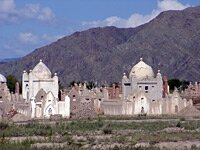
Many of the later mausoleums take the form of a small citadel – complete with four corner towers, crenulated walls, and often topped with a dome, cone or marquee – made from clay bricks, and adorned with the crescent moon – a symbol of Islam. They are often decorated with fancy patterns of brickwork – and the mausoleums at Uzgen in the Osh oblast and the Manas Gumbez in Talas are well preserved examples of this. Unfortunately, a large number of structures built in the past of adobe bricks (made from clay mixed with straw) have deteriorated and are being eroded away.
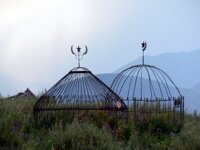
In Sary Jaz, in the Issyk Kul oblast, there are the remains of a wooden structure erected over a grave. More recently, ironwork in the shape of a yurt is erected over the gravesite. Today, many Kyrgyz today are buried under simple headstones or miniature, ironwork yurts covered with wildflowers in spring.
Also, rather poignant are the roadside memorials devoted to victims of road accidents that scatter the mountain roads. These are often plain, soviet style headstones – with an inscription and sometimes a photograph.
There are a number of examples of “graveyard art and architecture” which are of special interest:
Ak Taala – in the Naryn province has the mausoleum at Taylik Baatyr. As well as being striking for its architecture, it is interesting because it has two entrances which is very unusual. This is because it is actually two mausoleums joined together. There are two different accounts given to explain this … the first recounts that the mausoleums belong to the local khan (Taylik Baatyr) and his brother – however, Taylik’s brother was apparently never a khan and did not merit such a grand mausoleum. The other account proclaims that the second was actually built for Taylik’s wife. In Kyrgyz tradition, women never attend the graveyard – and would not have merited a mausoleum in their own right – but, so the story goes, on one occasion when Taylik was away, the local community was set upon by raisers and his wife successfully organized their defence and hence merited the special distinction of being granted a grand gumbez.
Bishkek – just to the south of the city, a little distance from the road to Ala Archa is the mausoleum of Baitik Kanaev, who was one of the Kyrgyz leaders who invited the Russian to help them overcome the Kokand Khanate at the end of the 19thcentury. Actually, it is not his last resting place – but just a memorial.
Burana Tower – near the tower is the site of three ancient mausoleums – only the base of the walls have been reconstructed so that visitors can get an idea of the shape.
Kochkor: cemetery – Usually, cemeteries are found on raised land, overlooking the community – although in some places (such as at Kochkor in the Naryn oblast) this wasn’t possible and the graveyard is found just outside the town. It is close to the road easily accessible, and well worth a visit.
Koshoi Korgon, just outside At Bashi in the Naryn oblast, is said to be the site of a mausoleum built by Manas for his fallen friend and cousin, Koshoy, following a battle.
Safed Bulan – In the Moslem graveyard, on outskirts of the village is the brick mausoleum of Shah-Fazil, reputedly built by his son around 1050 AD. He is reputed to have brought Islam to Central Asia. It is still an operating Sufi mosque and pilgrimage site. The central cupola is almost 16 m tall, and the interior is decorated with decorative panels, rosettes and relief inscriptions with Quranic texts and inscriptions in Farsi. Ibn-Nasir’s tomb stands in the middle surrounded by Islamic grave stones or kayrak.
People know the site as Safed Bulan, after a black maiden who is said to have lived in the area. Legend has it that a grandson of the Prophet Muhammed led an army to bring Islam to Central Asia. The local population at first acceded to the call to convert – but when the Arab army was at prayer, they attacked and after a short battle took about 2700 prisoners whom they then proceeded to despatch. A black woman who had been traveling with the army appeared on the battlescene searching for the body of her lover amongst the slain. When she saw the mass of bodies she instantly turned grey – and although she didn’t find her love, she stayed on to bury the heads of the fallen warriors. In recognition of her deeds, Allah turned her white as a sign of her godliness – hence the name (which is said to mean “White Woman”). After her gruesome task was completed she stayed on and lived out her life in the village looking after the graves of the fallen warriors. After her own death, she was buried nearby and a special mausoleum was erected in her honour. Eventually Shah Fasil returned to punish the pagans for their treachery and he, too, stayed on and was eventually buried in the mausoleum.
Although historians regard this as just a legend – and there is no account of such incidents in other sources, archaeologists have discovered evidence of as large battle dating from this period nearby.
A complex consists of the mausoleum itself, along with several others, several vaults, a necropolis – including a collection of 2700 heads – and a mosque – as well as the holy mountain Archa Mazar.
The site underwent major restorations in 1978 and 1996. Apparently the restorations made things worse in that they used concrete instead of traditional materials – resulting in damage to the microclimate inside. The US government has given a grant for new work to be undertaken to correct the damage.
Please note, the mausoleum is an example of living Central Asian Sufism, i.e. a site of religious significance – not a sterilized ‘monument’ or ersatz culture, and so visitors should dress modestly when visiting.
Sary Jaz – there are the remains of a wooden structure – a quadrilateral roof based on four pillars. It is thought that this may be an ancient design because there is a description of a similar structure in the Manas epic.
Talas – there are a number of ancient mausoleums in the Talas valley – but the most famous of all is the Manas Gumbez, located some 12 miles Southeast of the modern town. There are two different traditions – one says that his son Semetei carried the body here (to the village of Ahhyrtash, near the mouth of the Kenkol river, and built the mausoleum here for him. The other say that it was built by his wife, Kanykei, and his friend and counselor, Bakai – and that to prevent despoliation by his enemies they placed an inscription over the door that it was the mausoleum of a young girl. The grounds of the mausoleum now house a grand museum (built as part of the Manas 100 celebrations in 1995) and behind this is the Mount Kamyr – which is said to have provided a grand panorama of the valley where Manas’s warriors kept guard watching for potential invaders. Recent studies by French archaeologists suggest that this mound may have been man-made, which, if so, would have been a considerable undertaking and achievement. There are other signs of ancient fortifications at the site. The gumbez itself is a typical, Central Asian, single chamber mausoleum – built on a square base with an octagonal pyramid roof. It features on the reverse of the 20 som note. The brickwork shows signs of complex decoration.
Also in the Talas valley are a number of burial sites which have attracted interst: kurgans, with the deceased being buried in catacombs. Catacomb burial sites are found throughout Kyrgyzstan, and also further afield in Central Asia.
The first catacomb burial site was discovered in Kyrgyzstan in 1898, in the Talas area, by a Finnish archaeological expedition which aimed to study ancient Turkic writing that looked similar to the runes of Scandinavia. As part of their exactions they discovered, in the village of Kenaral and its surroundings, four catacomb burial sites (Karbus, Koen-Tokoi, Joon-Tobe, Chik-Tuee). A report on the expedition was published in Helsinki 20 years later but for some reason did not try to define either the dates of these monuments or their ethnic origin.
In 1938-1939, similar kurgans in the Talas area were studied by an archaeological expedition of the Academy of Sciences of Kyrgyz Republic and the Hermitage. On the left bank of the Kenkol River – a tributary of the River Talas – they found more than 60 such sites, which were documented two years later in a book: “The Kenkol burial ground”. This report addressed, for the first time, the questions of dating and origin of catacomb burials of Central Asia, however, the question remains unsettled to this day – the method of construction is different from other mauolseums in the surrounding region, and the presence of “foreign”, or “imported”, objects raises questions about if they were built by invading foreign peoples or local tribes.
It is thought that the Kenkol site houses a group of kurgans which date from the 2nd to the 4th centuries and is located near to the Gumbez of Manas (Manas Mausoleum). Many of the kurgans consist of underground, arched, rooms and rectangular hollows. Sometimes the body of the deceased was placed in a wooden coffin, or on a wooden bed.
The human remains excavated suggest a population with a racial mix and exhibit Mongoloid features.
In the kurgans were also found many artifacts with both daily and ceremonial functions, such as: clay and wooden plates; arrows with both iron and bone heads; bows with in-lays made from bone; bronze mirrors; wooden tables; clothes made from silk; and clay censers.
Uzgen – not far from the main road there is a small museum complex based around a tower – an old minaret –and three grand mausoleums dating from the 11th and 12th centuries. They are highly decorated and feature on the back of the 50 som note.
.




 Bishkek