Balbals
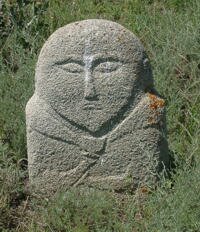
Balbals are small stone figures, (statues, statuettes), which are found scattered throughout the Steppes of Central Asia, (from North-western Mongolia to Turkey – the area between the Caspian and Black Seas), and in Northern Kyrgyzstan they are considered to be a feature.
This may be because these enigmatic stone figures are a number of places in Northern Kyrgyzstan where specimens have been collected together.
Originally they stood in isolation at various places on the steppes, often looking towards the east, (one source suggested towards the mountains), but the authorities decided that the best way to preserve them was to bring them together into museum complexes.
For example: there are a small number of them at the open air “Field of Petroglyphs” in Cholpon Ata, (although there are only a few here); a larger collection in the “Museum Under the Stars” at the Burana Tower, (just outside Tokmok); and a small collection on the Eastern side of the Historical Museum in Bishkek. There isn’t much that is known for definite about these mysterious figurines which provide us with many questions about their origins and purpose – and there are many theories and conjectures which have been suggested as possible answers.
Some scholars suggest that they might have been grave markers, and this is supported by the fact that excavations have shown that many of them appear to be on ancient grave sites. If they were “headstones” or grave markers, then it is not clear if they were depictions of:
- the deceased themselves, or
- someone they had defeated – killed – for example in battle.
Other scholars suggest that they might have been representations of important people, great Khans, supported by the fact, particularly in Mongolia, where inscriptions found with them refer to one of the Great Mongolian Khans of the sixth century. Others suggest that they might be representations of defeated enemies, erected after a battle as a reminder of their subservient state, supported by the interpretation of the symbolism which seem to be found on almost all of them.
Balbals can measure anything from half a meter tall to two meters. They would have been carved out of locally available stone and examples exist in granite, slate and sandstone. The level of workmanship in the carving varies from stone to stone.
There are several distinct styles of figures – but they tend to have a number of characteristics in common.
One type of Balbal consists of a flat piece of stone with the representation of a person carved into the surface, (although sometimes the rest of the body may also be carved into the surface – the head and facial features are found on all of them). These are probably the oldest of the balbals. Later examples seems to have developed into rounded sculptures in more details – including clothes, jewellery and weapons depicted.
The characters depicted are almost exclusively male. The faces depicted are of a Central Asian (even Mongolian) type. Virtually all the full figure depictions show a person holding a bowl in their raised right hand. This is a typical symbol of welcome in the region. It is also seen as a sign of submission – hence the suggestion that they might represent vanquished enemies who now submit to their conquerors – either as a monument, or a reminder. The most common form of clothing depicted is a form of jacket with triangular lapels. Most balbals are bareheaded – without headgear, hats or helmets. The hair, where it is depicted, is usually shown as plaits down the back.
Jewellery is often in the form of earrings, pendants, necklaces, or some decoration on the chest.
Some examples show the character holding a weapon in their left hand – or tucked into a belt … again possibly suggesting combat, or a military campaign, rather than a symbol of hospitality.
In some cases the figure seems to be sporting some sort of bag.
It is thought that they date from between the 6th and 10th centuries – and one suggestion for their apparent demise is the spread of Islam into the region which frowned on the depiction of living animals and people.
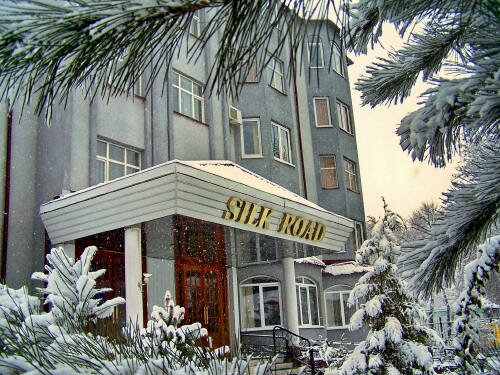
Some Balbals, however, are much more modern. We, for example, commissioned a sculptor to create two for the entrance to The Silk Road Lodge. A popular local newspaper has also run reports about strange appearance of new balbals in the fields around the eastern end of Lake Issyk Kul. They seem to appear mysteriously at night time and the locals say that they don’t know why, or how, they appear. The origins and purpose of the Balbal seems to be as inscrutable as the Mona Lisa and her smile.



 Bishkek