Spend, spend, spend
Apparently, there’s been some controversy in the British press about the possibility of Gordon Brown taking over as Chairman of the IMF, (International Monetary Fund), with David Cameron saying that he is not convinced that it’s a good idea. He feels that although Gordon Brown has plenty of experience as Chancellor of the Exchequer, (the British equivalent of the Minister of Finance or Secretary of the Treasury), he is not necessarily the best person to head an organization which deals with country’s that find themselves in financial difficulty.
Although many people think of the IMF working in poorer “Underdeveloped”, or Developing” economies, in the past the UK has also found itself in need of assistance from the IMF on a number of occasions, and several European countries are currently in receipt of assistance from the Fund. In return for a “bailout” the IMF imposed certain conditions on the British government’s handling of the economy.
Here in Kyrgyzstan, the IMF has played a considerable role over the years in helping the country’s economy in transition from the Central Command system of the former Soviet Union into a Free Market economy. They have provided support in the form of advice as well as funding – indeed, they have a mission in Kyrgyzstan at the moment to study fiscal sustainability over the medium term period and possibility to fulfill state budget revenues scheduled for year 2011. There is, however, some misgivings amongst the local people as they have seen over the years, under the tutelage of organizations like the IMF, factories close with the concomitant rise in unemployment and the fall of living standards – especially once you get out of the capital – and the apparent burgeoning of corruption.
Whoever does get the job as the Fund’s Chairman, Gordon Brown or someone else, they don’t face an easy task.
Part of the problem is the fact that people all over the world are not particularly good when it comes to handling money … and I suppose that I have to admit, that includes me! Maybe one reason people have trouble managing their finances is that it involves figures – and an awful lot of people have a fear of numbers: be it called numerophobia or arithmophobia. Some people actually take pride in their lack of ability or understanding of mathematics, or more specifically arithmetic, or to be precise: numbers. Financial Management, however, is a subject that spreads far beyond pure number theory … and is embroiled with all sorts of complex abstract concepts, especially as the numbers get bigger, (and hence the rewards and risks are greater), and the systems and schemes become more intricate and sophisticated.
In school, classes are taught how to read statements and calculate interest, and although most children have little difficulty coping with the appropriately titled “Simple Interest”, fewer seem able to get to grips with “Compound Interest”, yet alone grasp the difference between a quoted interest rate and the equivalent APR, (Annual Percentage Rate).
Now, I am not afraid of numbers, and I do understand one key principle: Cash is King. If you have cash, then you can do something, but if you don’t … then you can’t. I spend a lot of my time worrying about Cashflow. Although I have a basic understanding of the concepts, I’ll let my accountants worry about the details of technicalities on the Balance Sheet such as Depreciation and Currency Loss … but I do spend many hours worrying over payment schedules and overdue accounts.
I keep in mind the words of advice from Wilkins Micawber to the young David Copperfield:
“Annual income twenty pounds, annual expenditure nineteen pounds nineteen and six, result happiness. Annual income twenty pounds, annual expenditure twenty pounds ought and six, result misery.”
Indeed, the kids are sick and fed up of hearing me ask the question, “How many times can you a spend a som?” By now they know the answer and reply parrot fashion: “Once. Once you have spent it, you don’t have it any more. It’s not yours to spend, it’s somebody else’s and only they can spend it.” They can even add the corollary: “So, it is important to spend it wisely.”
I’m not, however, so keen on the other notable quotation associated with Wilkins Micawber: “Something will turn up,” although that does seem to be a popular philosophy here – especially in the local variation of: “vsye budet horosho“, (“everything will be OK”).
.
I came across an article recently about our attitudes to money which identified five archetypes of people, even those who are “financially astute”, who have bad “money habits”:
- misers fear becoming penniless and have trouble enjoying the benefits of their money
- spenders shop in an often uncontrolled manner, particularly when feeling low – and get a short-lived high, often followed by guilt
- tycoons see money as a route to power and approval, and believe wealth will make them happy
- bargain hunters feel superior when they get discounts, and feel angry if expected to pay full price
- gamblers feel exhilarated when taking chances, and find it hard to stop – even when losing – as a win brings a sense of power.
As I read that list I found myself thinking, “That sounds just like ‘so-and-so’”, although I wasn’t sure which one best describe me. Although the research identified five archetypes, I think there is a little bit of each in everyone.
The article pointed out that that people don’t always behave sensibly when it comes to money matters, and suggested that those graduates who have followed courses which included units on Financial Management were more likely to make mistakes with their investments, perhaps because they thought that they knew what they were doing and so, were tempted into rash decisions.
Another issue highlighted in the article was the ready availability of “easy money”: credit. With credit, people are able to buy now and pay later, but, unfortunately, they don’t always think of the difficulties that can arise and the implications of having to meet the repayment schedules, yet alone the consequences of failing to do so. There is predisposition to think, or to hope, like Wilkins Micawber, that “something will turn up”.
I know of several cases where a family’s home has been under threat because it was pledged against a loan and the borrower was having trouble with making the repayments. As a result, the kids have also become used to hearing me say: “never a borrower or a lender be …“, (Shakespeare, Hamlet, Act 1, Scene 3), and the follow up that “every som borrowed has to be repaid – with interest”, (which is nothing to do with the bard – although his subsequent line, “For loan oft loses both itself and friend“, is also valid).
(Incidentally, the interest may not be monetary; there are, after all, such things as “interest free loans”, but “nothing is for free“, and “there is always a catch” .)
.
Here in Kyrgyzstan, (basically, even now, a cash based society), the sage advice of Wilkins Micawber about the need to live within you means and the difference between “happiness” and “misery”, is likely to fall on stony ground. There seems to be a distinct tendency for cash to “burn a whole in people’s pockets” … if someone has 100 som, then it isn’t long before it’s spent.
I used to think that this was a reaction to the financial crisis that followed the collapse of the rouble in the early 1990’s, (before the introduction of the local currency, the som), and several of the financial scandals and bankruptcies that left people with savings which turned out to be worth very little: “Better to spend now, rather than later, when it is worth less – if anything”; a case of “let’s enjoy it while we can.”
There may well be an element of that, but it also seems to be a case of … we haven’t had the opportunity before, so let’s “make hay whilst the sun shines”.
There seems to be a distinct priority on how and where money is spent. People don’t have much disposable income, most of what they do have is spent on the “essentials”: food, housing, clothing. I am often surprised, however, at how one piece of modern piece of technology seems to have been elevated almost to the position of an essential: the mobile phone. The are ubiquitous. They are everywhere. Once the essentials have been provided, then the first “luxury item” that they purchase is a mobile phone. Sometimes, it seems as if the phone takes precedence over some of the essentials.
It hasn’t always been like that, of course. Shortly after we opened the guesthouse in Naryn, I got summoned by one the local officials for a “friendly little chat”. She was very pleasant as she explained that she was concerned about one particular aspect of our business. She didn’t exactly say so, but she clearly thought that we were being cheated by our staff. She told me: “Ian, you have to understand our local mentality. If someone comes into money, then they spend it. They buy some clothes – preferably foreign clothes. If they come into more money, then the buy a car – preferably a foreign make. If they come into even more money, then they build themselves a house.” She looked around at members of our staff in the room, dressed in new clothes – some of them foreign; some of whom had bought a car – one of them a foreign make, and one of whom was building an extension to their house.
(For the record: In reply, I pointed out that I had told them that they had to dress smartly, and that we had even helped to subsidize them by buying “uniform”; that unlike so many of the local population, they had jobs which paid them a regularly salary, (and a reasonable salary by local standards, although still low when compared to those in the UK), rather than having to wait months before being paid, and that we kept strict accounts and regularly checked their work. As far as I was aware, we had no grounds to distrust them. If she could find evidence to the effect that we were being cheated, then we would pursue the matter rigorously, but that we needed more than just a vague suspicion.)
The “local mentality” reminds me of the situation that Viv Nicholson found herself in, back in 1961, when she won over a hundred and fifty thousand pounds, (the equivalent of over three million pounds at today’s value), on the football pools, (a betting pool based on predicting the results of football matches). When asked what she would do with her winnings, she is reputed to have replied: “I’m going to spend, spend, spend.” Apparently, that’s exactly what she did, providing the tabloids with headlines until well after the money was exhausted.
These days, the companies in the West that run such systems as football pools and lotteries, offer an advisory service to winners on how to cope with the psychological and social pressures associated with such life changing experiences and Financial planning and Management to try and ensure that they gain the most benefit from their good fortune.
In her case, of course, it was her money, her winnings, which was frittered away over the course of time. Apparently, after a while, she did try to manage her dwindling fortune but made but made some bad investments and eventually lost it all.
..
The government, just the people of Kyrgyzstan in general, is in a difficult position in that it has limited resources, and faces many demands on the (tax) revenue that it is able to raise. In order to meet the needs and expectations of the people it is forced into trying to run a deficit budget. It is obviously faced with difficult decisions when it comes to managing its meager finances: the need to prioritize, to meet existing demands as much as possible but also – and, (probably, far more importantly), to plan ahead so as to avoid Wilkins Micawber’s “misery”.


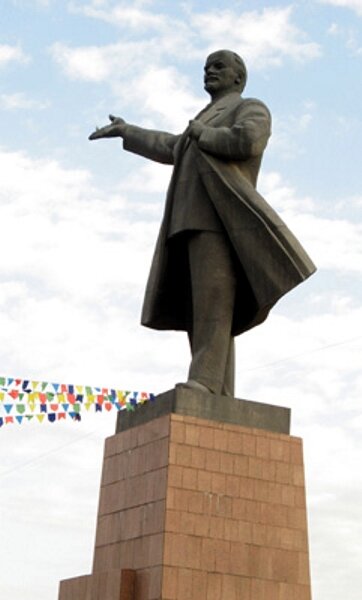




 Bishkek