Saying Goodbye to Askar
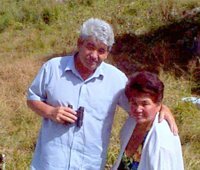
Askar was a really lovely man. He was a fairly short, stocky man with a quiet temperament and a friendly character. A family man, he raised five children – one of them was Tony’s Kyrgyz wife, Damira. That’s how I came to meet him.
He loved his children and they loved in return. He also doted on his grandchildren … nothing was too much for them.
When Tony left Kyrgyzstan to return home to New Zealand (and later Australia) with his wife and children, Askar took me to one side and said: “Ian, don’t think that you are alone here in Kyrgyzstan … you are part of our family, we are your family.” Every time I met him he made me feel as if I was his sixth child.
He was the life and soul of every party – not in any bad or exuberant way … but he was able to coax the best out of everyone … a natural Master of Ceremonies. For example, after a toast had been given he would turn to me and say: “What an excellent toast … Ian, you must drink to that toast …” (Excuse me? Drink a toast to the toast?) “… there’s a law … after such a toast you have to drink to it!” By then I should have known better … but yes, I would drink a toast to the toast.
When he retired a few years ago, the family organized a party for him … it was a grand affair. The Kyrgyz are very good at organizing such parties … such family feasts are called Tois. They booked one of the bigger restaurants in town and there must have been over two hundred people there. As usual, there were lots of toast, each one accompanied by the presentation of a Kalpak (a traditional Kyrgyz hat made from felt) and a chapan, (a velvet coat), to Askar – duly photographed – and a song(!). The Kyrgyz love singing … Kyrgyz songs are not exactly to my taste. The melodies often seem discordant and it’s customary for the audience to show their appreciation by giving whoops that sound like cat-calls: “oooo-aaahhh, whee-ahhh”. That night there were songs in Kyrgyz, in Russian, in Uzbek, in German … and in English. When it came to my turn to give a toast, I realized, I was going to have to sing as well. There was no way I could get out of it. I wished they had warned me – I would have come prepared … or found a reason to leave early.
You see, I don’t really have a good singing voice. Normally I can only ever be found singing in the bath … when it’s just for myself and there isn’t an audience … and even then, it’s not every time I have a bath … it’s a very rare occasion. I find it hard to maintain a tune and when my voice broke, I actually got “bumped” out of the school choir for “growling”, as the choirmaster put it. It was sooooooo embarrassing … as he walked up and down the ranks of the choir listening to each of us in turn in order to try and discern the source of “that strange growling sound” … and then he stopped in front of me and cried: “Claytor! It’s you!!!” Perhaps that’s the reason I hate Karaoke.
Anyway, I felt trapped … I was going to have to sing something – and I decided that it had better be something simple. To make matters worse, however, I don’t know that many songs all the way through … and didn’t think I would be able to get away with La-la-la-ing it. Sultan, one of Askar’s relatives, told me “Sing Yesterday – everybody knows Yesterday” … Now, although I used to know the words to Yesterday, (it was, after all, one of the pop songs of my youth – a symbol of the sixties – and yes, everybody here seems to know it), as I sat there waiting my turn, my mind went blank … I could remember the opening verse … but then … my mind went blank. Even sitting here now, thinking about the experience, it’s gone blank … So, when my turn eventually came, I chose to sing Jerusalem.
Now, I know that was a strange choice … a very strange choice … but there are only two verses … and I did know both of them. There wouldn’t be (shouldn’t be) a problem holding the tune because it is different for each verse – and even I did go wrong, it wouldn’t matter because no-one would be any the wiser. With Yesterday – everyone would notice! What’s more, our family have a strong affection for the hymn … it’s been sung at virtually every family funeral I have been to – it was sung for my mother, father, grandmothers and grandfathers – both sides of the family. It’s a sort of family anthem … anyway, that’s what I told them and then burst into the opening … “And did those feet, in ancient time …”
OK, it was a strange choice, but it happens, I think I did quite well, even if I say so myself … and everyone seemed to appreciate it, especially the dramatic crescendo in the second verse. Someone actually recorded it on video, and although I’ve never seen it, when Tony and Damira heard the stories about the party they said “Ian … singing … I don’t believe it”, until they saw the video and then even they said, “Malodetz!” – “Well done!”
Well, that was Askar’s sixtieth birthday party. After that he settled down to a quiet life, taking his grandson to school and other quiet domestic chores. He became a typical aksakal – elder – but without the beard.
Unfortunately, Askar was a diabetic, and in retirement he had to go to hospital for treatment on several occasions. On one occasion they thought he might have got gangrene and might have to lose leg – but, fortunately, they caught it in time.
A few weeks ago I went to a family gathering … Tony and Damira were over from Australia with their children and the whole family gathered for the occasion … Askar and Elana, their five children and their spouses, eleven grandchildren with another still in the womb waiting to make his appearance a close relative and a couple of close family friends adopted as “relatives”, like me. It was a jolly evening with masses of food weighing down the five meter long table, chatting and singing. It was marred, however, by one sad thing, Askar himself was in a bad way and didn’t sit with us at the table … but the grandchildren all went in to see him, one by one.
Fortunately he improved and I saw a short while later and he looked fine.
Finally his illness got the better of him. He was taken ill once more, very suddenly. It was very sudden. As I said, I had seen him only recently and he seemed fine … then one morning I hear is that he had developed gangrene in his leg, it swollen like a balloon and had been taken to hospital because he needed an operation, … then a few hours later came the news that he had died.
It was a shock. We were all shocked.
Although the family were, naturally, in a state of shock, centuries of tradition … and a well rehearsed routine … slipped into place.
Now, I have to been to some funerals in my time … for my grandfather, (the only one of grandparents that I knew), for my parents, for pupils who had been tragically taken from us while they were still children, for friends, and colleagues. I have even been to some here in Kyrgyzstan. I am not sure, however, that I was particularly well prepared for those, certainly not as well prepared as the Kyrgyz seem to be.
For centuries, they have followed a nomadic lifestyle, wandering from jailoo to jailoo with their flocks of sheep. (A jailoo is a mountain pasture, or meadow.) It was only as a result of the Soviet policy of collectivization that many Kyrgyz were forced in to a settled lifestyle in towns and villages. Despite this, the nomadic way of life is so ingrained in the national psyche that there is a saying that it is only when a Kyrgyz dies and is laid in his grave that he ceases to be a nomad and finally “settles down”. Perhaps it is not surprising, therefore, that funerals and the traditions surrounding them tend to be lavish and particular attention is paid to memorial structures and grave sites.
The body, as is usual, was brought home from the morgue and lay at home wrapped in a carpet – with the face exposed – and mourners start to gather straight away. Everybody turns up to pay their respects. Everybody. No exceptions … well, except for those that live so far away that they literally cannot make the journey in the three days before the internment takes place. Family, friends, neighbours, colleagues, distant relatives, (it doesn’t seem to matter how many times “removed” a cousin may be … if they can make the journey then they do so … it’s an obligation), even minor acquaintances. It’s easy to understand the common explanation for some delay … “so-and-so is not here, they are at a funeral.”
There are “official mourners” to cry with each new arrival as they mourn the departed … and there is much wailing and weeping … and at first, with my typical British “stiff upper lip” and “stop making a fuss” attitude, I found this somewhat disconcerting, and wondered what it must be doing for Askar’s family.
To me, Death is a part of Life – you can’t have one without the other … We lose things, pets and people all the time ….think, for example, how many pens we have mislaid, never to set eyes on again? It happens. People also leave us all the time – they move on … we move on. How many of school friends do we lose touch with after we leave school and go to university?, how many of our fellow students do we keep in touch with when we move on and start our career? … and so on.
The way I see it, the rituals associated with a funeral are not for the deceased … they are dead, what comfort, what benefit, do they get from it all? No, what’s important are the people who are left behind … and how the various rituals help them to cope with the experience. Looking back on it, I think that all that wailing and weeping did help, even if at times it seemed formal and, (well, to me at least), unreal. It was like a turning on a tap and provided a faucet to channel the grief.
The trouble with my Anglo Saxon, no nonsense, approach means that there is little outlet for grief and so things get bottled up inside. I remember, for example, when I heard that my mother died – I was here in Kyrgyzstan and my brother tried phoning me and couldn’t get through and so he had to send me an email. There’s no way to cushion the blow in an e-mail. It came as a shock, a bolt from the blue, and I cried … but not for long … I left the office to go and deal grief … but I was back in half. Better for me to be in the office doing something than sitting at home wallowing in grief. There was no outflow of emotion … but that doesn’t mean that I didn’t feel it. I’m not sure how well I dealt with it.
According to Kyrgyz tradition, the burial takes place within days of the death – according to Muslim tradition the body should be buried within four days and in some Central Asian communities the body has to be interred before the sun sets, (or rises if the death occurs at night). Traditionally, the Kyrgyz funeral takes place on the third day. When I first heard this I thought: Why the rush – but contrast that with the situation when my father died. It was just before Christmas and, what with the holidays, and the “backlog” of work that built up over the holiday period, it took almost a month before he could be buried … When I tell people here about that, they are shocked and nobody can understand … a month? … a whole month!
A yurt was setup in the garden. Traditionally, it would have been two yurts, one for the family and the second for the body, but this time there was just the one. Even amongst urban communities a yurt will probably be set – and if you see a yurt standing near to an apartment block, it is a reasonable assumption that someone has recently died.
On the day of the funeral itself, the mourners started to gather early and stood waiting for the ceremonies to begin. The crowd spread out of the house, the yard and across the street.
The body had been washed and covered in a shroud – called a kepin. For the transfer to the gravesite it was covered in white felt and placed on a stretcher. Once it was brought out of the yurt, the stretcher was placed on the ground and an imam asked: “Was the deceased a good man?”, and the assembled crowd responded: “Yes, he was.” The imam then asked if the deceased had any debts – and who will settle them and one of the heirs stepped forward and say “I will.” (It is traditional that debts to the deceased are also renounced.) According to tradition, after prayers, the body is then carried to the graveside, and in rural regions, where the cemetery is nearby, everyone walks … it is quite common to see a whole village walking behind a barrow. For Askar, we had to travel across town in a convoy of cars and minibuses.
As he was carried from his home for the last time it was a signal for another outburst, a crescendo, of yet more wailing and weeping.
Traditionally, the burial itself is an all male affair, according to Muslim tradition women do not attend at the graveside. So, whilst the men got into their vehicles the women gathered and went off to his wake. When we got the cemetery, as we walked from the vehicles to the graveside it started to rain – and one person noted that even the weather was crying for Askar.
The imam presided over the ceremonies, leading prayers and reciting from the Koran. Everyone was given a handkerchief to wipe away their tears … although to be honest no-one seemed to be crying at this point … only the weather … I think they had all cried their tears already long before. The body was placed in the ground and the mourners walked by and taking handfuls of soil, threw them over the body. Askar’s oldest son and grandson stood silently watching over the grave and then, finally, everyone in turn took a shovel and the grave was quickly covered over. There were no wreaths, no flowers at all apart from the ones that I took and laid on the grave … I said it was a British tradition.
The dress code here is fairly relaxed, and although most people wore dark clothes, it seemed a little strange to me that people were there in all sorts of casual dress – even track suits, but then, there is no real tradition here of “Sunday Best” – and I understand that even in the UK, this concept is dying out. As far as I could see, I was the only one wearing a black tie.
It was then back to the vehicles and off to the second sitting of the wake, the ladies having already participated in the first, where we fed traditional fare, horsemeat – the most expensive and prestigious meat – and lamb. As the meal came to an end, Askar’s youngest son was called upon to say the benediction and following the final Omin, (Amen), people gathered up any food left on the table into plastic bags and went on their way.
Although the funeral itself was over, the process of grieving continues. Seven days after the death, the family gathered again … to reminisce about Askar, and they’ll do so again after forty days. By now, though, the shock is gone and because everyone had their role to play throughout the process, (as official mourners, handing out handkerchiefs, throwing a handful of soil into the grave, shoveling earth into the grave, and so …), and everyone participated this seemed to ease the grieving process and to have made it much easier on them than it might have been in the west.
Of course, the more lavish the arrangements – the more expensive it is for the family. The typical cost of a horse, alone, is over a thousand dollars and a funeral can be a pauper a family even though all members of the extended family contribute towards the expenses. In 2002 there was a law passed in an attempt to limit the financial hardship that death brings to the deceased’s relatives placing a limit on the amount spent on funerals – but it seems to be honoured more by being ignored rather than observed, and I hate to think what the funeral cost Askar’s family.
But what a splendid way to say “Goodbye”.




 Bishkek