Food ettiquette
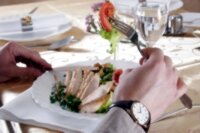
Using a frk "European style" ... Yes!, there are other ways to transfer from the plate to your mouth!
The other day I came across an article on a travel website about “Food Etiquette From Around the World“.
It appeared to be a “filler” article … one where the editor has a space and needs something to fill it and so turns to one of his (her) staff and asks for 500 words on something. In this case, the author, (a travel writer), collected together various quirky bits of advice drawn from places as diverse as Chile, France, Italy, Korea, Mexico, Russia, Thailand, and “the Middle East, India and some parts of Africa”, as “a quick guide” to some of the “oddest food related faux pas” that can be committed when traveling abroad – and not necessarily in strange exotic locations.
I am sure that, if there had been a bigger space to fill, she could have come up with 750 or 1000 words … all that would be needed is a little additional research.
The advive included: don’t refuse a drink in Russia as it is likely to offend your host, because offering someone a drink is a sign of trust and friendship; and when in Korea, if an older person approaches to refill your glass then, as a sign of respect, it should be held it in both hands whilst the liquid is dispensed.
On the subject of drink, she also told us that in Italy cappuccino is never drunk after noon – as it is thought that the creamy mass will upset the stomach and ruin the rest of the day – Espresso, however, is OK. I expect that the owners of Bishkek’s blossoming Caffeinie, (Coffee Houses, like the ones that Samuel Pepys used to frequent – literally, I suppose, Cafés, although there are other words used for this – especially Cafeteria), are glad that that particular foible hasn’t migrated here.
Fascinating though all this is … “it’s hardly”, as they say, “Rocket Science”.
The majority of the tidbits on offer, (pun intended!), in the article concerned handling food. In Thailand, for example, the use of chopsticks is considered “tacky” and although a fork may be used for eating stand alone items that are not part of a rice-based dish, it shouldn’t be used for transferring food from the main dishes to your mouth. The “correct” thing to do is to use the fork to push food onto a spoon.
In Mexico, you shouldn’t use cutlery to eat Tacos … it is better to use your hands … but in Mexican Restaurants in large swathes of the globe, that would mean your right hand as your left hand is associated with “bodily functions” and so considered unclean, (Sorry about that if you happen to be left handed), and there’s a distinct problem if it’s in Chile – because apparently you should touch your food with your hands … it’s considered bad manners and “not in keeping with European culture”.
That last one struck me as particularly odd … as I was under the impression that Chile is part of South America. It seems to speak volumes about Chile and Chileans.
I suppose the “civilizing” effect of European culture is to be felt here in Kyrgyzstan as well. Table manners are important and, as in Korea, respect for elders is an an important feature of life – and not just at mealtimes although these would rovie the most obvious example of the patriarchal hierarchy at work.
I said “patriarchal” because the traditional Kyrgyz nomadic family would usually consist of at least three generations living together in a small community, or ail (the equivalent to a village).
Mealtimes were organized on a strict hierarchical system. The aksakal – literally “white beard” – who was head of the household was considered to be the owner of all the family property – and for the nomadic Kyrgyz, that was primarily the livestock – and his authority was absolute. His eldest wife - the baybiche would direct the work. She was the supreme authority in all matters relating to household management and domestic tasks – objections against her instructions were not allowed and she was subordinate only to her husband.
The members of the family would sit in a strictly established order, the head of the household in the most honoured place, opposite the entrance to the yurt – unless, that is, there were guests … in which case he would surrender it to them.
His sons, sat to his right, in accordance with their ages. The Baybiche would sit on his left, and his daughters sat next to her, and then came daughters in law in order of precedence of their husbands. The youngest wife of aksakal sat next to the pot and guided the food distribution and the wife of the youngest son had to serve the contents of the cooking pot onto a wooden dish (chara). This dish was given to the youngest wife of aksakal, so that she could cut the meat into smaller pieces and then put it into small dishes (tabak): one was for aksakal, baybiche, the eldest son and daughters of the head of the family and another dish was given to the rest of the sons and their wives.
In fact, it went further in that at a toi - a celebratory feast or festival – when an animal was slaughtered, butchered and cooked, different parts of the animal were strictly allocated according to this hierarchy. In the classic case, the head of a slaughtered sheep is presented to the most honoured, (eldest), guest along with the sheep’s eyes. (That’s one reason I am never too keen on being an “honoured guest”).
Among the other pieces of useful advice, the author told us about the different foibles relating to the use of cutlery around the world.
We sometimes forget that this is a relatively new development. For a long time and in many cultures – eating with your hands was the norm and the only implements people needed were a knife for cutting and, perhaps, a spoon for dealing with liquids … although a bowl could be just as easily lifted to the lips as a goblet could.
The fork seems to have made an appearance in Roman Byzantium some time around the fourth century – and although it traveled through Italy sometime around the first millennium, but it took time to be adopted by the general population, (it seems to have been used mainly by the merchant and upper classes by 1600). Northern Europe was more resistant – one Englishman describing it as an “unmanly Italian affectation”. (!) The use of the table fork for eating did not become common in northern Europe until the 18th century and was not common in North America until the following century.
The Chileans might not approve of using your hands when eating – I wonder how they cope with the concept of “finger food”, but the Mexicans clearly understand that some foods are meant to be eaten with your hands. It’s not just Taco’s but, (as an Englishman of certain age), I can’t help but that Fish and Chips are not only meant to be eaten walking down the street, plucked by the fingers out of a packet wrapped up in yesterday’s newspaper – but they actually taste better like this.
Here in Kyrgyzstan, Manti and Samsa are meant to be held … not cut up on a plate with a knife and fork. There’s even people who claim that Plov, (pilau), is better eaten with the fingers, by the handful – but I am not sure how that is best achieved. The archetypal traditional Kyrgyz dish, Beshbarmak, is also meant to be eaten by hand … after all the name means “Five Fingers”.
As an aside: One of my favourite schoolboy jokes tells of a family one day having guests visit for Dinner and when all is ready they all sit down at the table for the meal. The youngest son of the household, little Johnny, reaches across the table for the ketchup, bread, or at least something … and an exasperated Mother, embarrassed at her offspring’s display of a lack of table manners asks, “Johnny, Don’t you have a tongue in your head?”. To which the wisecrack responds, “Yes, but my arms longer.”
Now, humour is extremely difficult to translate and not just in terms of language but also in terms of culture. Although I have tried telling that joke here, it always seems to fall flat. I suppose that could be a result f my translation skills, or a difference in the type of humour that people here tend to appreciate … or it may simply be because the scenario is one that people don’t recognize.
These days, it seems, many families rarely ever seem seem to sit down together for a meal – and I understand that is as true in the West as it is here.
One reason for this, here, might be down to a lack of a designated “dining space”. Some families have a home that has what could be termed a “dining room”, especially those in houses in what is euphemistically called “the private sector”, but for families living in apartments, space is usually at a premium and setting a room aside to be used just at mealtimes would be considered a luxury. Most families sit at a table in the kitchen, (which is usually a small room and although it means that food arrives on the table piping hot, fresh from the stove, can make for cramped conditions and present difficulties for the “chef”).
When there are guests, then a dining table is set up in the main “living room” – known here as the gostinaya – “guest room”; a room where guests where are received. This is a slightly different concept than that encountered in the West where a “guest room” is the bedroom set aside to accommodate visitors who come to stay.
The table is set up against the divan on one side and with all the serviceable chairs in the apartment pressed into service and placed around the other sides. This means that for some people the table is set at an appropriate height, but it’s possible that it might be too low whilst, usually, for those on the divan, the table surface is a little high which can make serving yourself and eating a little difficult.
As it happens, I don’t have a Dining Table in my apartment – not in the kitchen nor in the gostinaya. Actually, that’s not quite true … I do have a table that could serve as one, but it has a computer on it and it serves as a desk. I suppose that if I actually needed to, I could take the computer down and use the table … but, as it happens, I rarely have dinner guests, so it has never proved necessary.
As I said, most families have a table in the kitchen, so why don’t I? Well, my kitchen is so small and narrow, that a putting in even a small table would have meant having to sidle sideways every time someone wanted to get past it … and that would be extremely difficult to achieve if anyone was actually sitting there. As a result, I decided to erect a “breakfast bar” along one of the walls – it limits the number of people who can sit at … side by side, but takes up much less of that valuable space … and, anyway, it’s enough for me.



 Bishkek