A Kyrgyz vocabulary:
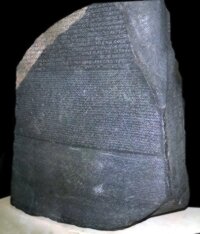
The Rosetta Stone
When I first moved to London, (yes, London – not Kyrgyzstan), I took a week of my holiday before starting work to explore the city. Although I had visited London before, it was only on specific trips to attend a conference or visit a theater, or something like that. So, I bought a travel card which gave me unlimited travel on the city’s Underground and Bus network, and every morning I got up and set out with a list of what I wanted to see and do.
There was a lot to see and do and I knew that I wouldn’t be able to “do” the city properly in the time available, but the idea was to “get my bearings” and decide which places were worth a follow up visit later on … with more time to explore more thoroughly.
I had, for example, set time aside to visit Parliament and attend a debate; see Rodin’s sculpture of the Burghers of Calais, then cross the road to Westminster Abbey before walking further on to the Roman Catholic Westminster Cathedral. A trip to St. Paul’s Cathedral was combined with a the Law Courts and especially the Old Bailey where I sat in on a trial for about an hour. Another occasion I traveled to Kensington, visited Harrod’s and the museums, (The Science Museum, the Natural History Museum, The Victoria and Albert Museum), before walking up to the Albert Hall, the Albert Memorial and round Hyde Park.
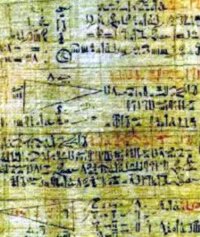
They don't look like right-angled triangles to me ...
One morning I trotted off to the British Museum where I was anxious to see the Rhind Papyrus – I wanted to see if that really was a generalized Right Angled Triangle, in which case the ancient Egyptians probably knew Pythagoras’ Theorem long before he did … or did the papyrus simply contain a number of specific examples which they knew knew from experience worked, without necessarily understanding why they did … like most people who have looked at it, I couldn’t make up my mind and remain unconvinced to this day as to which it was.
In one of the Egyptian halls, I came across what looked like a large slab of stone with inscriptions … but unlike the petroglyphs which we have here in Kyrgyzstan, these inscriptions were laid out in neat lines and obviously represented writing. At first I didn’t really understand what I was looking at, and then I read a notice nearby and did a double take. So, this was the Rosetta Stone - which just happens to be the most visited object in the whole museum.
Today marks the anniversary if the stone stele in 1799 by a French soldier in of an incredible discovery in a small village in the Nile Delta. I contained text written in three ancient scripts: Greek, Latin and Hieroglyphics. At that time, no one was able to read the Egyptian hieroglyphics and it is possible that the texts might have passed without much attention, except for the fact that the Greek and Latin texts were identical, in that they were translations of an official decree issued by King Ptolemy V.
Scholars wondered if the Hieroglyphics could be another vision in ancient Egyptian … and so it was analysed in detail and so it turned out to be. The Rosetta Stone turned out to be a multi-lingual “dictionary” and as a result, we hare now able to unlock many of the secrets of an ancient culture.
When it comes to understanding Kyrgyz, I often use what I call the “Rosetta technique”. It’s fine if I recognize the word, but if I don’t I look if to see if there is a Russian equivalent nearby which might help to illustrate its meaning.
Here is a lit of Kyrgyz words and their English equivalent … but it’s not meant to be a Kyrgyz-English dictionary as such … but a list of some Kyrgyz words which foreigners in Kyrgyzstan, (like me), might come across:
| Adat | A traditional legal system found throughout Central Asia, guided by authoritative members of the community. The new Soviet authorities banned its use in the 1920’s when they introduced a new system based on a civil code. |
| Adylet | Justice – and the name of one of the country’s political parties |
| Aitysh | The art of delivering an improvised epic, such as the Manas Epic, often accompanied on a Komuz. |
| Aiyl | A village or rural settlement – also used to refer to an extended family unit |
| Ak | = White |
| Akim | = “The Leader” – it can be used to refer to any leader in a community, but also has the specific meaning of referring to the Appointed head of a local administration |
| Ak-Jol | Literally “white way” or “White Road” – it is a phrase used at the start of a journey to wish someone: “Bon Voyage” |
| Aksakal | = “White Beard”, and is used to refer to an elder in a community – or to the oldest member of a family unit. |
| Akyn | A “bard” who performs songs and improvises the great epics, (such as the Manas epic) – as opposed to an “entertainer” who sings = zhyshy. The art-form dates back more than a millennium. |
| Ala Kachuu | The practice of “Bride Stealing” |
| Ala Kiyiz | A felt carpet made be laying ram dyed wool in a pattern on a chiy mat and then rolling it to create a single unit with the wool melded together. |
| Ala Too | =”Many coloured” |
| Alkasal | Wiseman |
| Almaz | = Diamond |
| Altyn | = gold |
| Ar Namys | = “Dignity” and is the name of one of the country’s political parties |
| Arak | = Vodka |
| Aryk | a canal or irrigation ditch |
| Ash | Refers to refreshment or food – especially that laid out on a table – hence Ashkana |
| Ashar | A traditional form of mutual assistance at the community level to people in need – similar to the concept of “alms”, or “charity”. It can refer to fund raising for poor members of society, single parent families, people affected by natural disasters, housing the elderly who have no children to lok after them, or even to free assistance such as helping to build or extend a house for needy members of the community. |
| Ashkana | A traditional café, or teahouse serving traditional dishes. |
| Ashu | = Pass, as in Tuu Ashu or Tuu pass |
| At | Horse |
| Ata Mekem | = Fatherland |
| Baatyr | A strong man or hero. It could refer to a warrior – perhaps the equivalent of “knight” in medieval Europe. |
| Bai | A rich person, sometimes used together with someone’s name as a sign of respect. It has also been extended to refer influential people as opposed to simply the rich. In Tsarist times, it referred to the heads of native administrations or landlords. |
| Baike | A term of respect used when addressing a older man, or to a male stranger – used throughout the republic – in the south it may be shortened to “ake” |
| Bars | The Snow Leopard |
| Barymta | Rustling – the theft of domestic animals – in olden times it might have been practiced as a night raid against the herds of a neighbouring tribe, but it could just as easily have been a Jigit “trying to make a name for himself”. |
| Bashkarma | The head of a lower administration, or of a collective farm, (kolhoz) |
| Bek | A tribal leader. It is sometimes used in conjunction with someone’s name as a sign of respect indicating the persons position in society. Perhaps the equivalent of “Sir” |
| Bozu | A yurt |
| Bulak | Spring or Source – as in Sary Bulak = “Yellow Spring” |
| Chapan | A traditional quilted “dressing gown” made of cotton. Often given as a present to honoured guests or as a leaving persent to members of the family embarking on a long trip. |
| Chiy | A reed which is used to create matting. It can be decorated or plain, and is used in rolling out felt. |
| Chon | = Large, or Great |
| Chopo Choor | A traditional musical wind instrument – usually made of clay and cupped in the hands. |
| Dastarkhan | A “tablecloth” laid on the floor or a low table on which food is put for a meal. |
| Davlat | The State Administration, the Government. |
| Dekhan | A peasant, or farmer working on the land as opposed to a pastoral nomad |
| Djigit | A horse rider or warrior – these days used to refer to brave, energetic, young men |
| Dukonhu | = Shop |
| Ejeh | Older Sister – a respectful title when addressing an older woman |
| Elechek | A traditional form of women’s headdress involving several meters of linen rolled around the head in the form of a turban. |
| En | = Meat |
| Gap | A group of friends or neighbours gathering for entertainment or discussion – usually a single sex gathering. |
| Gumbez | A mausoleum or burial place of a prominent person. |
| Hukmat | A term used to refer to a duty or obligation to the state – mainly used in the south. |
| Hukumat | Used to indicate the State – usually used in the south |
| Jailoo | A high mountain meadow used for pasturing sheep and other livestock in the Summer |
| Jibek Jolu | The Silk Road |
| Jogorku Kenesh | The name of the country’s parliament |
| Joldosh | = “Comrade” – used in the Soviet period as a title, especially for members of the Communist Party … like “Tovarish” in Russian. It can also mean a friend or companion. |
| Kadi | A judge who interprets Islamic law in Muslim countries. In the early days of the Revolution, the Soviets left simple criminal cases in the jurisdiction of the Kadi, but abolished the institution in the mid 1920’s |
| Kalym | “Bride price” or dowry |
| Kara | = Black |
| Kese | A traditional bowl – used especially when serving Kumyz |
| Khan | The traditional title for the head of a tribe, or confederation of tribes, In medieval times it referred to a “king”. It is sometimes used as the equivalent of “Lord” to indicate someone’s position in society. |
| Khana | A building, hall or living place –but can refer to a public building such as an Ashkhana (café) or Chaikhana (tea house). |
| Kichi | = Small |
| Kishlak | A small town or village. |
| Kolpak | The traditional male headdress |
| Komuz | A tradition, three stringed, musical instrument made from apricot wood, with a pear shaped body and long neck |
| Korgon | Soldier – warrior or Guard |
| Koshchi | = “Herdsman” – the name of the farmer’s union which played an important role in sovietization and the confiscation of lands and rich landlords |
| Kumyz | A national drink, prepared from fermented mare’s milk. |
| Kurak | A traditional craft involving patchwork. |
| Kurgan | A manmade hill, or burial place, (a “barrow”). Also used for a city wall or fortification |
| Kurpacha | A mattress – filled with cotton and put onto the floor of a yurt. It can be placed around a dastarkhan for people to sit on when eating, or as a mattress to sleep on. |
| Kurultai | A gathering of the people for an important event – an assembly or congress. It was at a Kurultai when a Khan, or tribal leader, would have been elected. There have been several Kurultai of the Kyrgyz diaspora – the first held in 1994 – and the government have called several in the early years of the 21st century, |
| Manap | In traditional Kyrgyz society, the term was used to refer to a tribal leader. In Tsarist times it was applied to the native (i.e. Kyrgyz) administration. It has come to mean a wealthy and influential person, but can be used with negative connotations. |
| Manaschi | An akyn who recites the Manas epic. |
| Mazar | A sacred burial place – where an prominent Islamic scholar is buried, or which is thought to have healing powers |
| Medresh | An Islamic school – or seminary. It is also used for the hostel or building which accommodates the students. |
| Mehmankhan | A guest room in a private home, and often used for a hotel. |
| Mekteb | An Islamic school providing elementary education |
| Mufti | The Islamic religious authority and the official leader of Muslims in the republic. The highest decision making body is called the Mufriat. |
| Myrza | A title used to refer to a senior person or administrator. Now used as a sort of honourific comparable to “Mister” or “Sir”. |
| Nan | = Bread |
| Noorus | The Spring Holiday – associated with New Year celebrated on 21st March. |
| Orda | State |
| Ordo | The place where the Khan’s yurt was erected – from the Turkish. |
| Qarnam | A traditional musical wind instrument – resembling a long pipe. Often used at public celebrations and weddings to sound fanfares. It is more commonly found in the South of the country. |
| Sart | Originally this was a term used to designate the Turkic and Persian speaking sedentary population, up until the 1920’s when it ceased to be employed. It is now used mainly in Southern Kyrgyzstan to refer to the Uzbek population – often with a negative connotation. |
| Sary | = Yellow |
| Shaari | = Town or City |
| Shazhere | A genealogical family tree. Every Kyrgyz male is supposed to know his ancestors for seven generations. |
| Shyrdak | A felt carpet created by cutting out motifs in different colours and stitching them together. |
| Suu | = Water – as Ak Suu – “White water”, Kara Suu = “Black water” |
| Temir Komuz | A musical instrument – resembling a Jew’s Harp |
| Toi | There are several occasions when it is traditional to hold a party to mark some milestone in the child’s life – like a birthday party – called a “Toi”. The dictionary translates this word as “feast” – or as “satisfy one’s hunger”. |
| Toraga | The Chairman of the Jogorku Kenesh (The Speaker of the Parliament) |
| Tunduuk | The wooden frame around the circular opening at the apex of a yurt – a symbol of the Kyrgyz. |
| Tush Kiyiz | Wall hangings with elaborate embroidery in traditional patters. |
| Uilonuu Toi | = Wedding |
| Ulut | = Tribe |
| Ustoz | A master, teacher or highly qualified person in their particular field. |
| Vazir | The chief minister of a Khanate |
| Zarzaman | = “Bitter time”, used to refer to a period of tragic events that affected the whole community, such as the events of 1916 |
| Zindan | This was a prison in medieval times, and is now used to refer to a place where people experience extreme discomforts. |




 Bishkek