Andrei Rublev
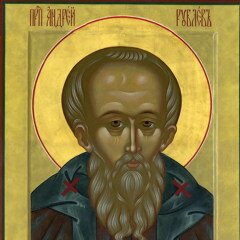
Andrei Rublev
In Russia, today is Andrei Rublev Day … dedicated to the memory of the famous fifteenth century icon painter.
We don’t know much about his life. We don’t know, for example, where or when he was born, (it is assumed that it was in the 1940s), we do know that he died in Moscow on 17th October, 1428, during an outbreak of the plague.
(Although Wikipedia has a different set of dates – being born sometime in 1360′s and dying on 29th January 1427 …. or 1430!)
It is presumed that he came from an educated family of artisans – as indicated his “nickname”, (Rublev – from the word, “Rubel” – a tool for rolling skins), because at that time surnames were only used by members of the upper classes.
Apparently, there is an old icon which was signed “Andrew Ivanov son Rublev“, but it is now believed the signature was added later and is a fake … however, it raises interesting questions, and perhaps provides an indirect indication that the artist’s father’s name was, in fact, really Ivan.
What we do know is drawn from the official chronicles and the first mention of him occurs in a document dating from 1405, where he appears in a list of artists, headed by Theophanes the Greek, responsible for painting the Annunciation Cathedral in the Moscow Kremlin. Unfortunately, the frescoes have not survived. Rublev appears at the of the list, (and with the title “monk”), implying that he was probably one the younger and junior members of the team.
Three years later he had become an artist in his own right being given equal credits in another list with Daniel Cherni, (Daniel Black), another painter.
He took monastic vows at the Trinity-Sergius Monastery and virtually all the rest of his life was spent in service either here or at Monastery of the Saviour in Moscow.
He participated in the painting in the Cathedrals of the Annunciation in Moscow and the Assumption in Vladimir ; as well as leading the decoration of the Trinity Cathedral at the Sergius Monastery. He is also credited with a number of other works such as the frescoes of the Assumption Cathedral in Zvenigotod, the icons known as Our Lady of Vladimir and Christ in Majesty; and some of the miniatures in Khitrova of the Gospel.
Even during his own lifetime, many of Rublev’s icons were venerated as miraculous. Throughout the sixteenth and seventeenth centuries, his name was held in great reverence – indeed his work became a role model . He was eventually canonized as an Orthodox saint in 1988 as part of the celebrations of the 1000th anniversary of the baptism of Russia into the Christian faith, following the example of Vladimir, the Prince of Kiev, who had abandoned paganism in favour of the new religion the year earlier..
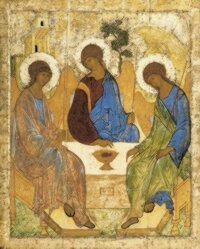
The Holy Trinity by Andrei Rublev
Perhaps his most famous icon is that of the Trinity, painted sometime between 1425 and 1427, (although, according to other studies, it was sometime about 1412 ), which is now house din the Tretyakov Gallery.
Now, it should be fairly obvious that Andrei Rublev never made it to Kyrgyzstan … so, I wouldn’t blame you for asking why I am writing a postcard about him.
Well, we do have one here in Kyrgyzstan, (or at least had one – no-one seems to know where it is), of his icons, (or at least a copy – not from the hands of the master himself).
It was a copy of the Trinity icon held at the Armenian Monastery at Svetly Mys on the Northern shore of Lake Issyk Kul, where St. Matthew is thought to have been buried.
During the sacking of the Monastery in 1916, the icon was rescued and, according to some sources. eventually found its way to Karakol, together with the icon of the Theotokos of Tikhvin, (originally thought to have been the work of another evangelist, St.Luke, although Art historians suggest it was painted by a Russian artist sometime around 1300) … but, as I said, apparently no-one seems to know what happened to it. I am told that the only representation of the “Trinity” there at the moment in on the panel over the doorway.
So, there’s a challenge for the historians … what happened to it?, where is it now?, will it emerge one day as have many of the exhibits currently housed in the museum in Bishkek’s Cathedral of the Resurrection?



 Bishkek