Growing up Kyrgyz
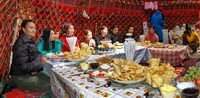
Gathering for a traditional meal
There is an English saying that “Rules are made to be broken, but traditions are to be kept”. This could easily be a Kyrgyz motto – especially when it comes to traditions associated with age.
Toi : There are several occasions when it is traditional to hold a party to mark some milestone in the child’s life – like a birthday party – called a “Toi”. The dictionary translates this word as “feast” – or as “ satisfy one’s hunger”.
The Dje-entek Toi is a celebration of the birth of the newborn child, where people are given melted butter (“sary mal”) which has been kept especially for the occasion in the stomach of a slaughtered lamb (or calf). Guests usually bring clothes for the baby – or maybe a shyrdak.Kyrkan Chygatuu – is a celebration held on the fourth day after the birth.
Another birthday party is called a Beshik Toi (“beshik” = cradle). A Beshik is a traditional wooden cradle found throughout Central Asia, the Caucasus and India – with an arc at each end and a rod joining them which is used to rock the baby to sleep. Traditionally, it is made from archa, (juniper). The Beshik toi is organized for the occasion when the child is placed in the cradle for the first time – usually in the first seven days after the birth. An old woman places the child into the cradle, a sign that the child would live as long as this old woman. (Interestingly – the shroud in which the dead are laid in the grave is also called a Beshik … it is the first and last bed).
The “appearance” – Koroonduk – (The word comes from the Kyrgyz word “to see”). The newborn infant is kept in seclusion for forty days. It was believed that a child stepped from the animal kingdom into the human world only after forty days. The baby is “anointed” with forty drops of salted water by specially chosen people and presented with a piece of patchwork – Kurak – which is made from forty pieces of material stitched together. (Forty – One for each day they have lived.) The baby’s hair would be shorn by an aksakal, who would receive a chapan for his services, and then buried in a sacred spot so that it could not be used in magical rites to harm the child. When neighbours, friends and relatives see the new born baby for the first time then they traditionally give a monetary gift to the parents.
Cutting the Binds: Tyshoo Kesuu – after the child’s first steps the legs are bound – then a party is held with races – usually five different races: for men, women, teenage boys, teenage girls, and children under 10. Presents are given to the winners – one of whom then cuts the binds around the child’s legs. Sometimes referred to as Tushoo kyrkuu which is a celebration held to mark the child’s first birthday.
Circumcision – chochok kestiryy, suinnet: according to Muslim tradition male children are circumcised, not at birth, but sometime between three and seven years old – and, again, a toi is organized.
When a child was between three and four years old, they would be placed on a horse with a special child’s saddle – ayrmach. A boy was provided with a kurdjun full of boiled meat, and one his adult relatives would ride with him around the local community, (ail), leading his horse from yurt to yurt. Each person coming out of a yurt to greet them was treated to meat from the Kurdjun and would, in turn, present the child with some harness or other livery, so upon arriving back home, the child would have gathered all the necessary things for his own horse.






 Bishkek