Disappearing Glaciers
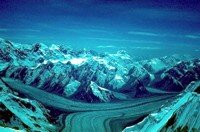
Confluence of two glaciers
At the highest altitudes, snow falls and does not melt. As more snow falls, it compresses that which is already lying on the ground, and forms sheets of ice – known as Glaciers.
Kyrgyzstan’s glaciers – and there are quite a lot of them, - have been in the news quite a bit recently …
- because of the reduction in their number and size in recent times;
- as a result of the controversy surrounding the development of the mining industry and claims of pollution;
- as a source of fresh water.
For the record: Kyrgyzstan’s Glaciers
- Although many sources refer to there being 8000 glaciers, (one says 8208), a more recent figure I have seen says just 6582 … but a recent news report conveyed the warning that “… in recent years, the number of glaciers has decreased from 8200 up to about 5000. By 2050, glaciers in Kyrgyzstan can be reduced by half … there is a threat of the disappearance of glaciers in Kyrgyzstan by the year 2100″;
- They cover over 8o00 square kilometers – about 30% of the total land area of the Kyrgyz Republic;
- They cover about 4% of the surface area of the country;
- It is thought that they hold approximately 650 billion cubic meters of water - enough to cover the whole of Kyrgyzstan to a depth of well over of a meter.
Some glaciers are within easy reach of Bishkek, (for example the Ak-Sai and Adygene in Ala Archa National park). The most famous of the glaciers in the country is the Enilchek (Inylchek) Glacier – actually there are two branches – Northern and Southern in the Peak Pobeda/Khan Tengri massif in the Eastern Tien Shan.
Here is a list of some of the major glaciers to be found in the republic. Different sources sometimes give different figures for their length and area – possibly a sign of the effects of climate change.
|
Glacier |
Location |
River |
Length (km) |
Area |
Altitude at foot |
|
Southern Enilchek |
Pobeda/Khan Tengri |
Enilchek |
60.5 |
632.3 |
2980 |
|
Northern Enilchek |
Pobeda/Khan Tengri |
Mezebacher Lakes |
32.8 |
215.2 |
3400 |
|
Kayingdi |
Pobeda/Khan Tengri |
Kayingdi |
29.0 |
97.2 |
3400 |
|
Korjinevskovo |
Zapaiski Ridge |
Djanai Dartak |
21.5 |
99.4 |
3890 |
|
Mushketova |
Pobeda/Khan Tengri |
Arir Ter |
20.5 |
71.3 |
3440 |
|
Semyenova |
Pobeda/Khan Tengri |
Sary Jaz |
20.2 |
64.5 |
3340 |
|
Lenin |
Lenin |
Achik Tash |
13.5 |
58.1 |
3760 |
|
Mushketova |
Kakshaal |
Kotur |
13.3 |
23.0 |
3940 |
|
Nalivkina |
Kakshaal |
Ai-Tala |
13.2 |
19.5 |
3960 |
|
Keikal |
Pobeda/Khan Tengri |
Terekti |
12.9 |
26.8 |
3380 |
|
Petrov |
Ak Shyirak |
Naryn |
14.3 |
73.9 |
3730 |
Kyrgyzstan’s disappearing glaciers
Although a 1994 guide book says that many of the glaciers were advancing, more recent evidence indicates that they are, actually, in the process of retreating and a joint report from the United Nations Environmental Program (UNEP) and the World Glacier Monitoring Service (WGMS) says that during the twentieth century the area under glaciers in the Tien Shan range decreased by 25-35%.
Another report, (from the Technical University of Dresden,) issued in 2005, commented that, in the Northern Tien Shan where the Kyrgyz and Kazakh borders meet, the glacier melt corresponds with temperature changes with only a “little decrease” occurring in the period 1960-1975 … but increasing significantly from 1975 onwards when the glaciated area decreased by 35-40 percent.
The Kyrgyz submission to the UN Framework Convention on Climate Change in 2009 reported that in the event of global warming resulting in a temperature rise of 4 to 6 degrees then the number of glaciers could fall from around 8200 to a mere 142.
The situation is spread uniformly throughout the country. For example glaciers on the Southern slopes of mountain ranges are disappearing at a greater rate than those on other slopes.
The retreat of the glaciers will almost certainly have a number of serious effects on the environment, agriculture and economy as the glaciers of the Tien Shan provide the key source of water for rivers and mountain streams which in turn feed irrigation systems and reservoirs used for hydro-electricity production, (not just in Kyrgyzstan but across the whole region of Central Asia), and water supply for the urban centres such as Bishkek. Several times in recent years, Kyrgyzstan has experienced a dramatic fall in the water levels at the strategic Toktogul Reservoir leading to “electricity rationing” being introduced.
Other predictions of the implications of retreating glaciers include an increase in desertification, less water for irrigation and a consequent reduction in the land available for pastures and growing crops.
Impact of the Mining industry
Located in a remote area of the Tien Shan mountains, at an altitude of over 4000 meters, the Kumtor gold mine lies in an area of fragile permafrost, in the A Shyirak glacier. Nearby are several diverse big glaciers and more than a dozen small ones, including: the Lysyi, Davidov, Sarytor, East and West Bordoo … and the Petrov glacier, (the largest valley type glacier in the Tien Shan) … 70 square kilometers of ice that feeds the Naryn River …
For the record: Where some of the ice is forced down mountain valleys, it gouges out a course which, once the ice has retreated, is typified by U-shaped valleys and hanging streams.
The ice in valley glaciers, (known locally as “ice rivers”), can move at a rate between 3 and 40 cm a day, depending upon the size – width, thickness and slope of the valley and the ice carries debris (moraine) along its course, to deposit it some great distance away. At the edges are often found crevasses – which may easily be covered by freshly fallen snow, and so present a particular hazard to mountaineers.
As an open pit mine, mountain slopes are removed in order to get at the ore, and that not only were parts of the glaciers apparently removed, in other places rock that had been removed from elsewhere was stored on the ice.
The commission which has been examining the work of the mine reports that this is having a marked effect on the Davydov glacier in particular, resulting in it being broken up from being a single glacier into two or three, losing the support offered by the “tongue”, threatening its stability and contaminating the ice … thus having an effect on the melt waters.
As a source of fresh water
The melt waters feeding the rivers that flow down from the mountains feeding the rivers of Central providing water for household, industrial and agricultural purposes – irrigation for crops and driving hydro electric power stations. It is estimated that 90 percent of the population of Central Asia depend on these waters.
The 800 kilometer Naryn River may rise in the Tien Shan mountains of Kyrgyzstan, but is a transboundary river flowing West and then South into the Fergana Valley and crosses the border into neighbouring Uzbekistan, where it merges with the Kara Darya River to form the Syr Darya.
The flow of water is important not only to ensure that water is available for use downstream, but also as to the timing of that delivery. Seasonal factors may lead to flooding as more meltwater feeds into the rivers.
The issue of water supply is thought to be one of the most dangerous potential flash points in the modern world, with Uzbekistan objecting strongly to hydroelectric projects upstream in both Kyrgyzstan and Tajikistan which it feels will threaten the security of its water supply in the future.
Last week, a seminar on the ”Impact of melting glaciers on water resources in Central Asia“, was organized by the United Nations Regional Centre for Preventive Diplomacy for Central Asia, UNESCO, the Executive Committee of IFAS and the World Bank.
According to a report on the seminar, it emerged that the effect of climate change isn’t having a uniform effect on glaciers around the world – the pace and nature of the changes brought about this phenomenon varies in different mountain regions around the world … but the influence on the glaciers in the mountains of Central Asia – located in a arid region the center of the continent is of particular significance.
Despite the recent development of cooperative initiatives, there is still a lack of detailed, accurate and up-to-date research. This, in turn, leads to mistrust and and an increase in the levels of tension in the region.
Hopefully, however, one of the outcomes of the seminar will be a greater awareness and willingness to work together to study, analyse and resolve any problems that Kyrgyzstan’s disappearing glaciers may lead to.




 Bishkek