Kurmanbek Baatyr
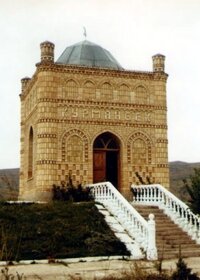
The Kurmanbek Baatyr mausoleum
As well as the epic saga Manas, the Kyrgyz have about 40 other “minor epics” such as Kojojash, Kurmanbek Baatyr, Tolubai and Er Toshtuk.
The name Kurmanbek is a fairly common name among the Kyrgyz and although it will probably be associated for many years to come with the second President of Kyrgyzstan, it has a long and illustrious history.
The minor epic Kurmanbek, is grounded in the 14th/15th century when Kyrgyzstan was part of the Kalmyk-Oriat state of Dzungaria, and is about the struggle of the Kyrgyz against foreign aggressors – the Kalmyks led by the Khan, Dalen.
For the record: the Kalmyks were a group of the Oirats, (western Mongols in Russia), whose descendants migrated from Dzhungaria in 1607. Today they form a majority in the autonomous Republic of Kalmykia on the western shore of the Caspian Sea.
Incidentally, Kalmykia is Europe’s only Buddhist government.
After the fall of the Yuan Dynasty in 1368, the Oirats emerged as a formidable foe against the Eastern Mongols, the Ming Chinese and their successor, the Manchu, who founded the Qing Dynasty, in a nearly 400-year military struggle for domination and control over both Inner Mongolia and Outer Mongolia. The struggle ended in 1757 with the defeat of the Oirats in Dzungaria; they were the last of the Mongol groups to resist vassalage to China
The hero of the epic , Kurmanbek Baatyr, rallies around himself representatives of the separate and disparate Kyrgyz tribes, and heroically defends the freedom and independence of the people.
In a city called Jazzes, near to present day Andijan, there lived a Khan by the name of Teyitbek. He was a weak khan and was unable to resist the hordes of Kalmyks which every year made devastating attacks on the Kyrgyz lands. His senior wife, Sulaika, was already forty years old and childless, when gave birth to a son, and after many days of celebrating he was given the name Kurmanbek.
From his childhood, Kurmanbek became famous for his intelligence and strength. When he was just twelve years old he won bouts in single combat against adult Dzhigits.
Then, when he was sixteen years old, he collected around himself forty companions representing the forty tribes of the Kyrgyz; giving them each a pitch black horse; dressing them all in chain mail armour and helmets; arming them with shields, swords and spears, bludgeons and fighting axes; training them to strengthen them and develop their fighting spirit. The he led them in daring raids on their enemies, killing several athletes and soldiers in duels.
Eventually, he developed a desire to end and seek revenge for the oppression and insults that his people had suffered at the hands of the Kalmyks and he decided to go war. Kurmanbek gathered his companions and addressed them. The set out and do battle, defeating various groups of soldiers, eventually demanding a tribute of gold and silver, cattle and camels.
Dolen gathers scholars from among the Kalmyks and explains the situation. They gather the tribute and send it Kurmanbek who, fearing a trap, attacks the convoy. A ceasefire is called, and the two groups negotiate a truce. Hearing about Kurmanbek’s victory over the Kalmyks, the Khan of Kashgar invites him to visit and heaps praise upon him and becomes a lifelong friend and ally.
However, Teyitbek, (Kurmanbek’s father), does not rejoice in his son’s victory, offended that Kurmanbek has acted without consulting him and after a lengthy argument conducted through an intermediary, the two are eventually reconciled – after a fashion.
Emissaries are sent to other Khans in the region, and after some difficulty a marriage is concluded between the hero’s daughter and the Khan of the Afghans. Kurmanbek and his wife settle down and a son, Seyitbek, is born.
The dispute with his quarrelsome father resurfaces and Kurmanbek decides to move away, to Turpan, which is now in Xingjian, in China and the family feud is intensified when Kurmanbek’s mother dies. Teyitbek retains Teltoru, Kurmanbek’s athletic war horse – something which will have fatal consequences.,
When Kurmanbek returns home, Dolen has decided not to pay the Kyrgyz their annual tribute and gathered his army. They approach the Kyrgyz camp at night and manage to remain undetected. Kurmanbek, however, has had a nightmare and describes it to his wife who interprets it for him – he is lost to the Kalmyks.
Kurmanbek mounts Korikuren, a young horse which lacks experience and fighting spirit of Teltoru, and sets forth to meet the Kalmyks. In the ensuing battle, Dolen flees, but turning and looking through his telescope, he realizes that the horse under Kurmanbek is not Teltoru but a young novice, and he gathers his fleeing troops and addresses them. He inspires them to turn back and face the oncoming Kyrgyz.
In the melee, Kurmanbek and his horse are surrounded by the enemy, the horse grows weak and the hero falls to the ground, where he slips and is stabbed by Dolen with a spear. He collapses on the ground with his blood seeping into the sand and loses consciousness. Regaining consciousness the following morning he crawls along a ditch and sees an approaching caravan. It was his old friend, Akkan, the Khan of Kashgar who, having heard of the fight with the Kalmyks is rushing to his aid. But it is too late. Kurmanbek dies of his wounds, and the Khan brings the sad news and the body to Kurmanbek’s wife and son.
Along with the dramatic narrative and recitative, the epic contains many sharp social motives and references to the traditional folk life, (for example, the description of courtship and marriage in the account of the marriage of Kurmanbek’s daughter to the Afghan Khan, Kanyshay).
There are four known versions of the epic.
- The first was written down in 1923 by K. Miftahov, taken from the storyteller M. Musulmankulov.
- The second variant dates from 1928 and was written down from a performance by the storyteller Manap Kalendarov living in the region of Jirgatal in Tajikistan.
- The fullest is the variant of the Akyn Kalyk Akiev which was published in Kyrgyzstan in 1938 and 1957.
- Then in 1966, a version was recorded by S. Dyikanbaev.




 Bishkek