The Besh Aral State Reserve
On April 17th, 1951, The Peak District in Britain became the country’s first National Park, so I thought I would take the opportunity to look at one of Kyrgyzstan’s National Parks.
Tucked far away in the far South Western corner of the Djalal Abad oblast, lies the Besh-Aral Zapovednik (Bio-diversity Reserve). Situated in the Chatkal Valley of the Djalal-Abad Oblast, 960 kilometers from Bishkek and 340 km from Djalal Abad the oblast centre and 25 km from Kanysh-Kiya the Chatkal Rayon centre.
The Reserve (with a total area of 63200 hectares) was created to preserve the habitat and to restore the populations of several endangered species found in the Western Tien Shan; in particular the Menzbir’s marmot and the Kauffmann and Greig tulips.
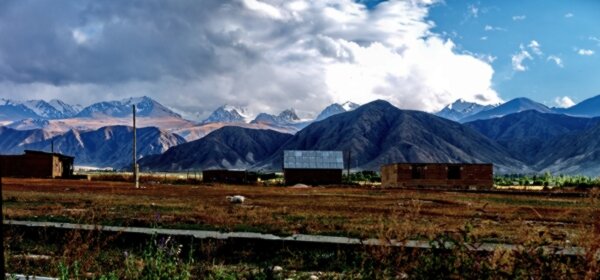
The reserve occupies the mountain slopes of the western end of Chatkal valley and the terrain ranges from 1000m to 4000m above sea level. The territory of the reserve contains a variety of landscapes: hilly and rocky, steep sloped mountain gorges, meadow steppe, alpine, with both coniferous and deciduous mountain forests, interspersed with turbulent rivers – the Chatkal River and its tributary, the Ters.
It was originally established in March 1979 with the purpose of establishing the reserve was to preserve the unique natural environment: the forests of the Chatkal valley; the habitat of the Menzbier’s Marmot and natural habitat of Greig and Cauffman tulips. Originally it covered 116,700 hectares. Since then it has seen several changes in its boundaries, first reducing it in size and then having other tracts of land added to it, and now it encompasses just over 112,000 hectares, (that is, 1120 square kilometers or 433 square miles).
Although an ancient link of the Silk Road passed through the Chatkal valley, and claims to be a popular tourists attraction … Besh Aral gets relatively few visitors. Access is difficult, over either the Kara-Buura pass (3305 m), or the Chapchim pass (2841 m) by gravel roads that are often impassable during winter and spring, (when they are often blocked by snow avalanches). Indeed, the major forest areas, containing, walnut and other fruit trees, (at the western end of the Chatkal Valley), is accessible only on horseback.
In the Soviet period, the Chatkal River did attract a number of visitors; it was a favourite stretch for white water rafting but with the dissolution of the USSR into separate countries, this is no longer possible as it involves crossing the border into Uzbekistan.
There is a rich and diverse variety of both plants and animals, with 46 species of mammals, 150 birds and somewhere between 1200 and 1500 plants, many of them listed in the Red Data Book as endangered to some degree.
- Amongst the mammals to be found in the Reserve are: the Western Tien Shan Marmot (also known as the Menzbir Marmot, Mormota menzbieri); the snow leopard; lynxes; bears; wild boar; porcupine; hare and ermine.
- Amongst the birds:eagles; vultures and stone marten
- Amongst the amphibians and reptiles, (mostly at the lower altitudes): steppe agama; gray gecko; desert gologlaza and coluber.
- Something like 117 different types of insects have been found in the reserve, around 30 species of spider have been identified, not to mention woodlice and terrestrial molluscs.
- Although there has been little research undertaken on the distribution of the fish in the reserve, some 12 species have been identified, including: Marinka; Osman; Char; Trout and Catfish
- Deciduous forests comprise trees such as walnut, apple, pear, almond, maple, hawthorn and also an undergrowth of shrubs such as honeysuckle, cotoneaster, Meyer’s currant, laxative buckthorn, spirea and dog rose to mention only a few. Woodlands of poplar, birch and willow are found on the floodplain along the river valleys, with an undergrowth of sea buckthorn, honeysuckle, willow, cotoneaster, dog rose, and the dove-coloured blackberry. Amongst the herbs growing here are liquorice, yarrow, St. John’s wort, and many grasses.
- The mountain coniferous forests comprise stands of juniper on the North facing slopes at elevations of 1700 to 3000m with trees between 4 and 7 m. high, and also spruce, with an undergrowth of mainly honeysuckle, barberry, spirea and dog rose. Meadow-steppe species grow in the open areas; and shade-loving forest grasses and mosses under the juniper trees.
- not forgetting a wide variety of grasses, herbs, lichens and fungi. A word of warning, some of the plants growing in the reserve are poisonous and some can cause skin burns.
The climate is sharply continental; humid with moderately severe winters and moderately warm summers.
The average annual temperature is 7 ° C and is characterized by sharp fluctuations in air temperature during the seasons, (the warmest months are July and August), and during the day. The annual rainfall is around 500-700 mm; (although in the lower reaches of the river Ters, it is around 250 mm). The driest months are August and September.
According to the Chatkal weather station, winds tend to be from the south-east and southerly directions. The average wind speed of 3.5 m /s.
The average air temperature
|
Jan |
Feb |
Mar |
Apr |
May |
Jun |
Jul |
Aug |
Sep |
Oct |
Nov |
Dec |
|
|
Temp |
-12.6 |
-9.3 |
-2.7 |
+3.1 |
8.6 |
13.9 |
16.2 |
16.0 |
12.0 |
5.6 |
-3.8 |
-13.3 |
The average annual rainfall
|
Jan |
Feb |
Mar |
Apr |
May |
Jun |
Jul |
Aug |
Sep |
Oct |
Nov |
Dec |
|
|
Rainfall |
73 |
60 |
106 |
112 |
47 |
31 |
11 |
11 |
7 |
25 |
81 |
74 |
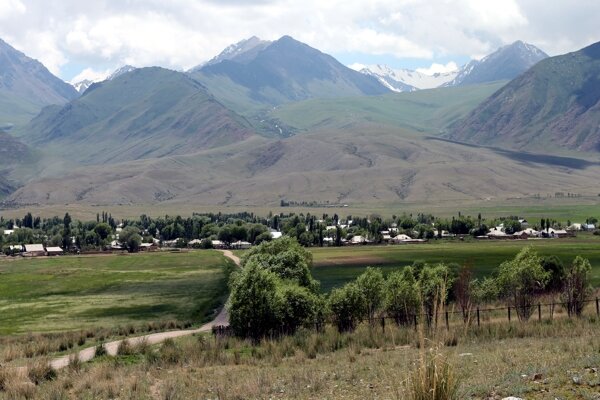
The administrative headquarters of the reserve are in the village of Djany Bazaar – which is about 26 kilometers outside the reserve itself, and there are several small villages within about 15 kilometers, (for example Kurulush and Ak Tash – each with a population of about 600 people). The local population are mainly employed in agriculture.


 Bishkek