Kumtor
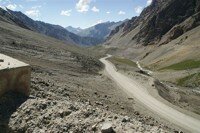
The Kumtor Gold Mine is an open-pit gold mining site in the Issyk Kul oblast, about 350 km (220 miles) southeast of the capital Bishkek and 80 km (50 mi) south of Lake Issyk-Kul, near the border with China. It is said to be the seventh-largest gold deposit in the world and the world’s second highest gold deposit, (after the Yanacocha gold mine in Peru), situated at an altitude of 4000m in a permafrost zone in the Tien Shan Mountains.
Although gold excavations were carried out in the region as long ago as in the 1920′s, the deposit was actually discovered only in 1978 – but not developed in the Soviet period. Shortly after independence a company executive of Cameco Gold Corporation visited Kyrgyzstan and negotiated a arrangement to exploit the deposit. (Cameco later became Canterra Gold Inc. and is a Canadian company with mining projects in Mongolia and the USA as well as in Kyrgyzstan.) As a result of the negotiations, the Kumtor Operating Company was established in 1992, responsible for financing (worth over USD450 million), production and sales of gold from the site.
The construction of the mine began in 1994 and it was completed in record time, commencing extraction in 1997 – and about 200 tonnes of ore were produced in the first ten years of operation. The gold reserves in the deposit are estimated to be about 716 tonnes. Once the current deposit is exhausted, then nearby deposits may be exploited and exploration licences have been issued so that the company can investigate the viability of mining them.
The company employees over two and a half thousand people (about 95% of them from the local population) and it represents, not only the country’s largest foreign investment, but also one of its largest employers and largest taxpayers. It contributed considerably to the fledgling Kyrgyz economy and helped to sustain it in the difficult times following independence, (despite facing a number of setbacks such as a cyanide spill, and a wall collapse). Indeed, gold was so important for the economy of the Kyrgyz Republic, that for the period immediately after independence it represented virtually all the foreign currency earnings of the new country, and some economic statistics were (and still are) quoted in two forms – for example: GDP and “GDP (without Kumtor)”. Kumtor also contributes to a number of local “good causes”.
It has not, however, been without controversy.
- The mine was linked to a major environmental incident in 1998 when a truck carrying 1762 kg of sodium cyanide (a chemical used to dissolve gold from granulated ore the use of which is highly controversial) fell into the Barskoon River on the way to Kumtor. Despite official claims that there was no risk to human life as a result of the spill, (including, by way of demonstration, the deputy minister going for a swim in the river), that tourist season in the nearby Issyk Kul reort zone was seriously affected; considerable sums of money were committed to compensation – although there were subsequent claims by the local population that the money never reached the intended beneficiaries and protests led to further payouts;
- there have been claims that the operation of the mine pollutes the environment in other ways as well. A book by the late Kyrgyz author Chinghiz Aitmatov, linked gold exploration with the melting of the high mountain glaciers and climate change;
- a wall collapse claimed the lives of several miners and led to claims that the company was operating unsafe practices – which, of course, it denies;
- many of the provisions of the agreement signed by the then President, Askar Akaev, and the company when it was established have been the subject of disagreements – especially following the Tulip Revolution of 2005 -
- because the agreement was not ratified by the Parliament, (the Jogorku Kenesh), it is argued that uit is not valid – especially in terms of the tax concessions it gave to the company – leading to
- calls for it to be rescinded, or at least renegotiated – which have, in turn, led to restructuring the company and the relationship between it and the Kyrgyz parties;
- a number of tax disputes and demands that the company pay considerable sums in terms of “unpaid taxes”.
- because the agreement was not ratified by the Parliament, (the Jogorku Kenesh), it is argued that uit is not valid – especially in terms of the tax concessions it gave to the company – leading to
More details can be found on the company’s webpage: http://www.centerra.ca/


 Bishkek