Akyns – a painting in the Museum of Fine Arts
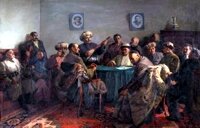
Akyns by Aitiev and Dzakul
A couple of months ago, one of the news agencies started publishing a series of articles about the some of the individual works of art contained in the collection of the Museum of Fine Arts. The second in the series featured a large painting the second floor, (first floor to the English like me, who call what everyone else calls the first floor the Ground Floor).
It was a group portrait from 1957 called Akyns.
It portrays thirteen people apparently sitting in a room, some at a table and others on chairs or on a divan. Despite its size, it is easy to pass it by; it’s a little dark and without knowing who the people are, it is easy to think of it as, perhaps, simply a group portrait of some committee or other – there are papers spread on the table before what could be the chairman. To my mind, it’s a good example of why Museums and Galleries in Kyrgyzstan could benefit from having better labels, brochures or guide books.
The article made me wonder about who exactly who were the people gathered together.
A couple of the group are holding a conversation, whilst another is playing a Komuz, (the traditional three stringed lute or mandolin which is a symbol of the Kyrgyz). That, together with the title, Akyns, gives a clue as to the composition of the group – although they are not strictly all akyns, they are important cultural figures in Kyrgyzstan from the first half of the twentieth Century.
For the record: The term “akyn” is used to refer to a performer that improvises verses – rather similar to a “minstrel” in olden Europe. The akyns began as the oral carriers of history, myth and philosophy for Central Asia’s pre-literate nomads. In practice, they were also extemporaneous preachers who lectured in sung verse on the political and moral issues of the day, adapting old legends or codes for the country’s latest ruler.
In the Soviet period, a lot of attention was paid to akyn and the communists used them to spread party propaganda. Akyns often sang about Lenin, the revolution and the achievements of the party.
One of the greatest Akyns of the Twentieth Century was Toktogul – who appears on the 100 som banknote and was a master at the art of Aytish. Some of his improvisations got him into trouble with the local “manaps” and they arranged for him to be exiled to Siberia. After the Bolshevik revolution he wrote a poem about Lenin which is sometimes credited as being the beginning of “democratic ideas” amongst the Kyrgyz.
Like Da Vinci’s masterpiece,, the Mona Lisa, the painting is divided into two distinct parts. To the left there are fold musicians, (akyns), dressed in traditional costume. To the right, dressed in modern “European” attire are representatives of other forms of cultural expression.
The thirteen people gathered together include:
- Alymkul Usenbaev (playing the Komuz), (1894- 1963), an akyn born in the village of Kara-Archa, in what is now Djety-Oguz rayon. Before the October Revolution of 1917, Usenbaev composed songs about the hard lot of ordinary people. His works written in the Soviet period extolled the creative labor of the Kyrgyz people.
- Abdylas Maldybaeva, (1906-1978), A musician – but not an akyn. Born in Kara Bulak, in the Chui oblast, Maldibaev was one of the first Kyrgyz composers and a singer (tenor). He began composing music at the age of 16 and some of his early songs were popular in the Soviet era. He experimented with music forms which were not a part of the Kyrgyz traditions, (such as hymns, marches, opera and a symphony). In 1954 he became the director of one of the prestigious musical colleges in Frunze (now Bishkek). He wrote musical dramas and what was the first Kyrgyz opera – “Aichurek”, which is still occasionally performed in the Bishkek Theatre of Opera and Ballet. Other works include “Ajal orduna”, “Altyn-Kyz”, “Toktogul” and “Manas”. In total, he composed some 400 songs and arranged 200 traditional melodies.
- Sayakbai Karalaev (in the light). A famous manaschi who appears on the five hundred som banknote. Born into a poor family in a small village, Akele, on the shores of Lake Issyk Kul. From 1935 he was engaged by the Kyrgyz Philharmonic Society as a professional “manaschi” when he began recording his version of the epic – a task which lasted until 1947 – which is considered to be a classic version of the epic.
- Toktonaly Shabdanbaev (behind Karalaev, leaning back in his chair), (1896-1978), an akyn birn in Kant region of Chui oblast.
- Musa Baetov, (1902-1949), a singer – tenor – and composer born in the Naryn oblast, known primarily as a folk singer with a very unique performing style accompanying himself on the Komuz and harmonica. His music was based on folk traditions and were often devoted to topical issues of the day – although his lyrical love and household songs were popular.
- Karamoldo Orozov, (1883-1960), a komuzist, born in the Issyk Kul region.
- Ybrai Tumanov, (1888-1967), a composer born in the Issyk Kul region – his composition Boz Salkyn is still very popular and is often performed by folk ensembles as part of their repertoire.
- Aaly Tokombaev, (1904-1988), is sometimes hailed as “The first Kyrgyz Writer”. His major work was a poem called “Bloody Years” – devoted to the events of 1916, and event he had lived through himself. One of his poems was published in the first issue of Erkin Too – the first Kyrgyz language newspaper – in 1924. He also translated a number of works into Kyrgyz – such as works by: Balzac, Dante, Gorky, Pushkin, Shakespeare and Tolstoy.
- Osmonkul Bolebalaev, (1888-1967), an akyn and poet born into a peasant family in the Kant region of Chui oblast. In his youth he wrote lyrical songs but after the Bolshevik Revolution of 1917, he civic motifs began to appear in his poems. As a performer, he was particular welkl known for his performances of the minor epic Kurmanbek and Toktogul’s Kedeikan.
- Said Bekmuratov, (1861 or 1901, sources differ-1966), born in the Karasuu region of the Osh oblast, a musician noted for his performances on the traditional two stringed, bowed instrument, the Kyl Kyyak.
- Kalyk Akiev, (1883-1953), an improviser, singer and storyteller, in the Naryn oblast. From the age of 12 he attended the Aitysh; contests that were usually held at sumptuous feasts or on holidays, between Akyns who would improvise verses, many of which he would perform songs poking fun at the local bais and manaps, including Satylganov Toktogul with whom he travelled and collaborated and after the death of Toktogul, Akiev devoted a lot of energy collecting and publishing the work of his great teacher.
- Myskal Omurkanova, (1915-1976), the only woman in the group, a komuzist who performed with the Phiharmonia
- Gapar Aitiev (seated with his back to the viewer), (1912-1984). He is known as “the first Kyrgyz painter” and was born in 1912 in the village 1st Tuleyken, (which is in the Kara-Suu rayon of the Osh oblast). He studied in Moscow in the mid 1930′s and is particularly known for his landscapes (which he preferred to paint in summer and early autumn), but he also painted portraits. His studio in Bishkek has been turned into a museum where examples of his works can be seen. Other works of his can be seen in the Fine Arts Museum itself and in the famous Tretyakov Gallery in Moscow. He received many awards including Hero of Socialist Labour and was the leader of the Artists Union for over 25 years.
Perhaps a little surprising, the portraits hanging on the wall behind them, looking over the group are not Marx and Engels, nor Lenin, nor Stalin … but Toktogul Satylganov, (a Kyrgyz akyn), and Maxim Gorky, (the Russian write and dramatist – the only Russian in the picture).
- Toktogul Satylganov, (1864-1933), a Kyrgyz poet – regarded as a democrat, a thinker, an outstanding komuzist (a performer of komuz music and improviser). He was born into a poor family in a village near to where the Toktogul reservoir now lies. His mother was a good singer and he began singing at the age of eight. Later, as a shepherd, he made up songs about the hardships of his life – a theme recurrent throughout all his life. He remained poor throughout his life – even losing his beloved to a richer man – and he always performed at gatherings of poor people – not for the rich, about whom he composed derogatory verses describing how they exploited the masses. (He seems to have had a talent for this – he turned “professional” at the age of eighteen after winning a traditional competition in which two contestants made up derogatory verses about each other.) The manaps (aristocracy) were unhappy about his and he was accused of participating in an uprising against the Russians – and sentenced to exile in Siberia. He escaped once – but was recaptured – and a second attempt was also unsuccessful. On a third attempt, in 1910, he was successful, aided by rum ours spread by his friends that he had drowned. His later songs have many references to his Russian friends – Semen and Hariton – who helped him escape from his penal servitude. At first, praised by the Soviets as a socialist – it is said that democratic ideas in Kyrgyz history began with him, and that Kyrgyz poetry dates from 1919 when he sang a eulogy of Lenin for the local Commissar – he later fell into disfavour with the authorities. His life and work are usually divided into four periods: the first “Before Siberia” period is characterized by traditional folk songs and lyrical love songs; the second by songs of advice and admonition; the third marks his return from Siberia and the before the Soviet Union – and includes the tragic song, “I have no son” – composed as a lamentation for his son, Topchybay, who died whilst Toktogul was in Siberia; the final period is known as the “Soviet” period when he composed songs such as “Long live Soviet Power” and “What a mother could give birth to such a son as Lenin”.
- Maxim Gorky, (1868 – 1936), famous as the founder of the Socialist Realism literary method which predominated literature in the Soviet Union. For him literature was an important political tool that could help to change the world. He wrote incessantly describing the lives of the ordinary people, those on the lowest social strata, the poor and the outcasts, depicting their hardships and deprivations but also their inward dignity and humanity. Towards the turn of the century he was gravitating towards the emerging socialist movements and in 1902 he met Lenin and they became close friends. This approach would often put him at odds with the Tsarist authorities and he was arrested on several occasions and even imprisoned. He even spent seven years in exile on the island of Capri, albeit ostensibly for health reasons. Although a close friend of Lenin’s and his close relationships with the Bolsheviks, (it’s not clear if he was ever actually a member of the party), he ran into trouble with the Soviet censors after the revolution and there was another period of self imposed exile in Italy on health grounds, althoughgh he was return and was to eventually die in Russia and at his funeral his coffin was carried by Stalin and Molotov amongst others.
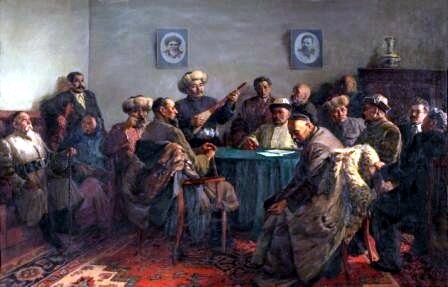
Akyns by Aitiev and Dzakul
One of the interesting features of the painting is that it is a cooperative effort, the work of two artists: Gapar Aitev – after whom the Museum is named – and Zhakul Kozhakmet.
For the record:
- Aitev - see above.
- Kozhakhmet was born in 1921 in the village of Ortho-Alysh, (which is not far from Bishkek in the Alamedin district). He studied art at the Frunze Academy (1938-1941), in Samarkand (1946) and Leningrad, (1947-1953). Serving during the Second World War, he held his first exhibition in 1948 and ten years later was elected as a Member of the Union of Artists. His paintings offered a narrative scenes depicting the life, struggle and social transformation of the Kyrgyz people, often on a large scale, drawing on materials, (landscape and thematic studies), gathered on his travels around the country. Some of his works, (such as “The squad to Frunze”, “First”, “Retired”, “Border”, “Return to work” and number of portraits), are also to be found in collection, “The Golden Fund of Kyrgyz Art”. He died in 1975.
In some ways, it strikes me, the picture is reminiscent of Da Vinci’s Last Supper and it would be interesting to know how many of the characters actually sat for their portrait, (presumably Kalyk Akiev didn’t because he died four the painting was executed), or whether, (like Da Vinci), the painting was executed over a period of time over a period of time with the artists searching for models to portray each individual maestro.




 Bishkek