Komuz
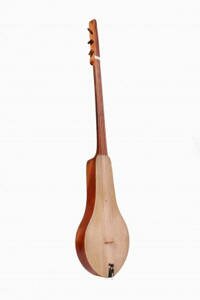
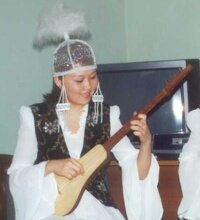
Among the numerous national instruments the most widespread and popular is the komuz, which has rich repertoire. It is a stringed instrument, made from a single piece of wood (apricot or juniper are the favoured timbers), and plucked like a guitar. While playing it, the three strings are clasped by the left hand to the fingerboard and the right hand is used to pluck the strings in a variety of ways to draw out the sounds.Today, the body of the komuz is usually made from a single piece of wood, but at one time there was a hollow in the body which made the sound resonating from the instrument even deeper.
It is a very versatile instrument and can be played by either men or women, boys or girls – as a solo instrument, as part of an larger group, or as part of a larger folk group ensemble featuring other traditional instruments. It is not unusual to see young children in the streets of Bishkek carrying a Komuz as they make their way to, or from, lessons in one of th city’s specialist “Music Schools”.
It is a very old instrument. In 1962, near the village of Shamsy in the Chui valley, archaeologists made a number of amazing discoveries – including the famous “Golden Mask” along with … a komuz – dating from the 4th and 5th centuries. (In fact it is still in the custody of the Historical Museum – along with a number of other artifacts found at the same time – but they are not on open display due to the lack of a suitable exhibition hall.)
Today, it also possible to come across an “electric komuz”.
Many of the melodies, (kyuu), are traditional and handed down from generation to generation – but akyns also compose new pieces.
There are a number of legends about the origin of the komuz. One tells of a Kyrgyz hunter, Kambarkan, who knew the “language” of many birds and wild animals, so that he could recognize them each by their voice. Once, when he was in the forest, he heard a new and wonderful sound. He was so taken by this incredible new sound that he could not leave the forest until he had discovered its source, and so he looked around to see if he could find where it was coming from. He climbed a tree to get a better vantage point, and there he saw two branches of a neighbouring tree connected by the dried intestine of a squirrel. The sound seemed to emanate from that “string”. “Perhaps,” he thought to himself, “she had tried jumping from one branch of the tree to another, but cut herself open”. Anyway, he took the string and a piece of wood from the tree and fashioned for himself a musical instrument – and became known as the Father of Melody.
Another legend tells how an old komuzist befriended a nightingale … that was entranced by his playing that she asked him to teach her to sing like the komuz – giving rise to a saying that the instrument taught even the nightingale how to sing.
Famous Komuzists include:
- Karamoldo – the komuzist who “played all day”
- Ogombaev – who “soothed” the heart of a dictator
- Toktogul Satylganov – the most famous akyn of the twentieth century



 Bishkek