Changeable Weather

World Meteorological Organization
Today is another one of those special UN Designated commemorative days, in this case World Meteorological Day. (March 23rd was chosen for because this was day, back in 1950, when the World Meteorological Organization – WMO – came into being as a specialized UN Agency.)
Weather and climate are truly international phenomena – they recognize no international boundaries. Weather extremes have a tremendous impact on our planet and its population, as has been evident over the past winter.
According to statistics issued by the WMO, between 1980 and 2007, nearly 7,500 natural disasters took the lives of over 2 million people and produced economic losses estimated at over US$ 1.2 trillion. The vast majority of these were caused by weather, climate or water related hazards such as tropical cyclones and storm surges, droughts, floods or related disease epidemics and insect infestations.

This year's theme for WMD is: "Watching the weather to protect life and property"
Each year a theme is chosen for World Meterological Day and this year’s theme is “Watching the weather to protect life and property“. The idea is to focuses attention on the crucial role of meteorological services in strengthening our safety and resilience to weather events.
Here in Kyrgyzstan, the agency that is in the “front line” from weather forecasting to dealing with the aftermath of an avalanche or flood is the Ministry of Emergency Situations … and they have certainly had their hands full in the recent past.
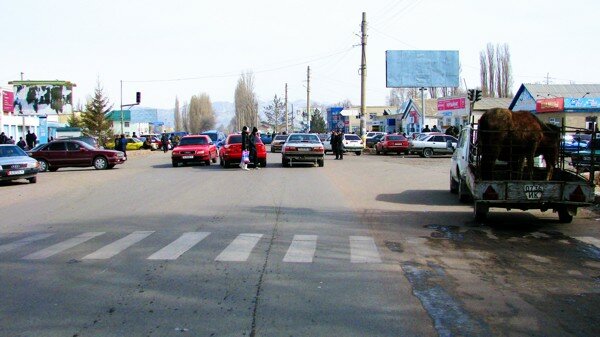
In recent times the weather here in Bishkek has been similar to that traditionally associated with Britain – changeable … but not as mild. Mind you, Britain hasn’t exactly been experiencing a mild climate in recent times ,,, I gather heavy snow and rain is causing havox across the country at the moment.
The temperature has varied considerably – up in the twenties one day, only to plummet into negative territory the next day. Thursday was a public holiday, Norus, and in the UK we tend to think of it as the first day of Spring, (here, Spring is deemed to start on March 1st). It was quite a spring like day, warm and pleasant but the following day was distinctly cool.
Also “changeable” is the news concerning the mining industry. At a conference in Hong Kong, Mines and Money 2013, Kyrgyzstan was named Mining Country of the Year, beating Papua New Guinea, Myanmar and Australia for the award. The prize was awarded on the basis of reforms in the mining sector, investment attractiveness and ease of doing business.
There was, on the other hand, reports of a survey which highlighted that the situation surrounding the troubled Kumtor gold mine is having an effect on potential investors – naming the country as one of the world’s “least attractive” places for mining companies to invest in. Kyrgyzstan was ranked in 92nd place, (out of 96), in the Policy Potential Index … which, interestingly, apparently did not consider corruption as a factor. It suggested that “investors seem to be taking a wait-and-see approach while the drama plays out”.
As an aside, I was interested to see another report that said that there is more gold in a ton of mobile phones than there is in 17 tons of ore … although it is more difficult to extract from mobile phones than it is from ore. Bearing in mind that Kyrgyzstan has one of the highest market penetration rates for mobile phones, with more more handsets having being sold than there are people in the population, that must mean that there is quite a lot of additional gold lying around in the country.
Mind you, there are investors interesting in putting their money into the country. One of the deputies complained in the parliament that one of them, who was looking to put something like 35 to 40 million dollars into the Kara Keche coal mine, was frustrated because the relevant Ministry wouldn’t respond to his approaches. The Ministry says that despite attempts to attract investors they’ve not received any concrete proposal yet. There definitely seems to be a lack of communication there.
The Chinese, on the other hand are investing heavily in a number of projects … and especially in the power industry, for example financing an oil refinery that could threaten Russia’s “monopoly”. They are also involved in the construction of a power line and the reconstruction of several roads, (including the main Bishkek-Torugart route which Chinese trucks use to bring goods for further transit into Kazakhstan, Russia and further West. They will be putting up most of the money for the China-Kyrgyzstan-Uzbekistan rail link, although the details have to be sorted out. I hope they don’t have second thoughts when they learn that the estimated cost has risen from two billion dollar in 2006 to six and a half billion. As well as inflation, something like a quarter of the increase has been described as being needed to meet “unexpected costs”.
Electricity generation is, of course, one of the main industry’s in Kyrgyzstan. Over the years there has been much comment about how cheap electricity is here, and many experts say that tariffs need to rise. The President came out against such a move this week, saying instead that the Energy Ministry needed an overhaul. Whereas, President Karimov of Uzbekistan has expressed concerns about the construction of the Kambar Ata hydro electric power station and the effects that this might/will have on water supply further downstream, Atambaev is convinced that out neighbours need the development as much as we do.
The Chinese influence is a “two edged sword” as far as many Kyrgyz are concerned … I have mentioned before that many seem unhappy at the rate of Chinese expansion into Kyrgyzstan and occasional disputes with Chinese companies or nationals working in the country.
Bishkek is planning to spend some 35 million som on repairing pot holes in the city streets – but, although that sounds like a lot, there are an awful lot of potholes. Fortunately, in addition the city has received a grant from China and there is a USD20 million loan from Turkey, some of which will which also be used to help repair some of the capital’s streets.
Language has been in the news a lot again – with the President defending his decision to sign the law on measures to strengthen the State language – Kyrgyz – which some people have taken to mean a demotion of Russian as an Official language. There is already concern, especially in the South of the country, that the position of Uzbek (which doesn’t enjoy the status as an Official language) is being undermined with the reduction in the number of schools where teaching is in that language.
He pointed out that all languages need to be supported but that different levels were needed for each language. He went on to say that Russian still needed to be supported as it was only through proficiency in international languages such as English and Russian that the people of Kyrgyzstan can develop – and Russian was especially important for the vast number of Kyrgyz citizens who traveled to Russia for work.
Indeed, it was revealed that something like a quarter of the population of Kyrgyzstan (and Tajikistan) are actually living outside the country as long term migrant workers – in places like Russia and Kazakhstan.
It’s not all one-way traffic however, as we also learned that last year saw 12000 people took Kyrgyz citizenship – stateless people, (such as refugees from Tajikistan and Afghanistan). That’s about 50% up on the previous year.
Well the State Commission for the National Language is being reformed into a National Commission for Language Policy … and it may mean more than just a name change. As one official pointed out: We have to develop Kyrgyz language without infringement of Russian language, in accordance with law. There are rural municipalities with absolute ignorance of Russian, so document management will be led there in Kyrgyz. We have never taken care of our language properly. We dot even have educational materials or books”.
The Human Development Index has received a fair amount of coverage during the week. Kyrgyzstan didn’t do terribly well, coming in at the 125th place – sharing the place with neighbouring Tajikistan. The UNDP started producing an annual report on Human Development around the world back in 1990.
Amongst the results of the analytical survey it emerged that Kyrgyzstan is falling behind in terms of the population with a Secondary Education – only about 81% of the population finishing school – the figure in the Soviet period was close to 99% – as, apparently, it still is in Kazakhstan.
There are several factors that might lead to this result – teacher shortages and, it was revealed this week, an acute shortage of textbooks. It seems that schools only have something like 40% of the textbooks they need. (It is said that something like 600 million som is needed each year to update the stock – that’s about twelve and a half million dollars.)
One of the more depressing aspects of the analysis revealed that 17.7 suicides per 200000 people in the population, Kyrgyzstan has the second highest suicide rate in Central Asia … quite a way behind Kazakhstan (with 52.4) but also well ahead of third place Uzbekistan (with 9.3).
In another report it turned out that at just over 70, Kyrgyzstan, (along with Kazakhstan and Russia), has the lowest life expectancy at birth of all the countries in the European Region – yes, sometimes Kyrgyzstan is classified as a part of Europe … it’s apparently something to do with having once been part of the Soviet Union.
Tax is not one of my favourite topics – but, as Benjamin Franklin pointed out – you cant escape it … not unless you are a multinational firm that can salt away it’s income offshore, that is. Or, for that matter a market stall holder in Central Asia’s largest market – Dordoi on the outskirts of Bishkek.
In theory, the market traders pay tax … and to make life easier, they are allowed to buy a “patent” which is a “presumptive tax” – a set one-off payment which releases the taxpayer from having to keep any records and having to calculate how much tax is actually due … unless they pass the threshold and become liable to register for VAT (… but then, who knows – because they don’t keep any records?). It is quite a good system in that it is simple and easy to operate – but that makes it open to abuse and the cost of the patent is critical – set it too low and the exchequer loses money – perhaps considerable sums of money … but set it too high and the taxpayer finds they are paying far more than they would under the ordinary tax system, (which is what happened to us when they said we had to buy a patent for our saunas).
Well, if you can believe the headlines, it appears that half of the traders in Dordoi don’t bother buying a patent so the taxman doesn’t even get the nominal patent fee.
At the moment the traders are up in arms because the patent fee has been increased, by 50%, and the “property tax” on the containers has also been increased, effectively by something like 165%. Business has been bad ever since 2010 when the border with Kazakhstan closed for several months as a result of the revolution, and then the formation of the Customs Union between Kazakhstan, Belarus and Russia, resulting in far less cross border trade.
In fact, the Prime Minister has said that the Tax Code needs to be looked at once more, because it isn’t working properly, (I think that means, in other words, that the government aren’t receiving enough in tax revenues to balance their budget).
In order to try and make the collection of taxes easier, instead of paying profit tax, (corporation tax) all in one go at the end of the year when the financial results are known, there is a system of planned payments – monthly payments with adjustments made at the end of each quarter/year so that the right amount of tax is paid. Well, someone thought up a change to the system so that firms now have to pay 1% of their turnover … which seems to be based on the idea of a 10% tax rate on a 10% profit margin. So far, so good – except for the fact that not everyone works on a 10% markup – yet alone a 10% profit margin.
As a result, some 78 petrol stations have closed – that 1% of turnover represents far more than they are liable for – and it has hit their cashflow, even if amendments are made at the end of the quarter and they end up with a huge tax credit.
As an aside: it’s not just the level of tax rates or the system itself that causes problems – and there are problems with both – but there are other issues as well. This week we needed to get a spravka (certificate) to the effect that we had no tax debts before the budget. Normally it’s just a formality but this time the tax official refused to give it – saying we had a debt of something like 120000 som. My accountant couldn’t understand what was going on … just a week ago we not only had no debts, we actually had a tax credit. The figures she was being quoted didn’t seem to make any sense to her. Then, after a long discussion, she noticed that the tax account number was not ours … the official was confusing us with another company altogether. Once she pointed this out, it became a formality once again … and we received the necessary spravka – but at the cost of several hours of discussion.
Well, with all this this depressing news, it is nice to have something positive to report …
Not only did a couple from Kyrgyzstan take 1st place in an international Ballroom Dancing competition … but the national football also managed to surprise everyone by qualifying for the Asian Football Confederation Cup in 2014 by coming out top in their qualifying group beating Macau, (1-0), Pakistan (1-0) and Tajikistan (1-0) … at least they seem to have been consistent – indeed, all three goals were scored by the same player: David Tetteh, (a 27 year old naturalized Ghanaian who plays for the Dordoi team … ).
It also seems that UNESCO has agreed to add traditional felt carpets (shydaks and ala kiyiz) to the list of Intangible Cultural Heritage.
Finally, tomorrow marks the anniversary of the Tulip Revolution … 24th March, 2005. I hadn’t realized that the name Tulip Revolution was coined by the BBC … in a report dated 26th November, 2004, they said:
In Kyrgyzstan this week, one politician referring to next year’s planned parliamentary and presidential elections spoke of “underground proclamations of opposition groups about preparing various kinds of revolution – rose, chestnut and the like”.
Given that more than 60 different species of tulip are found in Kyrgyzstan maybe any such move would be called the Tulip Revolution.
The anniversary is no longer a public holiday here … but President Atambaev issued a statement … which ended the following lines:
Our goal – to build a democratic and prosperous Kyrgyzstan. Maintain peace and stability in the country.
I believe that together we will achieve this goal. And each of us will be proud of their country, our Kyrgyzstan.
I must admit that I can’t help wondering if his message with on the future – especially the impending verdict in the case against the Ata Jurt politicians that attempted to storm the White back in October last year, due at the end of next week – as on the past.
_______________________________________
Postcard from Bishkek: the weekly postcard that I send out as an email also gets posted on the website ianbek.kg each week – and there are other postcards which don’t get sent out. This week, for example, there has been the following postcards:
- Getting around - Transport options for travelling around Kyrgyzstan – 17/03/13
- BishkekPark - Bishkek’s newest shopping center was supposed to open its doors on March 16th … with two towers it is destined to become Bishkek’s tallest building - 18/03/13
- Carry on Doctor … - It’s not easy to become a doctor in Kyrgyzstan – 19/03/13
- Atake Baatyr – The first Kyrgyz Ambassador - On the anniversary of establishing diplomatic relations between Russia and the Kyrgyz Republic, I took a look at the first Kyrgy Ambassador to the Tsar’s court in St. Petersburg - 20/03/13
- Playing truant - The kids are not in school today … but it’s OK, it’s all official and above board – they are not playing truant. Today is a public holiday – Norus. If, however, they had been in Poland, then they could well have been playing truant … it’s a tradition there to do a Ferris Bueller and take a day off on March 21st – 21/03/13
- Murza Gaparov - The Kyrgyz writer Murza Gaparov was born into a farming family on 22nd March, 1936, in the village of Noygut in the Nookat district of the Osh oblast. - 22/03/13
It is possible to follow me on Facebook, (where I have specific pages for Celestial Mountains and ianbek … and also links.kg and Kyrgyz Diary), and on twitter, (@Bishkekpostcard and @celestialMTC ).




 Bishkek