Getting around
There are many different aspects to organizing a tour for clients. A standard checklist of things that need to be considered when designing an itinerary includes:
- Transport
- Accommodation
- Guide Services
- Activities
One of the most important is the choice of transport. The decision of which transport to use can be a “make or break decision”.
Also, it’s often one of the most expensive parts of a tour. Although Kyrgyzstan is a small country, the distances traveled between venues can be considerable and the choice of transport can affect the level of comfort experienced by the client on their journey. In most cases people want to travel overland, which means hiring a vehicle.
We often get asked if it is possible to hire a car for an independent “self drive” option. Unfortunately there are no Car Hire firms like Budget or Hertz operating in Kyrgyzstan, (although there is a limited “self drive” hire service operated by one firm which is mainly designed for use by ex-pats like me), and in most cases it is necessary to hire a vehicle with driver.
Although there are some exceptions, and the fact that many experienced drivers have picked up sufficient basic knowledge of other languages for simple communication, most aren’t fluent in foreign languages.
There is a wide range of transport options available, depending upon the group size and the route of the itinerary:
-
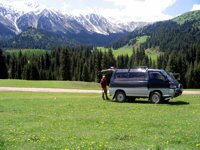
A Volkswagen Delica
Saloon cars are available for use within the main towns, such as Bishkek and Osh, and on the main roads between them. These are suitable for groups with just two or three passengers.
- “Jeeps” and Four Wheel Drive, (4WD), vehicles, (such as a Volkswagen Delica), are available for routes that take in some of the more remote areas and more difficult mountain roads that aren’t asphalted. These could be up suitable for slightly larger groups.
- Minibuses with up to 17 passenger places are available which can negotiate most routes, such as the roads up to Lake Son Kul.
- Buses, suitable for groups up to 50 passengers are also available, but there are some limitations as to which routes they can tackle.
There are a few “off road” routes, (for example the road up to Altyn Arashan near Karakol), that really require heavy duty six wheel drive vehicles – a GAZ33, for example, which is a Soviet heavy duty military type vehicle.
It should be noted that, in Kyrgyzstan, insurance is not compulsory, (although there are proposals for introducing this). As a result, although some do, not every driver and vehicle carries insurance for either third party or passengers … and belongings left in a vehicle are virtually never covered by any policy. As a result, travelers should check the terms and conditions of their own travel insurance policy to make sure that they are covered … and that the policy extends to Kyrgyzstan.
___________________
The cost of transport tends to be based on the type of vehicle and the distance traveled – plus an element for the driver’s food and accommodation during the trip. There may also be a cost involved in getting the vehicle to the start point of a tour or back home from the final point.
___________________
Not everyone, however, wants to book an all inclusive tour where we, the tour company, take responsibility for finding suitable transport and drivers. They prefer to travel “under their own steam”, for example driving their own vehicle, or as independent travelers.
For those who are their own vehicle, I wrote a postcard a couple of years ago about Driving in Kyrgyzstan which might be useful.
Independent travelers, of course, can decide to take one of the alternative options – local buses or shared taxis, or or using the limited rail network and, in the past, we have been asked to help independent travelers make arrangements, (purchase tickets and so on), but as the circumstances around every case is different, it is difficult to give blanket assurances as to what will be possible.
Buses: There is a fairly well developed system of bus routes around parts of the country – between Bishkek and Tashkent (a Kazakh transit visa is needed), Bishkek and Almaty, Bishkek and the towns around Lake Issyk Kul. There are NO bus services between Bishkek and Osh – buses are prohibited on two of the passes along this main route – and even minibuses are prohibited over the Too Ashu pass unless they happen to be a 4WD vehicle. Buses may represent the cheapest mode of transport – but they can be slow and uncomfortable. On the other hand, they do operate according to a timetable.
Marshroute – Minibus ‘taxis’: These usually run between the bus stations in major towns. They are a bit more expensive that the bus services – but tend to be quicker and more comfortable. They don’t necessarily run according to a timetable, however, instead waiting for potential clients in the bus station and only depart when full.
Shared / local taxis: Bradley Mahew, in one of the early editions of the Lonely Planet guide to Central Asia, listed the cheap taxis in Kyrgyzstan as one of his “Personal Highs” of Central Asia. Local taxis can be found in most major towns waiting for passengers around the local bus station. Basically, the drivers wait until they have a car load, and then depart. A carload usually means four passengers – three share the back seat, whilst the fourth sits up front with the driver. (Traditionally women don’t occupy a front seat). It is possible for a traveler to pay for the extra places to avoid having to crowd up on the back seat or to get the taxi to themselves.
Shared taxis may be cheap – and for the independent traveller, they might offer a good value way of getting from A to B – but they are not for everyone. The British Foreign and Commonwealth Office actually recommends against using them on their website. Apart from the fact that the passengers may have to crowd in the back seat for a long journey, they travel between fixed points – usually the bus station in each town – and don’t stop in order to allow one to take photographs, make detours, etc. Also it is a case of “pot luck” concerning fellow passengers, the driver … and the vehicle.
Trains: The network basically runs from Bishkek up to Balykchy at the Western end of Lake Issyk Kul, (although there are also trains linking Bishkek with Moscow and Tashkent).
____________________
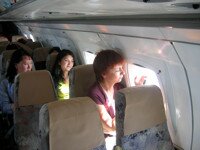
On the Bishkek-Osh flight ...
Flights: Sometimes, the best option is to fly … whether on an organized tour or as an independent traveler.
Internal flights, for example between Bishkek and Osh, are operated by local airlines. The cost of the ticket is not great, but the planes tend to be small and so the number of seats is limitedwhich can cause problems if the group is large and needs a number of tickets.
It’s not possible to book these from home, they have to be bought here in Kyrgyzstan and in most cases there is no system of reserving a seat – when making a booking, you pay and get a ticket … and a seat is reserved for you. If you don’t buy the the ticket, then the place is considered to be free and can be sold to another traveler.
To make matters worse, sometimes the seats aren’t released for sale until fairly near the departure date. Add to that the fact that there’s usually a fee for cancellation, (and in some cases the airlines terms and conditions do no not allow for refunds), which can make the timing for purchasing the tickets a little like walking a tightrope.
Perhaps the biggest concern, however, concern safety. Although I, personally, have no problem with taking a flight to, say, Osh, the Foreign Ministries of some countries comment in their travel advice about air safety … that there may be some question about the maintenance procedures on aircraft used on internal flights and advise against taking them. (Because of these concerns, local airlines do not fly to Europe or the US – and the FAA do not check and comment on safety procedures). This may raise questions about whether a travel insurance policy will cover a traveler on internal flights – so it is important for them to check with their insurance company before making any final arrangements.
Having said that, there are usually very few problems …


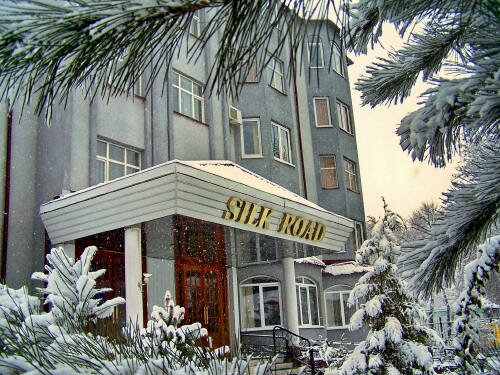
 Bishkek