A warning from the MChS
Logo of the Ministry of Emergency Situations
Over the weekend there was an “Avalanche Warning” issued by the Ministry of Emergency Situations, in connection with the forecast of more snow due in the next few days.
The Ministry of Emergency Situations, (MChS), was established just before Kyrgyzstan declared Independence from the Soviet Union.
In December 1990, The Council of Ministers in Moscow adopted a Resolution “On the establishment of the State union system prevention of emergency situations”, and in July 1991 the Cabinet of Ministers of the Republic of Kyrgyzstan adopted a similar resolution, establishing a Commission as a permanent body which then absorbed the role of the Office of Civil Defense and, in 1996, became the current Ministry.
Further re-organization in 2000 brought into the remit of the Ministry the responsibilities of the former Ministry of the Environment, Kyrgyzhydromet, (the weather service), and the State Forestry Agency. With such a wide portfolio of responsibilities, there are some 27 different offices or agencies, and the main objectives of the Ministry include:
- Monitoring and prediction of potential emergency situations arising out of both natural hazards such as: landslides, mudflows, avalanches, alpine glacial lakes, landslides and rockfalls, subsidence and “coastal” erosion, flooding … and also man-made processes and events, including hazardous production facilities, fire safety and the monitoring of radioactive and toxic tailings and waste dumps;
- The prevention of such situations wherever possible by adopting appropriate measures;
- Planning for Civil Protection; training authorities, civil defense forces and the population on how to act in emergency situations;
- The organization of rapid response disaster recovery and other “emergency operations”, in both peace and wartime, including the organization and carrying out of search and rescue operations.
The Ministry issues the weather forecast, (and occasional warning of extreme weather conditions).
They organize controlled avalanches in the in the twelve mountain areas which are prone to avalanches, in order to prevent the build-up of snow which could otherwise create a dangerous situation for drivers travelling through the zones – four of them along the main Bishkek-Osh highway.
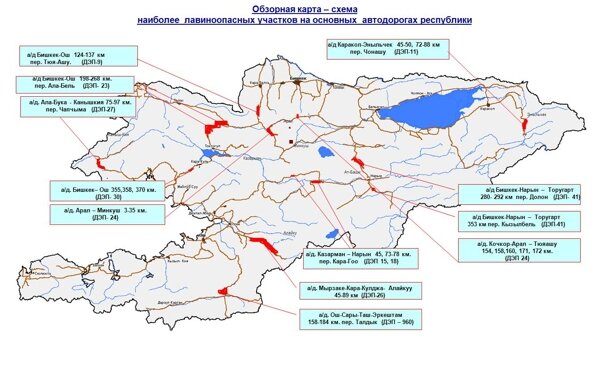
Avalanche zones
Another issue contained in the Warning notice was the possibility of floods. To be honest, I hadn’t realized quite how serious floods can be here. Last year, for example, there were 217 floods – 75 of them in the Djalal Abad oblast – affecting over 3300 homes and 40 community buildings, covering 9400 hectares of land, 415 kilometers of roads, 119 bridges … and causing over 700 million soms worth of damage.
Recently the Ministry was involved in preventative work on the River Ala Archa, smashing ice to ensure the free flow of river water so that dangerous levels didn’t build up threatening to flood surrounding land.

MChS statistics for 2012 Infographic - Emergency Situation for 2012 by type - from K-News
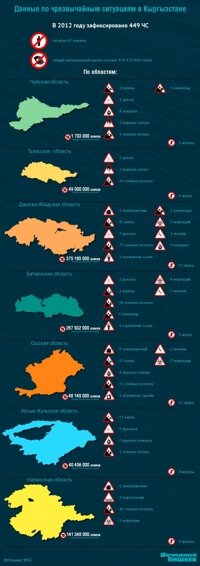
MChS statistics for 2012 Infographic - Emergency Situation by oblast - From Vecherniye Bishkek
As the majority of the emergency situations handled by the Ministry, (something like 80% according to their figures), occur in Southern Kyrgyzstan, in 2002 a special office was established based in Osh. The two Monitoring Offices have a total staff of just 27 people according to their website.
According to official statistics, in 2012 the Ministry responded to a total of 449 emergency situations in which some 47 people unfortunately died and involving damages to the value of almost a billion som, (that is, about twenty million dollars ).
These included
- 13 earthquakes – 9 in Osh oblast,
- 95 avalanches – 45 in Djalal Abad oblast,
- 34 large fires – 9 in Djalal Abad oblast,
- 14 landslides, mudslides – 14 in Osh oblast,
- 4 rockfalls – 2 in Djalal Abad oblast,
- 18 Hurricans, or Wind storms – 9 in Osh oblast – hail was blamed for almost 35 million soms worth of damage,
- those 217 floods – 75 in Djalal Abad oblast – affecting over 3300 homes and 40 community buildings, covering 9400 hectares, 415 kilometers of roads, 119 bridges … and causing over 700 million soms worth of damage,
- 13 infections, or – 8 in Batken oblast … as well as …
- glaciers bursting their bounds, fires, lightning strikes and a gas explosion.


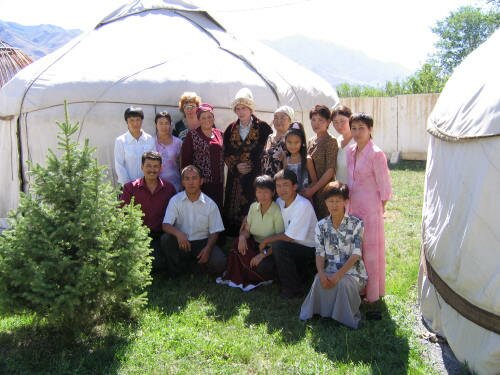



 Bishkek