Carry on Doctor …
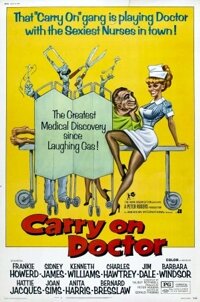
Poster for the 1967 film
In a recent news story, we learned that one of the Department Heads at the prestigious Medical Academy in Bishkek had been arrested for fraud when it was discovered that he was apparently prepared to sell a forged diploma for 25000 som – that’s just about USD550.
That came as quite a shock. The idea that a diploma that normally involves six years of study could be purchased, (and especially for such a small sum), was astounding.
As it happens, it wasn’t the first time that this issue has arisen – a few years ago there were stories form the South Asian sub-continent, (India and Pakistan), of people working as doctors who were discovered to have forged diplomas … but this is the first occasion that I can remember where the person responsible for issuing the diploma was apprehended.
This shouldn’t, however, be taken as an indicator of the level of the personnel medical services in the country. Generally speaking, in fact, (at least according to the British Embassy), the medic personnel in Kyrgyzstan, “are well trained and knowledgeable but the system lacks the modern health care technology available in the UK.” In the light of my personal experience, I would support this view.
Kyrgyzstan inherited a Health system from the former Soviet Union, an extensive network of health facilities and a system of training health workers. In the Soviet period, there were many foreign students that came here on exchange and other programmes. The provision of these services, however, were expensive and benefited by the fact that they were subsidized from finances provided from Moscow …
When Independence came in 1999, those subsidies disappeared … and the responsibility for the maintenance and development of these facilities fell on the health authorities of the newly declared country and in the following years, Kyrgyzstan’s health system suffered increasing shortages of, for example, both health professionals and medicine.
There was great pressure on the public treasury and government expenditure on health care decreased as a percentage of total expenditures, (in 2010 it represented only 2.4% of GDP compared to 11% in many Western economies), whilst indicators such as the ratio of population to the number of doctors worsened substantially, (from almost 34 doctors per 10000 people in 1996 to just over 28 in 2001 and just under 23 in 2011 … that’s a global figure and a similar situation is observed when looking at professional delivering direct, immediate and practical health care).
Salaries for health professionals were low, (especially compared to equivalent posts in the West), until 2011 when, with the support of funding from a World Bank programme, they doubled or tripled. Many doctors and nurses either left the profession in search of better paid jobs, joined one of the growing number of private health services, or emigrated – 225 emigrated in 2007 and nearly 1500 in 2010. When salaries were increased in 2011 it was hoped to help solve the issue of understaffed hospitals – especially in the rural regions, where additional funds were targeted.
There is also the fact that, as in many other professions, the age profile of medical personnel is changing with many doctors either approaching, or over, retirement age – especially in the regions, such as in Naryn and Issyk Kul.
At the moment there are five Higher Education Institutes who run courses in Medicine designed at training doctors, (and there are fourteen colleges preparing students on paramedic and pharmaceutical courses), with an increasing number of students graduating with diplomas: 788 in 2006 and 1362 in 2010. However, not all of those graduates go on to work in the health service.
I have an acquaintance who has recently qualified – I am fairly confident that he did indeed study and didn’t purchase his diploma – and has now working as an intern in a city hospital. He tells me that a number of his former classmates have taken internships abroad – in Russia, Kazakhstan or Turkey, for example.
More to the point, however, the loss of financial subsidies has meant that many institutions experienced difficulty in maintaining their courses. As a result, institutions started to charge tuition fees and, as is often the case, (even in Britain), foreign students are seen as a useful source of additional finance. The fees for foreign students can be higher than those charged for locals – who benefit from fees paid for, (subsidized), out of the the state budget … and are technically obliged to return to work in the service. (In 2010 – over four fifths of the graduates fell into this category).
Even if the fees paid by foreign students are higher than those charged to Kyrgyz citizens, they are still considerably less than those charged by Medical schools in places like India and Pakistan. What is more, a former Indian ambassador once explained to me, the entry qualifications are not as demanding as those applied in India – who are able to select the best qualified candidates. Those who obtain less prestigious grades in their final school examinations can still enroll on a Medical course if they can afford the fees, living and travel expenses … and are prepared to study in Central Asia.
In fact there are a considerable number of such students – and during the events of 2010 a number of Indian and Pakistani students were evacuated from Osh. Indeed, just one Medical school has over 1000 foreign students studying Medicine – most of them from India and Pakistan.
Most of the students live in hostel accommodation, although I have met some that have rented apartments instead.
Most of the institutes teach in Russian, although at least one offers courses in English. Special courses in Russian are provided but it must be difficult for both students and tutors in that they are working in a language of which they are not a native speaker. Indeed, there is a criticism that it is easier to pass an examination in English because the students have a greater greater knowledge of, and skill in, English than their tutors.
That may appear to give them advantage – but, even when they have their final diploma, when they return home, they still have to take an examination, (for example, the one administered by the Medical Council of India), in order to get their license to practice as a doctor in their home country. (It’s not clear how many students pass those examinations. In an article on the topic in December last year, one journalist quoted figures ranging from 70% to 1%! – the article is well worth reading.)





 Bishkek