The Oval
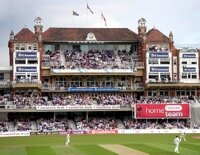
The Oval Pavilion - one of the iconic images of Cricket
Life is full of little surprises … Take the Oval, for example.
The Oval is an international cricket ground in Kennington, London and, like Lord’s and the Melbourne Cricket Ground, its name is well known as one of the quintessentially English game of Cricket. It is the home ground of Surrey County Cricket Club. Traditionally it hosts the final Test match of each English summer season in late August or early September.
What is not so well known is that it also played an important role in the development of another sport: Football – or, especially for the Americans for whom the name Football refers to a totally different Sport: Soccer.
Not only was the venue for the first ever international match, (between England and Scotland on 5th March 1870, which ended in a one-all draw), but it also hosted the first ever FA Cup final, (on 16th March, 1872, when The Wanderers beat the Royal Engineers, 1–0) and all subsequent FA Cup finals until 1892 – except for the 1873 one, (which was played at Lillie Bridge – near to the present day ground of Stamford Bridge – when the Wanderers – again – beat Oxford University 2-0).
For the record: I suppose that I should also mention that it staged the seven International Rugby Union matches including the second which was, (once again), between England and Scotland, in 1872.
The ground has also hosted many other events, including: hockey fixtures; Australian Rules Football, as well as serving as a practice ground for American Football and staging a variety of concerts.
There have been quite a few sporting events this week … although they’ve been somewhat overshadowed and pushed out the headlines by some of the other events of the week.
There used to be a somewhat cynical observation about Kyrgyzstan being obsessed with the sport of holding Demonstrations … and it is true that people attending rallies were often described as being of “athletic build”.
Well, this week we have seen a number of such rallies … perhaps the most ironic being held on Tuesday, which was billed as a “Rally against Rallies”. I don’t think that many of the people who attended could have been described as having an “athletic build.”
The organizers of another, planned for the next day, in support of the politicians currently on trial for trying to storm the White House, decided to call it off. Their trial has been winding up and the prosecution has asked the judges to impose lengthy prison sentences – but that didn’t stop them giving exclusive interviews to the press.
Instead, another group decided to hold a demonstration calling for the resignation of the government, a moratorium on the sale of land, prosecution for those responsible for the Kumtor agreements, a stop to Chinese expansion in the country … and other things … and said that they expected some 5000 people to attend. As it turned out, there were far less – I heeded the advice of the British and Foreign Commonwealth Office to avoid demonstrations and didn’t go to take a look, but decided to keep an eye on the on-line web cams instead. I have heard estimates of there having been anywhere between 50 and 800 people who turned up in the main Ala Too square … and judging from what I saw from the webcam, (and bearing in mind that there was apparently quite a large police presence on the square – which might have inflated the impression of how many people were there), there seemed to be over 200 but I am not sure that it got as high as 800. Despite the gossip that had been circulating over the previous few days, they certainly didn’t pose any threat of disorder and the traffic kept moving through the square uninterrupted.
The Endless protest in Djalal Abad, which shrank somewhat over last weekend, as many of the participants decided to go home for the celebrations, was finally called off on Thursday.
All this didn’t stop one activist saying that Kyrgyzstan needed a new “Khan” – apparently drawing comparisons with constitutional monarchy’s which he seemed to think were a guarantee of peace and stability. Well, he might have a point, but the Kyrgyz don’t really have a tradition of a Grand Khan … over the centuries there have been several attempts to create one including Ormon Khan, Alimbek Datka, and Shabdan Baatyr – but no-one has really succeeded in assuming the mantle of the eighth century Barsbek or the legendary Manas … and even Manas didn’t have a smooth ride – the whole point of the last two books in the epic saga is how Semetei, (his son), and Seitek, (his grandson), have to come to terms and deals with his enemies and rivals.
Some people still see the hand of the Bakiev’s trying to manipulate events and becoming that Khan … but if he is, then I think he is probably wasting his time, effort and money … even if he still has supporters in the country, he is too divisive a figure – and is unlikely to make a comeback like Peron did … and even he had to wait eighteen years to make his.
In the meantime, the Mayor of Bishkek seems to have worked a minor miracle – in that the vote of no confidence in him was postponed … he hasn’t yet seen off the opposition, he hasn’t hit them for six, but he’s forced to follow on – to continue the cricketing theme.
During the week the Ministry of Emergency situations said that they would testing the city’s network of sirens that are supposed to warn the population of the threat of emergencies, natural and man made disasters. They announced it in plenty of time so that people didn’t panic when they heard the sirens. I was fascinated by the news … having lived here for almost eighteen years and didn’t know that there was such a system. Apparently there are 129 sirens scattered around the city – 45 of them connected to a central headquarters and 50 operated manually by local officials, (the other 34 are known not to be in working order … !). They are supposed to be audible over an area of about one and a half square kilometers. Well, when the appointed time, (11:00am, yesterday), I listened … but didn’t hear a thing … presumably my local siren is one of the 34 – or maybe they called the exercise off.
Maybe, however, the exercise was handicapped by power cuts … we’ve had several throughout the week.
The President also gave interviews to the Press during the week. He has once again underlined his opinion that the Transit Base at Manas has to close and become a civilian facility. When he was asked about whether he thought the American withdrawal from Afghanistan might be a destabilizing factor for Central Asia, (although most of the international commentaries I have seen warn that this is likely to be the case and that both Russia and China are positioning themselves for the possibility), he said “No”.
Another piece of interesting news on the international front was that most of the foreign investments made in Kyrgyzstan last year came from Canada and China, (both around USD155 million). Next was the United Kingdom, with approximately USD70 million, and German, USD32 million) … the CIS countries invested about USD27 million. Foreign investment seems to have fallen by almost 40% from the previous year – and that was before the issues over Kumtor became exacerbated. If the article in this week’s Economist is anything to go by, we can expect that situation to get worse.
I presume that the majority of that Canadian investment involved the Kumtor operation, and future inward investment from that quarter may be under threat if a resolution isn’t found – even if the government and Centerra have agreed that the mine needs to keep working normally in the interim. The Chinese might also be feeling a little uneasy given some of the rhetoric against “Chinese expansion” that came in Wednesday’s Rally.
Still, the government seems to have good relations with China. President Atambaev sent congratulations to Xi Jinpin on his election as President of China. Apparently Xi Jinpin has agreed to come to Kyrgyzstan on a state visit later in the year … in fact, it’s going to be a busy year. The President of Austria has been here this week, and later Prime Minister of Turkey, President Putin of Russia and the President of Germany are also scheduled for a visit ,,, not to mention planned summits of the Collective Security Treaty Organization and the Shanghai Cooperation Organization – all to take place this year … I suppose that means yet more chaos on Bishkek’s streets as traffic is re-routed here there and everywhere.
Among the issues that might strain relations with Russia are:
- the threat that Russia will end the visa free regime with Central Asian countries … which could cause problems for our migrant workers over there … with the consequent knock on effect when it comes to the remittances they send to their families back home – making an important contribution to the Kyrgyz economy … and
- the status of use of the Russian Language. Recent changes in the legislation and regulations has started to get Russian speakers a little anxious. These include the provision that all official documentation will have to be provided in the State Language – Kyrgyz – with translations into the Official Language – Russian – only as and when needed.
What impact these two might have in the light of Kyrgyzstan’s imminent accession to the Customs Union is not yet clear.
One of the Deputies has been floating the idea that we should change the definition of the weekend – moving Sunday to Friday, as a non-working day, that is. This would make it easier for Muslims to attend Namaz – prayers – something which is difficult at the moment because it is a normal working day.
Another suggestion that has been floated is that the government should delegate some of it’s price control functions to the regions … although there seems to be some doubt about how this would work.
The fight against corruption continues … with more arrests for Bribes – including three high ranking officials such as the Chief Inspector of Customs, (the arrest was actually videoed and a copy posted on the internet by the State Security Services – the KGB – although the video seemed to show a lot more than the 10000 som he is supposed to have extorted from businessman for “flaws in their documentation”) … and also the Deputy Head of the Police Academy(! now that seems to give a new significance to all those films.)
Today is the first of several Subbotniks, (Subbota is Russian for Saturday – and Subbotnik refers to the practice in Soviet times for the people to do “voluntary” work – usually on a Saturday – cleaning the streets and territory around buildings … a sort of citywide “Spring Clean”). In theory the local authority encourages citizens and businesses to join in the activity … but government employees and school children are basically drafted.
Another “institution” inherited from the Soviet Union is the Propiska - the registration of someone’s place of residence. Actually, it’s a lot more than simply registration – it amounts to a “permission” to live at that address. In the times of the Tsars, Russia was very very strictly controlled and that included control over where people were allowed to live. Ironically, the Bolsheviks under Lenin opposed this system, denouncing it as undemocratic and vowing to abolish it – which they did, almost as soon as they seized power. It wasn’t long, before something similar was reintroduced and under Uncle Joseph (Stalin) it was refined and became a major instrument of social control. Without the appropriate Propiska not only were you not allowed to live in a particular area – you couldn’t access any of the government provided services – education, health care … and so on.
After the collapse of the USSR, the Supreme Court in Russia declared the Propiska as unconstitutional and it was abolished – but just as in the former Soviet Union, a revised version was introduced and apparently bureaucratic creep has ensued making the new system just as stringent as the one it replaced.
The issue of whether a Propiska is necessary or not has been under discussion here for some time, with some people arguing for its abolition and others that it be reformed into a purely administrative registration – for statistical and other purposes. The debate has now been highlighted by the revelation that there are thousands of people living in the residential districts on the outskirts of Bishkek without being in possession of the necessary stamp in their passport – in some cases, not even having a passport.
To the British and Americans for whom a passport is mainly used for international travel – not having a passport might not seem to be a big issue – but here it most definitely is! If you don’t have a passport – you are nothing more than a body … you’re not a person. No access to education, no access to health care, no access to social services, no right to employment, to get married and have a family, no right to a pension … and so on.
You certainly wouldn’t be allowed to play Cricket for Surrey …
My statistic of the week comes from the news that the average salaries and pensions in Kyrgyzstan have doubled over the last three years - the pension rising from 2131 som to 4070 (from USD45 a month to USD83) with average salaries now standing at 10566 soms, (about USD220). Although that sounds pretty impressive, I can’t help thinking about the old adage about “double of nothing … “.
Finally: I received an interesting question during the week – about the situation regarding compulsory military service – especially those from ethnic minority groups. (I presume the question arose out of some comments about how the civil service and law enforcement agencies are not only predominantly Kyrgyz, they are almost entirely staffed by Kyrgyz personnel).
The same is true about the Armed forces. In fact, this was one of the issues which was commented on by the foreign press and observers at the time of the incidents in Osh, in June 2010 – the Army were seen as distinctly Kyrgyz – although, apparently, there were examples of soldiers standing up in defense of the local minorities.
Here, there is a system of “compulsory service” … well, sort of. Technically, everyone between the ages of 18 and 27 are liable for call up, which usually takes place in October each year. It used to be that service lasted for two years – but it is now just one.
However, there are some exceptions … students in full time education, for example, can delay their call up … and if they enroll at one of the Military Cadres in their University, then this can count as their service. There are other exceptions allowed, for health or social reasons. Then there is the system of “alternative service” – basically the potential conscript pays a fee, (I think it is meant to be a portion of their salary), and is exempted … although they are still called upon to perform certain tasks and attend some training.
As it happens virtually all the young potential conscripts from the “other” nationalities take advantage of this system. Although I haven’t exactly racked my brains over this, I can think of only one person of my acquaintance – a Ukranian, I think – who has served. (There is, however, an interesting book, called “My Army“, which written by a young ethnic Russian volunteer soldier about his experiences in the Army … and is not always flattering to the service).
Sometimes there is discussion about the conditions under which soldiers live – for example, when 39 soldiers that were supposed to be guarding the Presidential Residence in Ala Archa staged a mass walkout to complain about the treatment they received at the hands of their officers. There have also been videos posted on the video sharing sites which seem to show a certain amount of hazing going on. The general impression seems to be that most people would be happy – more than happy – if they did not have to serve.
However, they have to do their service, (one way or another), in order to get their Voennie Bilyet – service record – or else there can be problems later in getting work or benefits.
This system system of “Alternative Service” … has been some discussion in recent times: some officials in the Ministry of Defense don’t like this system and think that National Service is necessary to help encourage National Pride. Others seem to prefer the idea of progressing towards a small, voluntary, professional, Army such as we have in Britain and the States.
_______________________________________
Postcard from Bishkek: the weekly postcard that I send out as an email also gets posted on the website ianbek.kg each week – and there are other postcards which don’t get sent out. This week, for example, there has been the following postcards:
- Wider horizons - One of the problems with trying yo attract tourists to Kyrgyzstan is that it is a small country, (that few people know much about), so many of our visitors actually visit two or three countries – for example, along the Silk Road – and so I looked at what sort of experiences are possible in the wider region of Central Asia – 10/03/13
- Deer - I was tempted to call this one something like Bambi which was inspired by a report on the internet that “there are now more deer in the UK than at any time since the last Ice Age. The population is currently estimated at around 1.5 million.” – 11-03/13
- Day against Cyber Censorship - a “unique” commemorative day in that it was once officially sanctioned by the United Nations, but had that recognition withdrawn by UNESCO – 12/03/13.
- Friendship Monument. - One of my favourite monuments in Bishkek – 13/03/13
- Questions, questions - Pi day – commemorating the irrational mathematical constant, Einstein’s Birthday and International Ask a Question Day – 14/03/13
- Airan, Kefir and Chalap - refreshing traditional beverages – 15/03/13
It is possible to follow me on Facebook, (where I have specific pages for Celestial Mountains and ianbek … and also links.kg and Kyrgyz Diary), and on twitter, (@Bishkekpostcard and @celestialMTC ).




 Bishkek