Friendship Monument.
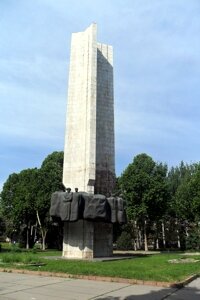
The Friendship Monument
One of my favourite monuments in Bishkek is located just off Prospect Chui, between the White House and Ala Too Square: the Friendship Monument.
On the Northern side of Prospect Chui – opposite the marble clad facade of Ilbirs sewing factory, (just how many capital cities in the world can claim to have a factory have a factory, not just in the heart of the city, but flanking the main square?), there is a row of flagpoles, which are decorated with multicoloured flags for holidays and festivals.
Behind them there is a tree lined sidewalk, which forms the southern flank of Friendship Square- the monument being the centerpiece of the square.
Trees surround the square on three sides – the Northern edge has steps leading down to Pushkin Street which now seems to serve as a car park for staff working at the White House.
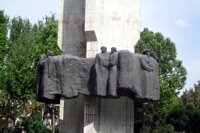
The ring of figures representing the nationalities of Kyrgyzstan living in peace and harmony
The monument is a marble tiled obelisk with three flanges and a ring of figures cast in copper suspended above the base, representing Russian and Kyrgyz mothers and the family of nationalities resident in Kyrgyzstan – living in peace and harmony.
Designed by the noted monumental artist Sadykov, it was constructed in 1974 as part of a programme to develop a modern city center, which saw the erection of grandiose marble clad buildings such as the White House, the Historical and Museum of Fine Arts, the National Library … and, of course, the “disguising” of the Ilbirs factory.
The square was inaugurated in a ceremony attended by Alexei Kosygin, Leonid Brezhnev and other dignitaries who planted the trees around the square. Originally, each one had a name plate saying who had planted each tree – but they have long since disappeared.
One of the attractions of the monument is the enigma concerning it’s origins. I have seen three different suggestions as to what the monument was commissioned to commemorate – all of which seem feasible, but none of which seem to quite fit the bill. Was it to commemorate …:
- the 50th anniversary of the establishment of the Kyrgyz Republic? … however, although the Kara-Kyrgyz Autonomous Region of the Russian Soviet Federative Socialist Republic, (RSFSR), was established in October 1924, it wasn’t a republic … in 1925 it was designated as an oblast in a reorganization and only became a republic in February 1926.
- the 50th anniversary of the USSR? … however, the Union of Socialist Soviet Republics was created in December 1922 when a conference of delegations from Russia, the Transcaucasian SFSR, the Ukraine and Belarus approved the “Treaty of Creation of the USSR”.
- the 100th anniversary of the Kyrgyz “voluntarily” joining the Russian Empire? … however, this is generally assumed to have taken place in 1876 when Moscow annexed the Kokand Khanate.
Whatever, it is a striking monument; simple and plain yet modern and symbolic.





 Bishkek
I came across this in the official sites in the Kyrgyz Republic which are considered to be of specific Historical or Cultural importance, and which come under state protection:
So, I suppose that answers that particular point.