Airan, Kefir and Chalap
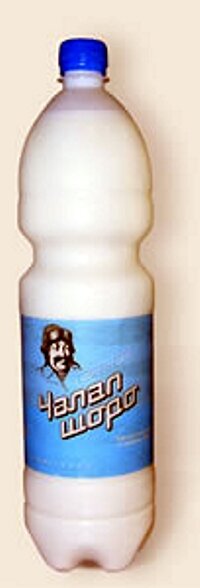
Chalap Shoro
A short while ago I was on my way up to Naryn and, after an early morning start, we decided to stop off en-route for a bite of breakfast and a cup of tea. I looked at the menu and surprised everyone, having seen that Airan was listed, and asked if they had any available.
I quite like Airan as a drink and although “drinking yogurt” was making an appearance in the shops back in the UK just before I came out here almost eighteen years ago, I can’t say that I was really very familiar with it.
Occasionally I might have had a glass of Kefir in a Greek or Turkish restaurant, but it was only when I first came to Naryn that I was really introduced to these two beverages.
I confess that, for a while, used to get confused about the differences between the two … both being milk based soft drinks but I have come to appreciate them – not just for breakfast, but also as a refreshing drink on a hot day.
Airan is a drink made from yogurt, (a thick yogurt is preferred), mixed with water, (and sometimes salt). It seems to be a Turkic beverage and Turkey is still the world’s greatest producer where it is a standard “soft drink” offered to guests and a familiar item on the menu at many cafés and “fast food” establishments. It can be served with any meal and is refreshing on its own.
Airan is also popular here in Kyrgyzstan, (the Kyrgyz, being one of the Turkic peoples and with a number of Turkish restaurants and cafés throughout the country – especially here in Bishkek).
It can be made by simply blending the ingredients, or by adding a flavouring such as mint and/or garlic.
Chalap is a Kyrgyz version of Airan – yogurt, water (especially, these days, carbonated water), and salt mixed together. Here in Bishkek it is manufactured, marketed and sold from large vats on the street by special vendors working for the Maksym Shoro company, (as well as being available in plastic bottles in shops and supermarkets).
Kefir is a very old drink that is thought to have originated with nomadic shepherds in the Caucasus Mountains. It is made from fermented milk, (cow’s milk, cheep milk or goat’s milk can all be used) and grains (called “kefir grains”), which look a little like cauliflower florets and contain yeast and other compounds.
The origin of this bacterial culture that are usually referred to as “kefir grains” is shrouded in mystery. It seems that attempts to create them artificially have been unsuccessful and, according to one source: “There is a legend among the Islamic people living on the northern slopes of the Caucasus Mountains that Mohammed gave kefir grains to Orthodox Christians, thereby teaching them to make kefir. Called the “Grains of the Prophet,” they were jealously guarded by their owners, as they believed the grains would lose their potency if the secret of their use became common knowledge. Thus, kefir grains were secretly passed from one generation to the next, closely guarded as part of the wealth of each family within the tribe, and although foreigners were sometimes given kefir to drink—Marco Polo recounts tasting kefir in the book of his eastern travels—the method of making kefir was kept secret and the drink was all but forgotten until the 19th century.”
That particular article goes into more detail of the history of how the Russians sought, discovered and then exploited the “magical grains” … .
The grains are seeded by some taken from an existing stock and added to the liquid, (… as part of the fermentation process, more grains are produced, some of which will be removed to seed the next batch for fermentation … ), which is then covered and stirred several times during the day. Because the liquid expands as part of the fermentation process which produces carbon dioxide gas, it is important that sufficient room is left in the container for this this expansion to take place.
As with Kumys, traditionally kefir was made in special bags made out of animal skins and allowed to ferment at room temperatures, (if the temperature is too cold the fermentation process stops and if it is too hot – say over 40° – then this can kill the bacteria in the culture) and these would be placed near to the doorway so that whenever someone passed by they would knock, prod or push it in order to help ensure that the milk and the kefir grains were well and truly mixed as the fementation took place. The fermentation process normally lasts a day, (for example, the mix is left overnight and consumed the next day), and although it can still be safely consumed at any time over the next 30 days – the longer it is left, the more sour it becomes.
When the liquid is ready for serving, it is passed through a sieve to remove the grains.
Commercial production of Kefir may involve a two stage fermentation process – the second one after the grains have been removed and additional milk has been added – and is usually pasteurized … and may have been flavoured in the same way as yogurt often is..
Apart from being a refreshing drink, it also has claims made for it as a health food – aiding in digestion of lactose and “cleaning the digestive tract”, helping reduce blood pressure and possibly regulating cholesterol and blood sugar levels, aiding the immune system and being useful in the treatment of ulcers, tuberculosis, eczema, depression and anxiety and a variety of other ailments …
It is also said that kefir is a very effective “hangover cure” … personally, I am not sure about that, but I do have to admit that when it has been suggested as an alternative to the more traditional “hair of the dog” … it does seem to have worked!



 Bishkek