Deer
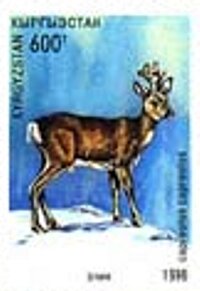
Kyrgyz stamp depicting a Red Deer
It’s amazing what you can learn from the internet. Apparently, “There are now more deer in the UK than at any time since the last Ice Age. The population is currently estimated at around 1.5 million.”
That took me by surprise when I saw it. It raised lots of questions in my mind. I wondered, for example, how the population figures were determined … and, anyway, many of them were “in the wild” and how many were being farmed for venison?
As it happens, in English the word “deer” originally had a very broad in meaning and referred to a wild animal of any kind, (as opposed to “cattle” which referred to domestic livestock). It was only around 1500 that the modern identification with members of the Cervidae family of ruminant mammals came about.
Deer are widely distributed, with indigenous representatives in all continents except Antarctica and Australia, (although, apparently, there’s only one form of native deer in Africa). The Eurasian continent, (which, of course, includes Kyrgyzstan), boasts the most species of deer in the world.
There are two species of deer that are currently found in Kyrgyzstan:
The Maral, or Red Deer: Although they are also sometimes called Red Deer, their colour often varies. Young animals have white spots in their fur, (some adults also have white spots) and in the summer their coat is lighter than in winter. They usually have a white patch on the chest.
These animals live in woods and neighbouring bush land, but in the past also adapted to life on the steppes and meadows – and apart from the very high mountainous regions – that’s just about everywhere in Kyrgyzstan.
Consequently, about 150 years ago they were found throughout the territory of the republic and their presence is recognised in several place names, names of rivers and other natural boundaries – such as Urmaral. Today, however, they are found mainly in the special reserve in the Naryn region – where there are 300 animals. Some individuals have been spotted in the Eastern part of Issyk Kul – where there seem to have crossed over the border from neighbouring Kazakhstan.
Unfortunately they are very vulnerable to poachers. Some scholars suggest that the true situation concerning the fate of the Maral Deer is complicated by the fact that similar species have also been introduced from the Caucasus.
The main difference between the native and introduced species can be seen in the male of the species. The male deer can be quite large and they grow large antlers – shedding them annually and growing new ones. The antlers of local deer pointed upwards and to the side, whereas the antlers of the introduced species form a small crown at the extremities in mature males. For example: in the 1960s a small number of animals were released into the Sary Chelek area – and numbers increased – but then hunting depleted them once more and the species has virtually disappeared from the region. The only sign that there are still some specimens alive is the occasional discovery of discarded antlers.
The Central Asian Red Deer, (Cervus wallichii), is one of the species that have been farmed over the centuries by the Chinese, Mongol and Turkic peoples for their antlers.
The Eastern Roe Deer, (Capreolus pygargus): The Eastern Roe Deer is the smallest of the deer found in the Tien Shan, it grows to about 125cm tall. The fur is a bright rusty red in summer and dark brown in winter. It sports a large white flash on its chest, large antlers, (up to 50 centimeters long with three tines, or prongs), but no tail. Young deer have a row of white spots along their flanks, but they disappear when the animal matures.
They live in the mountain steppes regions, (areas covered with bushes, not very steep sloes and generally snow free), at altitudes between 900 and 2500 meters. The mountain meadows are usually rich in verdant herbs which provide ample feed. They are also found in some of the river valleys where there are reeds and other vegetation flanking the river banks.
Herds of Eastern Roe Deer are found throughout Northern and Central Kyrgyzstan: along the Kyrgyz Range, from Eastern Issyk Kul, Chon Kemin, Jumgal, Chichkan and Suusamyr.
There are something like 500 hunting licenses issued for them each year but it is also a heavily poached species but, despite this, it is estimated that the population in Kyrgyzstan has remained stable over the last 50 years with something like 7500 animals.
For the record: In addition, two species of deer were introduced in the past but have not survived:
The Sika Deer, (Cervus nippon), which originate from Japan and the Far East of Asia and were introduced into the wlnut forests of the Chatkal range and around the village of Arkit in 1957. Unfortunately, they fell prey to predators and within a year all the specimens were killed.
The Fallow Deer (Dama Dama), which were introduced into the forests surrounding Sary Chelek in 1962 and prefer open land, often grazing in fields and using forests for cover. Lynx wolves and poachers have meant that an early increase in numbers was reversed and it is now thought that there are no more specimens in the country.
Deer also hold an important place in traditional Kyrgyz culture, appearing in several legends and epics, such as that of Kojojash the Hunter.
The Kyrgyz are just one of a wide variety of Turkic nations. Like most Turkic nations, there are legends by which the Kyrgyz trace their ancestry to a totem animal.
The Turkic peoples actually have a single totem – the wolf – and a wolf’s head was an emblem which was often embroidered on their flags. There is a legend that tells how, in a bloody battle, the entire Hunnu tribe were annihilated – save for the youngest son of the tribal leader. His enemies cut off his arms and legs and threw him into a marsh – presumably thinking that was an end of him and his people. A wolf, however, found the child and tended to him … fed him and cared for him. They became husband and wife and had ten sons. The youngest was called Ashina – and he became the ancestor of the Turkic Khans. His brothers had names like Kypchak, Kyrgyz, Tartar and became the ancestors of these separate Turkic nations.
The Deer and the Elk are the animal totems for two of the Kyrgyz tribes, the Bagu and Sarybagysh.
I wrote a postcard about the legend of the origin the Bagu tribe, here is the one about the origins of the Sarybagysh, (the “tribe of the Elk”, Bagysh is the Kyrgyz word for “Elk”), which tells of a hunter who lived near Naryn.
After his wife died, he lived together with his four year old daughter. One day, when he was hunting in the Alamyshyk Mountains, he trapped an Elk which had recently given birth to a cub and so had a ready supply of fresh milk. He gave some of the milk to his young daughter – and before long the elk was feeding the girl as she would had fed her own offspring.
Another man, Tagay Bai, lied in the Issyk Kul region. He had two sons: Orozbek and Dolozbek. Orozbek was already the father of three children. One day he was visiting the region on a hunting expedition when he saw an elk apparently feeding a young girl. Scared by what he saw he shot the animal – and the distraught girl began to cry … loudly. Orozbek took the elk as a trophy and left the region for home, taking the girl with him, where she lived with him and his family.
Some years later, she married Orozbek’s nephew, the son of his younger brother, Dolozbek.
Recalling the circumstance of how they first encountered her, her new family referred to her as the ”the Elk’s Daughter”. That’s how the Sarybagysh got their name – which, when translated means “yellow elk”.


 Bishkek