The Family Frunze
The article in Slovo Kyrgyzstan (In Russian) about the Frunze family
Sunday marked the anniversary of Mikhail Vasilievich Frunze in 1885 and yesterday was the anniversary of the renaming the city of Frunze as Bishkek. Both of would have been natural choices for a postcard, but I have already written about the famous Red Army General, (uhh … twice actually), the change of name and, for that matter, about Frunze Street in Bishkek and so I had almost decided to let these two anniversaries pass.
I did consider, however, writing about the Frunze Museum … but then I came across a newspaper article which had some fascinating additional information about the General’s family, and I thought it was worth sharing it.
Most of the guide and history books tell us about Mikhail’s father, Vasily Mikailovich, a Moldavian Doctor’s assistant. Although his family came from Moldovia, Vasiliy himself was born in Kiev, in the Ukraine, the son of a peasant family. He graduated from Madical school in Moscow and joined the army – being sent to Turkestan as this region was then called. He liked it here and decided to settle here after completing his military service.
The family of Mikhail’s mother, Maura Efimovna Bochkaraeva, moved to Voronezh in Semirechiye, (the Seven Rivers area), and it was here that she met and married Vasily. By all accounts she was an intelligent and strong willed woman, who played the guitar and sang beautifully – inspiring a love of music in her family.
Together they had five children; three girls (Claudia, Ludmila and Lydia), and two boys, (Constantine and “Misha”).
Both parents tried to make that their children received a good education. Apparently, however, Vasily was not popular with the authorities because he was friendly with various groups in the local population; Uzbeks, Uighurs, Dungans and Kazakhs), and after a run in he dismissed from his job. He got another in Syrdarya region and after a short while there, died a few years later, (in 1897 – when Mikhail was only 12).
That left the family without a breadwinner and Efimovna wrote asking to the school authorities in Vernenskiy, where the boys were studying, asking for assistance. The request was accepted and approved and she received a grant 120 rubles for Misha … on the condition that he progressed from class to class each year. He obviouslyt did because he graduated from high school in 1904 and enrolled as a student of Economics at the Polytechnic. After three years of study, he began his career as a revolutionary.
His brother, Kostya, also studied at school, receiving remedial tuition, as well as a place to board. The tuition obviously helped because he graduated from high school with a “gold medal”, and was admitted to the University in Kazan – in Tatarstan. After graduation he returned to Pishkek where he worked as a country doctor, serving in the military, (participating in the Russian Japanese war), and as a specialist in Forensic medicine … eventually retiring in 1940 and moving with his family back to Moscow, an honoured Doctor of the Tajik SSR, and hero of Socialist Labour.
His sister Claudia also graduated from high school – and was also awarded a “gold medal”. She worked as a nurse and after marriage accompanied her husband to Italy until he returned to Moscow to continue his studies.
After graduating from school, Ludmila enrolled at the St. Petersburg Medical University before returning to Pishpek to work as a therapist. She alsoalso worked in other parts of Kyrgyzstan. She married but after her husband diued she lived with her in-laws, with her children, in China where she worked in a Russian office before returning to Moscow in the 1930s and continued to live there for the rest of her life. During the Second World War she served as a Colonel in the Medical Corps.
Lydia was the youngest in the family and was born after her father’s death in 1897. She graduated from the Voronezh Academy and married married the geologist Alexei Nadezhdin.
Meanwhile, Mikhail had met and married Sophia Popov in Chita. Sophia’s family had been exiled from Russia and after attending school in Irkurtsk she worked as a teacher in an elementary school. She enrolled in the HIstorical Philology department of a private University in Moscow, but dropping out because of her links to elements in Tomsk, never completed her course. Instead she travelled to Chita where she met the young Mikhail and they were married in 1917. Together they had two children: Tatiana and Timur.
After the death of the parents the two children were brought by their grandmother, Efimovna, but she too died soon afterwards. The children were adopted by Clement Voroshilov.
Timur graduated from the Kachin Military Flight School and in August 1941 he and Voroshin traveled to Samara. Timur died in action in heavy fighting on the Old Russ front on January 9th, 1941 and was awarded the title Hero of the Soviet Union.
In Moscow there are still some surviving relatives of the Red Army General: Cousins, a niece, three grandchildren and three Great-grandchildren.





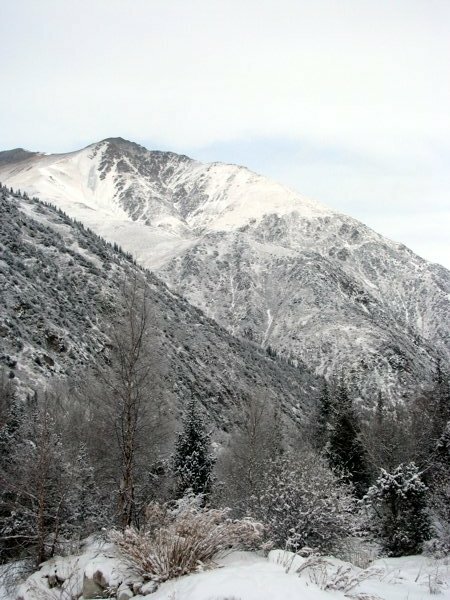

 Bishkek