Ulitsa Frunze
Frunze Street runs East-to-West, from Lermontov street on the Eastern outskirts of the city to the Ala Archa cemetery (just after Molodaya Gvardia) in the West.
- Until 1927 (one source says 1924!) the street was known as Sudeiskaya (Judicial Street),
- then it was named Frunze Street after the Civil War General: Mikhail Vasilievich Frunze, who was born in the city.
It extends East to West through the northern central district of the city from the Alamedin river to the Ala Archa cemetery. In places it is narrow, tree lined, and in other a wide major thoroughfare. Along it you will see
- private housing, (both small “chastniy dom” and large apartment blocks),
- institutes of higher education (such as the State University and the Bishkek Business College),
- Museums and the National Library,
- Ministries, the parliament and other official buildings,
- shops,
- places of entertainment (the Circus, bowling alley, restaurants, sports stadium),
- hotels,
- parks, and
- a cemetery.
|
East |
|||||
|
North – Away from the Mountains |
South – Towards the Mountains |
||||
| Dostuk Hotel. | |||||
|
Sultan Ibraimova Street |
|||||
|
The Naryn Restaurant – housing a couple of nightclubs and a casino. |
Victory Square (Ploshad Pobeda): on the site of the former Central Bazaar and containing theVictory War Memorial, completed in 1984, the 40th anniversary of the victory over Nazi Germany in the second world war (the Great Patriotic War). A woman, (a mother/a wife), stands over the eternal flame, waiting for her son/husband who will never return home from the war, standing under a tynduk in the form of a funeral wreath (one of the symbols of the nation) held aloft by three ribs of red granite representing a yurt. The image is a wistful reflection on the great cost of victory. It is not unusual to see parties of newlyweds stop here to lay flowers in remembrance. | ||||
|
Sultan Ibraimova Street |
|||||
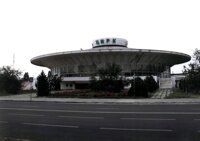
The Circus The round building is The Circus. Sometimes, local acts perform here – but it also plays host to a number of visiting troupes from China and other CIS countries. It stands on the site of the the building in which the first meeting of the Supreme Soviet of the Kyrgyz SSR was held. |
The building on the corner is the Central Apteka (Chemist/drugstore.) | ||||
|
Sovietskaya |
|||||
| On the corner of Sovietskaya and Frunze is the National Librarywhich has over the years since it was founded in 1934 it has become one of the major repositories of culture in the country. It moved into its present home on Sovietskaya in 1984 – to mark its 50th anniversary. The library collects copies of all literature published in the country, as well as a variety of publications from other CIS countries and further afield. There are a total of over 6 million documents, (books, magazines, newspapers, sheet music, records, patent and other reference documents and some 97000 Doctoral dissertations, private papers of several prominent people) in 89 languages – including a copy of the first book ever to be printed in Russian – “Apostol” which was printed in Moscow in 1564. The library adds some 120 thousand items every year. Interestingly, there are books in Kyrgyz written in Arabic, Latin and Cyrillic scripts – reflecting the various changes that have taken place in the transformation from an oral, nomadic tradition. It also houses a number of exhibitions and conferences every year. The blue spruce trees in front of the building were planted by visiting writers and artists including: Arthur Miller, James Baldwin and Peter Ustinov. In the small park area behind the National Library, hidden amongst the trees is the statue of Dzerzhinsky. It bears no name or inscription. At one time this stood on a plinth in Oak Park, at the foot of the upper part of Prospect Erkindik. At that time the Avenue was also named Dzerzhinsky. His statue replaced that of Lenin when that was moved into the main square – and was in turn replaced by the monument to Erkindik. Rather than lose the statue, it was relocated here. As a young boy he shot his sister – but in some accounts it was his brother that was responsible for the girl’s death. He was a religious youth and even entertained the idea of joining the Jesuits. However, he then took an interest in social justice and so became involved in revolutionary politics and became one of the leaders of the Socialist parties of Poland and Lithuania. Active in the 1905 revolution, he organized strikes and worked amongst the military. Later he was arrested and imprisoned several times – and contracted tuberculosis. He was active once more in the 1917 revolutions and later in the Polish Communist Party. However, Dzerzhinsky is probably best remembered as the founder of the NKVD – the forerunner of the KGB. | The building on the corner of Sovietskaya and Frunze was one of the few buildings in the capital in which it was possible to see Kyrgyz writing in the Latin script. The inscription was over the door on the corner – but is now hidden behind a yellow name sign. The inscription belongs to the time when this was a Savings Bank. For many older people this Bank is associated with bad memories. Apparently, because of rumours that the Nazis had forged lots of banknotes Stalin ordered a currency reform. People brought bags of money to the bank – and lost it all. |
||||
|
Tynystanova Street |
|||||
| The building of the Ministry of the Interior. | |||||
|
Prospect Erkindik |
|||||
| Building of the Ministry of Finance and the Economy Central Police Station of the Pervomaiskiy Rayon (district). |

Frunze Museum The Frunze Museum – The museum traces the life and career of Mikhail Frunze – and what is supposed to be the house in which he was born and brought up is preserved on the ground floor (although there is some doubt whether this is the right house – it is typical of the period) – and there is an exhibition of the achievements of the city and Kirgizia during the Soviet period.
|
||||
|
Razzakova Stre |
|||||
| The Park Hotel is just down Orozbekov Street – opposite the Consul Restaurant and San Fidelo Night Club |
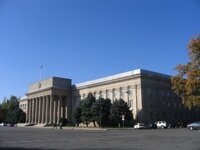
The Jogorku Kenesh (Parliament) Government House: Until recently, this used to be the home of the Jogoku Kenesh (Parliament). Originally built in 1936 it served as the Government House until 1984 when the White House on Prospect Chui was built. In 1964, it underwent a considerable renovation following a visit by the then General Secretary, Nikita Khrushchev, who declared that the building was in a bad state of repair and did not a suitable building to house the government of one of the republics of the Soviet Union. It has undergone further renovation also in recent years. Following the 2010 revolution, the Government offices returned to their former home and the Parliament was rehoused in the White House. |
||||
|
Orozbekova Street |
|||||
| The National Archives building. The archives have about half a million documents. At the far end of the building, down Oruzbekova is the Consul Restaurant and San Fidelo Night Club. There is a white statue of Lenin in the Hallway. The building also houses the Engineering Academy and the Bishkek State Prosecutor’s Office.The International School of Business and Management | |||||
|
Panfilov Street |
|||||
| The Children’s and Youth Sports School of Martial Arts and Acrobatics | Panfilov Park – once called Red Star Park because of the pattern made by its network of pathways, but renamed in honour of the war hero whose statue can be found at the Eastern end of the park. The park is filled with amusement rides for children and a small ferris wheel. | ||||
| Continuation of Logvinenko Street | |||||
| The former building of the National Olympic Committee - now the Japanese EmbassyThe ground floor of the apartment block on the corner of Frunze and Togolok Moldo houses the local ZAKS – the Registry Office – where weddings are sometimes officiated. | The Spartak Stadium- the main sports arena in the city and can accommodate 23000 spectators. It is used to host not only sporting events, such as football, athletics and even American Football, but also festivals, dog shows and pop concerts. The Turnstiles are rarely used. The building on the corner houses the offices of the State Agency for Sport and Physical Culture. The complex also houses a gymnasium and boxing hall in which many local sportsmen train. | ||||
|
Togolok Moldo |
|||||
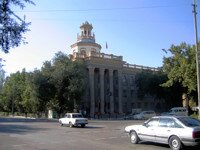
Bishkek University of Business and Economics The building on the corner on the corner of Togolok Moldo and Frunze is the Bishkek State University of Business and Economics. |
The building on the corner houses the State Statistical Office of the Kyrgyz Republic. |
||||
| Koenkozeva Street – The Silk Road Lodge | |||||
|
Isanova |
|||||
|
Prospect Manas |
|||||
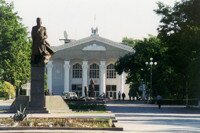
The Kyrgyz State National University Building of the Kyrgyz State National University (at the time of the Great Patriotic War (WWII) this served as a Hotel) Outside the main entrance is a statue of Djusup Balasugin – the 11th century philosopher and poet born in the city of Balasugin (where the Burana Tower now stands) and is featured on the 1000 som banknote. |
Boulevard to the Philharmonia and the building in the distance if the Bishkek Marie (Town Hall) on Prospect Chui. | ||||
|
Turusbekova Street |
|||||
|
Chevshenko Street |
|||||
| Umetalieva Street | |||||
|
Kalyka Akieva Street |
|||||
|
Molodaya Gvardia |
|||||
| The building behind the block of flats was built as a kindergarten but now serving as the Tax Offices of the Leninskiy Rayon (District) | |||||
| Ala Archa Cemetry: Somewhat overgrown, the cemetery has some significant graves – including two Prime Ministers of Independent Kyrgyzstan who died in Office (Nasirdin Isanov – 1991 – and Jumabek Ibraimov – 2000). The grounds were set aside to serve as a Muslim cemetery before the Revolution and the largest number of graves are of Kyrgyz people, although there are some Jews and Uighurs buried here as well. Russians are not buried here – they have other cemeteries. Amongst the other notable personages buried here include Sayakbai Karaliev (the poet and manaschi who is featured on the 500 som note) – under a big stone monument along the northern east-west avenue. | |||||
|
West |
|||||




 Bishkek