M. V. Frunze
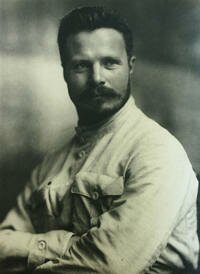
Mikhail Vasilievich FRUNZE is renowned as the Red Army General who “subdued” Central Asia
Mikhail Vasilievich Frunze was supposedly born in Bishkek – which was then called Pishpek – in 1885. “Supposedly”, because there are some suggestions that he might have actually be born in Belevodsk – a little to the West of the city. The reasoning behind this suggestion is that is where his birth was registered by his parents.
(The register actually records his surname as Fronze … not Frunze … but apart from this apparently isolated occurrence, throughout his life he was known by the generally recognised variant.)
His father was a Moldavian doctor’s assistant.
After finishing at Pishpek City School, he attended “grammar” school in the city of Pravda – where he was awarded a Gold Medal. In 1904 he became a student in the Economics faculty at the Petersburg Polytechnical Institute where he was active in politics amongst student and workers’ groups.
He spent a tempestuous time as a student in Moscow. He became involved in Revolutionary politics and was an important leader in the 1905 Revolution, leading striking textile workers in Shuya and Ivanovo. Following the disastrous defeat of the revolution by the Tsarist forces, Frunze was arrested and sentenced to death (twice!). He was later reprieved and his sentence commuted to life with hard labour. After ten years in Siberian camps, he escaped to Chita, (a city in Eastern Sibera), where he became editor of the Bolshevik weekly newspaper called Vostochnoe Obozrenie, (=Eastern Review).
During the February Revolution of 1917, Frunze was head of the Minsk civilian militia before being elected president of the Byelorussian Soviet. He later went to Moscow and led an armed force of workers to aid in the struggle for control of the city and commanded the Red Guards, which occupied the Kremlin in October 1917.
He was a major player in the civil war, responsible for directing the defeat of the White Russian Army under Admiral Kolchak in Siberia and for routing another army commanded by General Wrangle in the Caucasus Mountains – retaking the Crimea for the Bolsheviks and puching Wrangle’s army out of Russia. He was also instrumental in the destruction of Nestor Makhno’s anarchist movement in Ukraine after Makhno refused to merge with the Red Army.
In September 1918 he was dispatched to Tashkent in an armoured train to head a “Turkic Commission” along with another general, (General Kuibyshev), to prevent a counter-revolution; to purge the “elite”, re-educate the masses and introduce the industrialisation of the region. He then led the Bolshevik forces which took Khiva (meeting virtually no resistance) and Bukhara (after a four day fight) in 1920, and then pushed the Basmachi rebels out of Ferghana valley. During the early days of the Russian Civil War, Frunze was appointed as head of the Southern Army Group. After defeating Admiral Aleksandr Kolchak and the White Army in Omsk, Leon Trotsky (the head of the Red Army) gave total command of the Eastern Front to him. Frunze went on to rid his native Turkestan of White troops.
In 1921 Frunze was elected to the Central Committee and in January, 1925, became the Chairman of the Revolutionary Military Council, replacing Trotsky as War Commissar and was responsible for introducing a system of conscription requiring compulsory peacetime military service and moulding the Red Army into a formidable fighting force and revolutionary tool.
After Lenin’s death, he was a strong supporter of Grigory Zinoviev, Frunze came into conflict with Josef Stalin. He survived several mysterious car accidents and eventually died, supposedly due to a “chloroform overdose”, on 31 October, 1925, during a stomach operation (at the order of the Politburo !), and it is believed by some that Stalin arranged his death.
He was buried in the Kremlin Wall Necropolis.
The authorities in his hometown wanted to do honour to the city’s most famous and illustrious son, and so they decided to rename the city after him. Following the fashion of the times they passed a resolution adopting the name Frunzegrad, like Leningrad and Stalingrad. Apparently, Stalin was not too pleased by this show of affection for a popular hero. Lenin was already dead and had been the great Revolutionary Leader, and Stalin … he may have still been living but he was the leader of leader of the nation and the “father of the people”. Mikhail Vasilievitch, on the other hand, was only a general. After a short period, the “grad” was dropped from the ending of the name.
Frunze was the author of several books and articles on modern, 20th century, tactics which were required reading for officer cadets during the Soviet period.
His home town was renamed Frunze in his honour. (The name was changed to Bishkek in 1991.) There is a statue of him standing outside Moscow, a metro station named in his honour in Moscow and one of the leading Soviet Military academies was named after him.
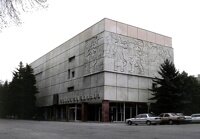
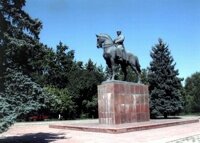
The Frunze Museum (on Frunze Street) preserves many artefacts related to the general’s life and times, including what is said to be the house in which he was born … although many people say that the wrong house was preserved. Even so, the house is probably typical of the sort of dwelling in which Russian settlers of the period lived – and the thatched roof is probably the only good example left in the city of what was at that time the universal roofing, although the house at 145 Moskovskaya is also typical of the wooden log houses built by early settlers – and is now in private ownership and has been renovated. There is a statue of M. V. Frunze on horseback facing the railway station at the top of Prospekt Erkindik.





 Bishkek