Ala Too Square
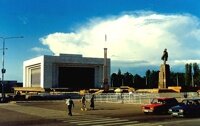
Yesterday afternoon, I walked back to the office from a meeting in the Hyatt. Of course, I could have got a taxi, but the sun was shining, it was warm and I felt that it would be nice to take a stroll through the city centre.
I walked past the Opera and Ballet theatre, along the side of the Museum of Fine Arts and cut through Oak Park to the main Ala Too Square, which was teeming with life. They had turned the fountains on and I was sorely tempted to settle down and take out a book and read a chapter, or two. On the other hand, I knew that there was work waiting for me … and at least two more meetings … so after a brief stop to look around and soak up tthe atmosphere, I made me way back to my office and my computer
It occurred to me that it might be an idea to pass on a little information about Bishkek’s main square … so here goes:
Ala Too Square used to be called Lenin Square and it marked the centre of the capital – at least for ceremonial, formalities, parades and the like.
For several years a statue of Lenin (which was erected in 1984) stood on the plinth in front of the Historical Museum in the center of the square … and following Independence, Bishkek was the only one of the Central Asian Republics where he still presided over the central square in the capital city. Then in 2002 it was decided to replace him with the statue of Erkindik – which means “”Freedom” in Kyrgyz - as a symbol of the new times.
Underneath the square is apparently a “secret” complex of rooms connected to the White House by a long underground corridor. Apparently it hasn’t been used since before independence – there are still portraits of members of the politburo of the Soviet Union including Andropov and Brezhnev and apparently a lot of dust everywhere.
The square is nearly always busy which people passing through, photographers and Karaoke machines. It really comes into its own, however, on holidays or festivals. Large gatherings of people are common for prayers at Nooruz (March 20th), at New Year or on Independence Day, when parades take place in front of the podium and fireworks light up the night sky, or for concerts on the stage erected at the southern end of the square.
Pictures from the square were broadcast all over the world in March 2005, as a mass demonstrations was held here, which led to the Tulip Revolution – when President Askar Akaev fled from the White House. It, once again, became the centerpiece of news coverage from the republic in November 2006 when another popular demonstration led to the adoption of a new constitution.
The square was renovated in 2009, with new musical fountains, a flower clock, some statues and a new flagpole.
| East (towards Sovietskaya) |
South “Vierk” – Up Towards the mountains |
West (towards the Main Ala Too Square) |
|
To the South, in the distance at the far end of the square is the building forming an Arch which is the Ministry of Agriculture and Water Resources.
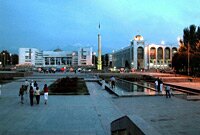
In the South Western Corner is the burnt out shell of the General Prosecutors Office which was destroyed during the revolution of April 7th, 2010.
|
||
| Kievskaya | ||
|
The square is surrounded by a magnificent marble edifice – which is exactly just that … when the square was being laid, the marble was placed on the exterior of the existing building - a clothing factory – to make it fit into its new magnificent surroundings. The porticos on the Eastern and Western flanks of the square offer a cool shady walkway between Kievskaya and Prospect Chui.The Square has a stage at the Southern end which is used for open-air concerts.
Along the length of the square, either side of Prospect Chui, are photographers who will take your picture – but you need to return the next day to collect them. |
||
| Prospect Chui | ||
To the East, the old two storey building topped with a dome is Dom Druzhba (“Friendship House). Built by the Czech Interhelpa Group in the 19302, it was the first Government House. There is a story of a nomad visiting the city from his high mountain pastures (Jailoo) who went back and told all his family and acquaintances what a wonderful city it was – with such tall building that if you bent over backwards looking upwards – with the top of your head on the ground behind you – then you still could not see the top of the building – it was this building he was describing. When the second Government house (currently the parliament) was built – this became the Historical Museum.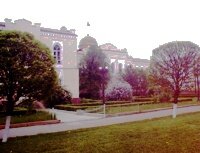
Further to the East is an open-air Art gallery. |
Erkindik – The Kyrgyz “Statue of Liberty” – was unveiled in 1999 to commemorate the eighth year of independence, this represents a Kyrgyz woman holding a flame ringed tynduk, and replaced a statue of Derzhinsky (founder of the Cheka – the forerunner of the KGB) further East at the foot of Prospect Erkindik.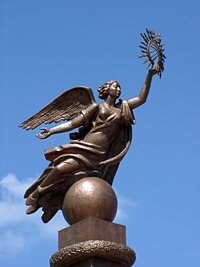
(Lenin was moved to the center of the Old Square which lies behind the Historical Museum. Instead of pointing symbolically towards the future … or, as say people prefer towards the mountains, he now points at the American University of Central Asia.)
|
To the West of Erkindik is the Official State Flagpole – built in 1998. The guard is changed every day, on the hour, from 07:00 till 18:00. Do not try going into the fenced off area – unless you want to be arrested – the sentries are not there as models for you to pose with for photographs, even if this is common practice elsewhere in the world. ”
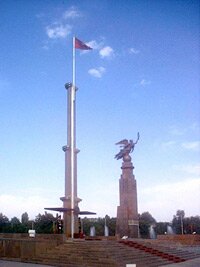
This is a photo of the original flagpole. In 2009 a new flagpole was erected to hold a new, flag which measures 30 square meters. |
Behind Dom Druzhba is Oak Park. There is a roadway to the West, which contains The Alley of Statesmen with busts of some important statesmen including several who also have streets named after them in Bishkek:
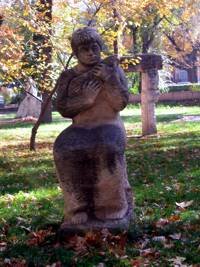
Oak Park began as a grove of Oaks planted by Alexei Fetisov in 1890 and home to the Russian Drama Theatre, The Memorial to the Red Guards and the Open Air Museum of Sculpture.
|
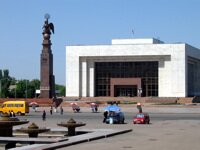
The large “marble Cube” standing behind the Erkindik Monument is the Historical Museum. The Museum was founded in 1925 in the building which was supposed to be the boyhood home of Mikhail Frunze – now preserved in the Frunze Museum – and accepted its first visitors in March the next year. It used to be called the Lenin Museum – and some older residents still refer to it as such. The ground floor houses temporary exhibits but the permanent exhibits depict natural and political history of the country and the Soviet heritage. There is a statue of Lenin leading the revolutionary masses a ceiling painting of a wedding party attended by the melting pot of the nationalities of the Soviet Union. The historical museum began life in 1926 in the “boyhood home” of Mikhail Frunze now preserved in the Frunze Museum – in 1937 it was transferred to what is now the Friendship building before moving to it’s present home in the 1980’s.
|
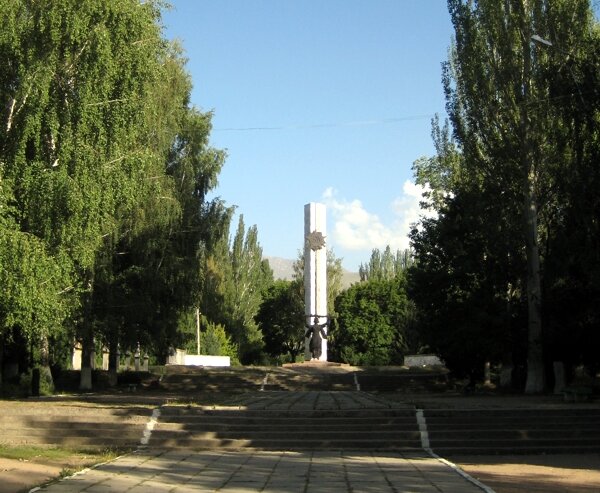
Further East are the Friendship Monument (The Monument to the Friendship of Peoples, or Druzhba) – erected to commemorate the 100th anniversary of the Assumption of Kyrgyzstan into the Russian Empire – erected in 1978. There are two stories about the origin of the monument. Some say that the square was inaugurated by Kosygin in 1974 to mark the 50th anniversary of the USSR and others that it was to mark the 100th anniversary of the Kyrgyz “voluntarily” joining the Russian Empire. The trees were all planted by dignitaries, including Kosygin and Brezhnev, but the plaques which recoded their names have long since disappeared.
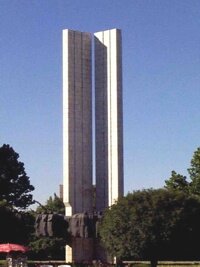
Beyond this is the White House – or Government House built in 1984. 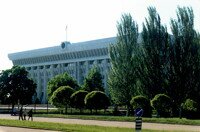
|
| North “Vneez” – Down Away from the Mountains |
||




 Bishkek