Myortvoye Ozero – Kyrgyzstan’s Dead Sea
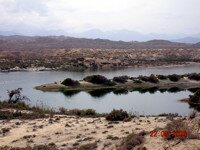
Myortvoye Ozero
I got “hi-jacked” this last weekend, on my monthly trip up to Naryn. There was nothing sinister about it, but we ended up doing something that was not in the plan.
These trips to Naryn, apart from being work – the regular check on how things are going up at the guesthouse – they are a definite break in the usual routine. There’s a six hour journey either way, when I either read one of the half dozen or so books that I have on the go at any one time, or listen to podcasts on my MP3 player. Often, we also like to take time out to visit interesting new places en-route, if there is time.
Although this wasn’t a particular busy month; it wasn’t the end of the quarter with lots of financial and statistical reports to finalise and submit to the authorities, we didn’t have anything else planned … or, least I didn’t … the others, however, seemed to have everything planned. It seems I was the victim of a conspiracy.
As it happens, there were five of this month: Me; Tatiana – my accountant; Salijan – the driver and two guests – Elena and Sultan. Once we arrived, over dinner we got chatting about how we might make it a more interesting trip and take a detaour somewhere. It turned out that one of our company had never been to Son Kul, two had never been to Tash Rabat and four of us had never been to Myortvoye Ozera – Kyrgyzstan’s Dead Sea.
Tash Rabat was in the wrong direction anyway, and Son Kul would probably have made a very long day, but as most of us had never been to Myortvoye Ozero … that option won the day. Now, Tatiana has been nagging me for months about visiting it, and she was the only one of us who had already been there. I pointed out that I saw one problem … we hadn’t planned on it, so no-one had the swimming togs with them – but it turned out that I was the only without a costume … the others had all packed them.
So the decision was made … Myortvoye Ozero it was to be and the next morning, after a hearty breakfast, off we set.
We drove up over the Dolon Pass and down to Kochkor, past the Orto Tokoi Reservoir and then took the turning towards the southern shores of Lake Issyk Kul. For most of the way, the road which runs around the southern shore of Lake Issyk Kul hugs the coast quite closely. About 30km from Balykchy, however, if veers inland and at Bokonbaeva swings back northwards, towards the shoreline.
About halfway along this stretch, just after the village of Kara Koo, there is a turnoff towards the lake, alongside the river Ak Terek. It is not a good road – it is not asphalt and so is neither “fast” nor comfortable. It took us half an hour to travel the 13km – a very bumpy 13km – from the main road to the lake. Lake Kara Kol, (Black Lake), to give it its proper name, (but it is more commonly known as Salornoye Ozera - “Salty Lake” as well as ”Myortvoye Ozero” ).
Once we had descended a dry gulch, one side of the “road”, (lets be generous), was a dry sandy hillside sporting just dried out grasses or shrubs, but the other side, (nearer the river), was surprisingly and fertile with grasses, trees, corn and even an apple orchard. We passed what appeared to be a sort of cillage pond, without a village – although there were scattered farmsteads, and although we asked Tatiana if that was it … she shook her head and pointed further up the road. Then we saw a much larger lake, but no, that wasn’t it either. That was Lake Issyk Kul itself. Eventually we came to a small settlement with four permanent buildings, a host of yurts offering food and accommodation and a shlagbaum … a barrier. To go further meant paying a fee.
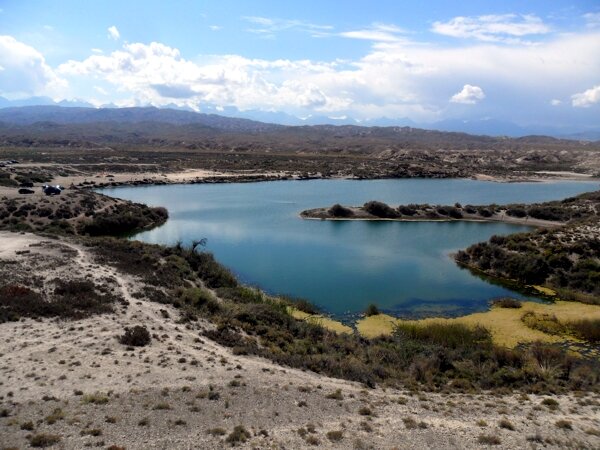
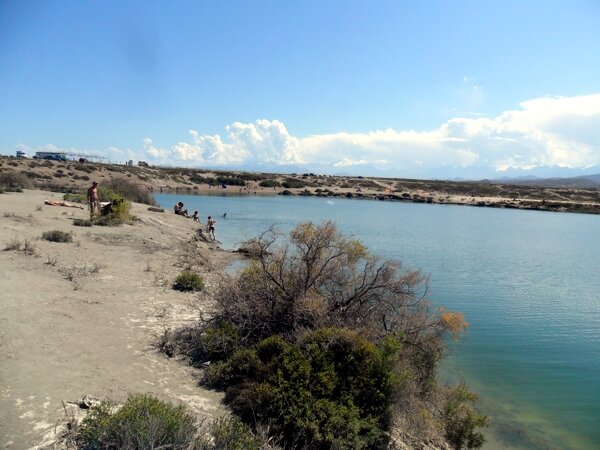
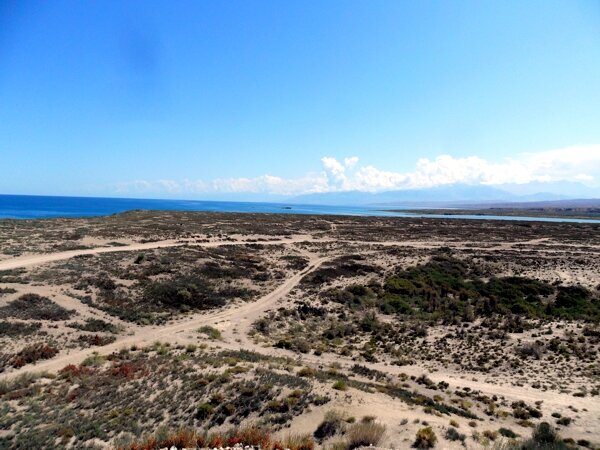
It lies in a hollow, cut off from Issyk Kul by small hills – dusty, rocky, outcrops covered by shrubs. Standing on these hills you can look one way and see Lake Issyk Kul, turn and face the other direction and there before you lay the Salty Lake.
Issyk Kul derives its name, (“Warm Lake”), from the fact that it never freezes over and one of the reasons for this is that it is a salt water lake. Although there are over 80 streams and rivers feeding water into the lake, there is no outflow, and evaporation leaves a higher concentration of mineral salts in the water that remains – lowering the freezing point. The Dead Sea in Israel is also a “salt lake” – with no outlet, but the concentration of mineral salts is such that there are other side effects … perhaps the most famous of which is that increases the buoyancy of the waters so that it is possible for a person to simply float on the waters.
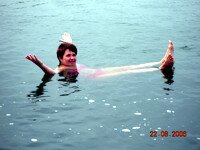
A "swimmer" lying on the surface
Myortvoye Ozero has the same feature. The minerals within the water support the weight of a person lying on the surface. As I stood on the shore of the lake, some new arrivals descended to join me and said, “It’s our first time here” … I didn’t tell them it was mine too, but then they asked, “This is the salt lake?”, and I could safely answer, ”Yes”. ”Is it true that you cannot sink in it?” In answer to that I said “Yes,” and pointed out to one of the swimmers in the middle of the small lake who was lying on the lake surface, arms and legs akimbo.
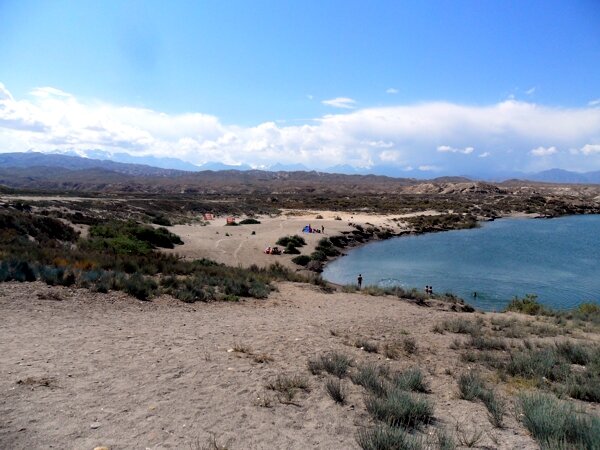
The lake is surrounded on three sides by small beaches and in the summer there can be quite a few people on the beach – swimming in the lake and coating themselves with black mud which is said to be therapeutic. Some of the local people even claim that drinking the waters is healthy – but I wouldn’t recommend this, I certainly didn’t try.
What I did do was go for a walk. I am not that keen on swimming and the lack of a swimming costume was not a great handicap for me. I was happy walking along the hills, halfway around the lake, round the reed beds at one end of the lake, looking at the berries, (black, red and golden orange in colour), and saw several fast moving lizards running from bush to bush in order to take advantage of the little shaded that was on offer from the heat of the midday sun.
Here are some photos from our visit:













 Bishkek