Beshkempir – The adopted son
Beshkempir, (known in the West as “The Adopted Son”), a film by Aktan Abdikalikov and was made in 1988. It was his first feature film and has been hailed as “a worldwide success”.
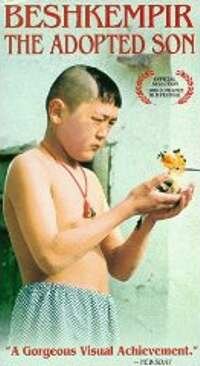
This “Coming of Age” film is one of a sequence of three by Abdikalikov which have autobiographical elements. It offers slowly unfolding drama in which the central character, Beshkempir, (played by the director’s son Mirlan), undergoes an identity crisis at the age of 13 when he learns that he is adopted. Confused about his status and identity, Beshkempir must find his place in the world and make that painful transition from childhood to adulthood.
In the opening scene, an infant boy is given to a childless couple to adopt. He is given the name Beshkempir, which is Kyrgyz for “five grandmothers” - a name sometimes given to adopted children to signify the role played by a council of old women of the village, deciding where a child from one family may be bestowed on another which is infertile.
Against a backdrop of daily village life which doesn’t seem to have changed for thousands of years, (people making bricks from mud and straw, winnowing grain in the wind, pruning fruit trees, hand-spinning thread, sewing, making reed mats, fishing, drying balls of manure for fuel … drinking vodka), Beshkempir is shown growing up like all boys. His chief motivation is ”fun”: he plays with his friends and is scolded by his stern father for playing when he should be working. The friends wrestle in the mud, taunt a hive of bees, steal chicken eggs, sneak into a neighbour’s yard to stare a naked woman treat herself with leeches, sculpt a female form in the sand and rehearsing sex with it – just the sorts of things adolescent boys will do. Sometimes, a young man with a bicycle enlists Beshkempir’s help in courting a village girl. He helps a friend, (a movie projectionist), court a girl. He nearly misses out on a trip to an outdoor film showing because he’s afraid to ask his father for money; his tender-hearted grandmother gives it to him instead. The crowd of villagers watches what is obviously an Indian musical, complete with a belly-dancing heroine.
Beshkempir is attracted to a girl named Ainura, but when he tries to flirt with her, another jealous boy picks a fight. an orphan. The other boy, who has received a few blows in a fight, suddenly blurts out, “You’re an orphan and a foundling!” When he asks his grandmother, she denies it, insisting that he is of her blood line and telling him that his name was given to him “to ward off the evil eye”. But the feud between the two friends worsens and the other boy’s mother, a malicious gossip, reveals all in front of Beshkempir: he is not his parents’ natural child. His stern father hits him for having creating this embarrassing situation. “Hit me instead,” his wife says.
Now he understands why his mother was so cold with him, and why his father so distant.
The distraught boy runs away and joins some fishermen, only returning upon the news of his grandmother’s serious illness. In fact she dies before he gets home, and her funeral is the occasion for reconciliation. His father tells him simply, “You were adopted. We couldn’t have any children.” Beshkempir and his friend embrace and are reconciled.
The men of the village gather together for the funeral … according to Turkic tradition, only men can bury the body. Before they can do so, an appointed relative has to settle the earthly affairs of the deceased and Beshkempir gets to pronounce his grandmother’s testament to the assembled village: “If she had any debts, I will pay them; if anyone was in debt to her, I void it.”
In the end, he borrows the projectionist’s bicycle and begins courting Ainura.
Filmed in the Kyrgyz village called Bar-Boulak, it is mainly in black and white with some colour sequences which are used to highlight feminine sensitivities. There is little music in the film, (it is only used in key scenes), instead natural sounds, (birds, wind, etc.), are used to give a sense of the expansive environment.
There are autobiographical elements within the film. When an interviewer asked Abdikalikov, the film’s director if the tradition depicted in the film, by which a large family offers a newborn to a childless couple, had any special significance for him. “Indeed,” he said, “that is what happened to me. I was adopted. It may be a good custom, but it is very shocking when you learn as a teenager that you were adopted.”
The film has been shown at a number of Festivals and won almost 30 awards, including:
- The Silver Leopard Prize at the Locarno Film Festival in Switzerland, 1998
- The Don Quixote Prize at the International Association of Cinema Clubs
- The Grand Prize at the Eurasia Film Festival in Kazakhstan, 1998
- The Viewer’s Choice Award and the Jury’s Choice Award at the Vienna Film Festival in Austria, 1998
- The Asian Films Jury Award at the Tokyo Film Festival in Japan, 1999
- The Grand Prize and the Students Choice Award at the Kottobus in Germany, 1999
- The Prize of the Swiss Cinema Laboratory for Technical Excellence, 1999
- The Viewer’s Choice Award and the Prize of the French Producers’ Association at the Anjou Film Festival in France, 1999
- The Jury Award for Artistic Contribution at the Buenos Aires Film Festival in Argentina, 1999
- The Silver Film Can Award and the FIPRESSI Award at the Singapore Film Festival, 1999





 Bishkek