Malvern
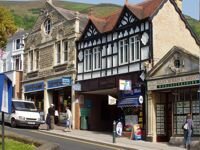
Church Street, Great Malvern
Malvern, where I grew up, was a small town with a population of about 30,000, (which would be a sizeable city in Kyrgyzstan), but it was originally a number of villages, (Great Malvern, Malvern Link, North Malvern, West Malvern, Little Malvern, Malvern Wells and a number with names that don’t contain the name “Malvern” like Colwall, and Barnards Green), which grew up around the Malvern Hills.
To us, growing up in Malvern, it was a small town. I am a “Small Town Boy”! Small enough to go out on a Saturday morning an guarantee running into friends even if you hadn’t made any specific arrangements to do so. Everyone seemed to know everyone else. My father in particular, being a postman, seemed to know everyone – and everyone seemed to know him. At least, if he didn’t know someone then he could find out about them by asking one of his colleagues. All my friends, especially girlfriends, went to under a close scrutiny – not all them passing muster and receiving approval.
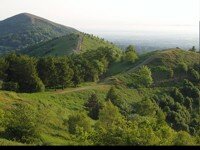
The Malvern Hills
The most obvious landmark in the town are the Malvern Hills. They stretch for about 10 miles North to South and rise majestically from the plain of the Severn River to the West, and to the East there are undulating hills as Herefordshire extends towards the Welsh Mountains. The hills meant that to go anywhere in Malvern meant having to climb, (what seemed to me at the time), steep inclines and it was a real disincentive to ride a bike anywhere – although it is true that “what goes up must come down” and so so strenuous pedaling would be alternated with coasting downhill (at dangerously increasing speeds … I crashed and wrote off two cycles this way!) To this day I still don’t really understand the motivation of Mountain Bikers who thrill at climbing to the passes of the Tien Shan, Pamir and Karakorum ranges.
When I first met Tony, from New Zealand, he upset me (well, slightly offended me), by saying that England was basically flat. How could he say that to someone from Malvern, graced as we were with the glorious hills? Standing on the top of the Worcestershire Beacon in the center of the range, there is no higher spot to the East until you get to the Urals separating Europe from Asia! Now, having been to New Zealand – and, of course, Kyrgyzstan – I understand. In England we don’t really have mountains … OK – technically they may be mountains … because they are over a certain height, but I now realize that we are probably “making mountains out of molehills”.
Hey, it is possible to drive a car to the top of Ben Nevis, Britain’s highest peak – there are photographs in the pubs of Fort William, at the foot of the “mountain”, to prove it. Try that on Peak Pobeda!
(Apparently the actual figure for defining a mountain changes according to the context -I was told in Geography lessons that it was 1000 feet, or about 300m … in Kyrgyzstan they don’t consider anything to be mountainous unless it is over 1500m, which is about 93% of the country!).
Like most places in Britain, Malvern has a long history. In fact, the name, itself, probably dates back to ancient times and is derived from a word which meant “Bare-Hill”, (apparently, in Welsh, “Moelfryn” has a similar meaning: “bald hill”).
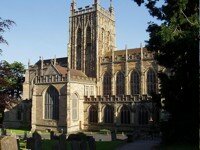
Malvern Priory
Malvern was the site of a Benedictine monastery, which, after the hills is probably the second best known landmark in the town. The Priory was established in 1085. It is said that Saint Wulfstan, who was the Bishop of Worcester at the time, encouraged a hermit named Aldwyn to found a monastery in what was then the wilderness of Malvern Chase. The Priory was built for thirty monks on land belonging to Westminster Abbey. The current church, however, is the result of more recent renovations which date from about 1470. The great square central tower is very similar to that of the nearby Gloucester Cathedral; it was built by the same masons. The church has a fine collection of stained glass windows which ranges from medieval to modern. One was a gift from Henry VIII in 1501, and another from the Duke of Gloucester, who later became Richard III. It was saved from destruction in the “dissolution of the monasteries” under Henry VIII because the locals bought it to serve as their parish church because their existing church was in a bad state of decay. The bought it for the grand sum of twenty pounds.
(One of the few things I brought with me to Kyrgyzstan as a memento of home was a Victorian Print of the Abbey Gateway)
Malvern is a famous spa, known for its bottled water since 1622 – it is now bottled by Schweppes out of their factory on the Western side of the hills. There are a number of natural springs and a Victorian rhyme claimed that Malvern water was so pure that it owed its fame to the fact that it contained “nothing at all”. Believe it or not, even here in Kyrgyzstan – where we lots of Mineral waters of our own – I sometimes find a bottle on a shop shelf or in a bar.
One of the Annual events which take place in the lee of the hills – and something we always used to look forward to – is The Three Counties Show – an agricultural fair.
Malvern is home to several famous public schools, the most notable being Malvern College and Malvern Girls College (now renamed Malvern St. James after its merger with another local school). Amongst the famous alluminii are: Jeremy Paxman, Denholm Elliott, Barbara Cartland and Aleister Crowley.
Not exactly an industrial town, Malvern is however the home of one of the world’s longest existing private car factories, The Morgan Motor Car which makes traditional sports cars which over the years have become a ‘cult’ vehicle, and are exported all over the world.
During the Second World War, Malvern was the location to which the UK government was to be evacuated, (at least part of it), in case of invasion or emergency. During this time, it also became the home of Telecommunications Research Establishment, (TRE), renowned for its role in the history of radar. It has been said that World War II was won on the playing fields of Malvern, home of the cavity magnetron – whatever that is. The site of TRE still exists in Malvern, but due to shifts in scientific focus, its name has undergone several changes including RRE (Royal Radar Establishment), RSRE (Royal Signals and Radar Establishment), DRA (Defence Research Agency) and DERA (Defence Evaluation and Research Agency) … but I knew it as, and will always remember it as RRE. Apparently, although part of it has been privatized, it and is still the major source of employment in the town, and has spawned a number of smaller light engineering companies in the neighbourhood.
Amongst the other various claims to fame that the town owns:
- According to legend, the British chieftain Caractacus took his last stand against the Romans on what is now called the Herefordshire Beacon in the Malvern Hills but, although there are fortifications on the hill from the period, this has been disputed in more recent times.
- The beginning of the medieval poem “Piers Plowman”, by Langland, (one of the earliest pieces of English literature), is set on the Malvern hillside.
- Cardinal Wolsey, (Henry VIII’s Chancellor) had his first posting in the lee of the hills.
- Charles Darwin’s daughter Anne is buried in the graveyard of Malvern Priory.
- Peter Mark Roget (creator of Roget’s Thesaurus) is buried in the graveyard of St James, West Malvern.
- British composer Edward Elgar taught in Great Malvern and much of his work was influenced by the Malvern Hills. Elgar is buried at St. Wulstan’s, Little Malvern.
- C. S. Lewis, was a pupil at Malvern College. It is said that he and J. R. R. Tolkien used to walk on the Malvern Hills. There is a story that once, when walking home one winter evening after having had a drink in one of the local pubs, it started to snow. They saw a lamp post shining out through the snow and Lewis turned to his friends and said “that would make a very nice opening line to a book”. It may not have been the opening line, but he did use the image in his book “The Lion, the Witch and the Wardrobe”, as the characters enter the realm of Narnia.
- It is sometimes claimed that Haile Selassie, the Emperor of Ethiopia, spent some of his exile here, in the Abbey Hotel – but if he did, I didn’t know anything about it.
So this is the environment I grew up in during the 1950′s and 60′s: a small urban English town, steeped, (albeit lightly) in culture, history and tradition … not exactly rural and not really a city … but having a sense of its own importance, status and it’s place in the world.
Photos from Wikipedia:



