A meeting with the President

It was rush hour as we made our way from my office to the Ministry of Education for the first meeting of the Advisory Council of the new European School.
Traffic was heavy. At first, I thought that the traffic lights didn’t seem to be working at the crossroads as the traffic was blocked by vehicles that had tried to get across and been forced to a standstill as they straddled the carriageway blocking the on the oncoming traffic. Fortunately, we were turning right and our path was clear. I saw a traffic policeman in the center of the centre of the crossroads trying to make order out of the chaos and felt sorry for him. ”He had better get that sorted out quickly or he’ll be for the high jump”, I thought. You see, I knew who was about to come down that street in a few minutes time.
Sultan, my driver, noticed that there were a lot of traffic police posted along the side of the road. I began to worry if I had left enough time for the short journey and if I was going to be late. Sultan, with creditable self-assurance must have sensed my concern because made a point of telling me not to worry. “They won’t stop me,” he said, because I haven’t broken any of the traffic regulations.” Both he and I know, however, that this doesn’t really mean anything. If the GAI want to stop you, they will … and it can then become a bit of a trial of strength between the inspector standing on his dignity and the aggrieved driver standing on his rights.
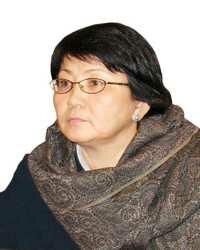
As we drew close to the Ministry, I said he had better drop me off “on the corner”. “No,” he protested, “no problem. I’ll take you to the door.” When we got to the corner, however, he saw that he couldn’t fulfill that promise. There were yet more police and the road was blocked off with a barrier. “It looks as if they are expecting someone important,” he muttered. I quietly responded with, “Yes, they are. Madame President.”
His demeanour changed in an instant. “You’re going to a meeting with Roza Otunbaeva?”, he asked incredulously. “Yes.” I replied. “Well, peredai privyet!”, he said, “Say hello from me”.
I pointed out that I didn’t think that would be possible … I may well be in a meeting with the President, but there would also be about “a hundred odd” other people present.
I made my way through the security … others were being turned away by the burly security guards and told to come back later. My name, however, was on the list. Once that had been checked off I was given the once over by a metal detector, and that caused a bit of a delay because although I had taken out my mobile phone, camera, pen and so on … I had missed a few coins. Life was so much easier when Kyrgyzstan didn’t have coins.
Anyway, after I had located the odd coins deep in my pockets, I was eventually allowed through the checkpoint and up to the conference room, where I had to get my name ticked off yet another list. This time, however, there were no metal detectors and I was ushered into the hall to take my allocated seat.
I was wrong … well, almost. There weren’t a hundred of us, just about thirty, but the gathered press corps well and truly outnumbered those of us who were supposed to participating in the event.
We needn’t have worried about me being late, either. As is usual, here, things didn’t start on time. I hesitate the meeting started late – after all, back in Britain we have a saying that the Queen is never late, and I suppose it is the same with the President here. It’s just that preparations take place but the event, itself, doesn’t get underway until she has taken her place.
Once she had sat down, the formalities could begin.
This was a meeting of the Advisory Council for the newly established European School that I wrote a postcard about a few weeks ago. A number of parents have decided to set up a new school, teaching mainly in English, which will follow the internationally recognized European International Baccalaureate, (IB), system.
After the initial open remarks by the Chairman of the Advisory Council, there was a presentation by the Chairman of the Supervisory Board.
In it, he pointed out that they have already come a long way in just a few months, registering the school, obtaining a license, setting up an initial management board, parents’ association and advisory council drawn from representatives of the diplomatic corps in Bishkek and representatives of Business. That’s why I was there. I had been invited as a member of the IBC, (International Business Council), with a background in Education.
They’ve also appointed the main staff: a Principal, some of the teaching staff and an Executive Director who will manage the project. They are all experienced and Kimberley Jones, the newly appointed Principal, has experience and a strong record of working in schools in this part of the world, including setting up and developing new schools.
The staff will take up their posts in June, ready to open up a “summer school” in July before term starts in earnest later in the year.
Apparently, there are already some students provisionally registered. Well, that’s a not a big surprise, after all the whole idea was the initiative of a group of parents who were looking for a European style school for their children. What was a pleasant surprise to me was that they seem to have been able to attract a reasonable number of additional pupils. It will cater for just primary school children to begin with but add at least one new year group over the next seven years so that it can cover the complete age range up to IB.
The one problem is that, as yet, they haven’t finally concluded a contract for the lease of suitable premises, although they have a number of alternatives under consideration. It is difficult to find the right balance between what’s available, affordable, in the right sort of location, with the right sort of rooms, space to expand, and facilities (outdoor) for the children to relax and play. The four alternatives all have their advantages, but also, unfortunately they also all have their disadvantages.
This could be an important point as new regulations governing private schools and educational institutions require that, if they don’t have their own buildings, then they should have at least a seven year lease on the buildings they occupy.
Amongst the other salient points that he drew out was the fact that although it’s a private school, it has been established as a non-commercial organization, as a charity. None of the founders will receive any benefit other than a quality education for their children and the knowledge that they actually doing something positive, something concrete to make a difference and were not sitting back, resting on their laurels. No dividends. No share of any profits. Indeed, any profits which might accrue would be ploughed back into the future development of the school.
He also stressed that he hoped that the presence of the school would help to make a difference in the rest of the Kyrgyz educational system. For example, by setting an example which other schools could take up and by helping to train staff in Child Centered Educational techniques.
They also hoped to establish a scholarship scheme whereby some places could be offered to children from less well-off families that could not afford the full fees.
Indeed, the cost of place in the school is expensive, and at least one press report on the meeting highlighted this, asking “How many parents in our country will be able to pay that money to provide decent education to their children?” – a good question, but it’s clear that there are some and there are also those who value their children’s education that they are prepared to pay substantial for a “private education”.
The report continued by referring to the provision in the constitution for education to be free, adding “Why annoy the vast majority of our fellow citizens, who argue that for many it is a difficult problem to just to get the kids to school, to buy them books and clothes.” Now, I am no great friend of “private education”. I spent all my teaching career in the state sector back in the UK, but I do appreciate that it is a matter of individual choice how to spend one’s disposable income.
That doesn’t mean that the government shouldn’t fulfil its obligations and provide “free” education, (it’s not “free”, by the way, someone pays for it – the taxpayer), or that is shouldn’t be the “best” that they can provide.
Whether the presence of “private schools” is equitable, or what effect they will have on the rest of the education sector in the country – both arguments with which we are familiar in the UK, are arguable. In a way it can be seen as parents buying “privilege” for their offspring not available to others, but if parents have sufficient disposable income and choose to spend it in providing a private education for their children, thus investing in their future, then … so be it. ”It’s a free world”, as they say.
What’s more, the presence of the school will not damage existing state schools by depriving them of them of resources. The parents will still be contributing to the state sector through their taxes. On the contrary, it is possible that it may help other schools by showcasing different possibilities.
There’s also the fact that the presence of such a school should help make the country a more appealing option when trying to attract foreigners, (investors, consultants, etc.), who do not want to leave their children in boarding schools in their home country but to bring them with them. One of the first things they do is search for suitable schools in the neighbourhood before deciding whether or not to relocate to a new country. The presence of such schools should help them to make that decision.
.
The floor was then turned over to the President for her remarks. She welcomed the initiative – but that was no surprise, after all she had accepted the invitation to attend, so it was obvious that she thought it was a positive development, that the creation of the European School in Central Asia was particularly timely.
Of course, as the head of state she also had to point out that there were already many schools in the country, some state owned and run, whilst others were privately owned and run. ”We have a good educational institutions,” she said, but … there were problems, “many of them do not allow children to continue their studies abroad. ” She pointed out that Kyrgyzstan urgently needed a reform of the education system, but noting that there were something like two thousand schools in the country, it is difficult to implement effective education reforms. This new school would help to broaden the range of educational opportunities in the country.
It was interesting to note that she took “head on” the issue of Kyrgyzstan’s poor position in the PISA survey, (the Program for International Student Assessment), when Kyrgyz school students have apparently performed badly. This is a worldwide evaluation of scholastic performance organized by the Organization of Economic Cooperation and Development, (OECD). The scheme assesses pupils in a variety of fields including Mathematics, Reading, Comprehension and Science. Kyrgyzstan students came in last place in 2010 – well somebody has to. All the same, it was the cause of considerable comment and anguish in the media when the report was published. The assessment is carried out once every three years and the previous time the ratings were published, (in 2006), Kyrgyzstan also came bottom of the table – in 57th place. In 2010, however, there were 65 countries in the survey and so the results seem even worse. The Ministry of Education, however, tried to put a positive spin on the publication of the results saying that even though Kyrgyzstan Students are holding up the rest of the table, there are signs of improvement in some areas and there were an awful lot of countries that did not take part in the Assessment.
She also referred to another OSCE survey, into Competitiveness in Central Asia, and made great play of the fact that there was a healthy competition in the field of education and that to be competitive it was necessary to invest, not just in traditional industry, (in manufacturing), but also to invest in people; that is, into education. She declared that investment in education was a priority for the government and thanked the “investors” for their investment in the future of the country.
.
Her speech was followed by, shorter, ones from the Minister of Education and the Ambassador of the European Union, echoing many of the points that had already been raised about education being an investment in people. By now the press corps was thinning out, many of the TV crews rushing off to prepare their clips for bulletins to be broadcast later the day. Many reporters, however, were still there and I could hear the keys on their laptops being tapped as they attentively made notes to be later whipped up into an article.
When it was time for Questions and Discussion, the room went silent. No-one had any questions, and that surprised me a little. Although it was a formal occasion; was, basically, a formality; the fact that we all knew the background and the presentation had been clear and precise, I was still a bit surprised that there hadn’t been at least a “planted” question. Still, the absence of any meant that we were able to recoup some of the time lost at the beginning of the proceedings and finish more or less on time.
We all stood as the President took her leave, exchanging courtesies with some people on the way, and then I and the others made my way out of the conference room. Some members of the press that had waited to the end swooped on members of the school for interviews, but I made my way out into the sultry mid morning heat and headed back to the office.
.


 Bishkek