Earth Hour
There is a tradition here to turn off lights when not in use. That’s all well and good, but it causes me a certain amount of concern.
Shortly after we had opened our hotel, the Silk Road Lodge in downtown Bishkek, I would often go to visit it in the evenings and was greeted by a place in darkness. There was often only one light burning in reception and the corridors on each floor were pitch black. It didn’t look welcoming and gave the impression that the place was closed.
I kept pointing out that although not all the lights had to be on at full power, but at least some had to be on. This was not only to show that we were open for business but also for health and safety reasons. People leaving their rooms in the evening needed to be able to find their way around without fumbling for light switches which may not be in a convenient spot compared to the location of their rooms.
Heaven forbid that a fire or earthquake happened at nighttime, when people would be in a panic and rush headlong for the nearest exit – in unfamiliar surroundings. The emergency lighting might be enough to indicate the direction, but the lighting, (assuming it survived whatever calamity had befallen us), would also be needed.
There is a problem in Bishkek that many lights tend not to be working. Street lights, lights in the open spaces around buildings, and these can lead to dangerous situations … such as missing a step and falling into a pot hole, or worse, being confronted by people up to “no good”, intentionally or otherwise.
As I said, all the lighting doesn’t have to all be on and at full power, but there has to be enough provided for health and safety.
The main reason given to me for the habit of turning off the lights seemed to be one of economy. No problem. It’s a balancing act of providing sufficient light to maintain health and safety, whilst at the same time economizing on power usage. There are ways of economizing, such as: have two, or more, circuit so that only one has be lit at any one time in order to provide sufficient illumination for finding your way around; use lower power bulbs; use low energy bulbs; use sensor operated lights, (around the office, for example, we have sensors which turn on lights when someone approaches the buildings).
Today, in particular, there is another, special, reason for turning off lights: Earth Hour happens today, between 20:30 and 21:30 local time.
Earth Hour is a global event held annually on the last Saturday of March. Households and businesses are asked to turn off their non-essential lights for one hour to raise awareness towards the need to take action on climate change.
(Note: “non-essential” lights … that raises the interesting question about what is “essential” which I suppose everyone has to answer for themselves).
Earth Hour was conceived by The World Wildlife Fund for Nature, (WWF), and The Sydney Morning Herald in 2007, when 2.2 million residents of Sydney participated. Following Sydney’s lead, many other cities around the world adopted the event in 2008. Each year since then the event has grown in scale and impact. This year there is a special campaign, “I will if you will” aimed at trying to take the campaign further than the symbolic action of turning the lights off for just one hour, and encouraging participants to adopt other actions to support sustainability.
I am not sure what support the campaign will have here in Kyrgyzstan although I have seen some tweets and posts connected with it. One of them, in an attempt at humour, suggested that Kyrgyzstan was “showing off”; the rest of the world switched off the lights for just one hour, but most of the country has been experiencing much longer power outages as a result of “over consumption” and system breakdowns.
A report out this week which painted a desolate picture of the bleak midwinter we have experienced, when the “frosty winds made moan” and snow fell, “snow on snow”. In fact the problem wasn’t felt just in the middle of winter – it actually began in October, (two months before Winter is officially considered to begin), when the temperature fell to minus 6 and the surge in demand for power caused 168 power outages. In one single day in November there were 500. In total, there were some 4000 during the winter season – that is, more than 30 a day. It was the worst year that we have experienced in recent times – even worse than the winter of 2008 which saw rolling power cuts across the country.
Normally the heating season ends on April Fools’ Day, and the central heating system in the cities are turned off. In fact, they turned ours off a couple of days early, on Thursday. This has made us a little anxious because, although the sun is shining and it’s quite warm at the moment, (so warm in fact that someone actually made a comment the Vesnya ne budet (There’ll be no Spring), we’ve jumped straight into summer, the forecast for the immediate future is for below normal temperatures for this time of year.
Having been caught out this year, the various energy producers, (electric, gas, central heating, coal, petrol …), have started making plans for next winter. We have to applaud their foresight, but the bill looks immense – some thirty four million Euros just to replace the aging electricity cables … which will, in turn, undoubtedly mean more disruption while the work is carried out.
This bleak news all came in the same week that Kumtor, (one of the biggest and highest gold mines in the world and the mainstay of the economy accounting for over 90% of the country’s gold production, 12% of the GDP and considerable tax revenues), announced an expected fall in production – “slashing” its output forecast by about a third according to one report and well over a third in another. This is due to “ice movement in the pit” according to Centerra, the Canadian parent company, and any repeat of the 10-day industrial action which occurred earlier this year when protesters interrupted fuel and other supplies to the mine by blocking roads, could also jeopardise production figures. The situation could also raise questions about future development of the site. That could bode bad news for the Kyrgyz economy in the future, indeed there are reports about some officials being alarmed at the prospect, but it presented an immediate problem for Centerra, who saw their shares plunging 15%.
If the prospect of Labour disputes is worrying for Kumtor, the government seem to have backed down on a confrontation with the Trade Unions over the adoption of a new Labour Code to govern Employment Issues. I mentioned last week that there were protests about the introduction of a new draft law, and although there are reports that this draft has now been dropped, (“scrapped” according to one commentary), but it seems to me that it has simply been delayed in that the period for consultations has been extended and all comments from the trade unions will be taken into account. Apparently, the Minister of the Economy is reported to have said: “If workers have any suggestions, we will accept them.” Although I am now a “businessman”, in a former times I was a trade union representative, and even I found that an amazing statement,
At least those protests seem to have done their job … raised the public profile of the issue and encouraged debate without breaking out in disorder and mayhem.
The events in the south, (Osh and Djalal Abad), in 2010 when chaos and violence broke out and not just disorder and mayhem, is back in the news. One report at the beginning of the week concentrated on the effects felt amongst the children who lived through the events. Although the physical damage done in the violent rioting is being repaired, the psychological impact may take much longer to tackle, partly because it’s not as visible or obvious and partly due to the lack of resources. It quoted examples of children scared to return to school, stammering and other stress related symptoms. At least there seems to some help on this front as, recently, there have been reports of aid given by the international community to address this shortcoming.
The International Crisis Group, (ICG), also issued a report on the aftermath of the violence and warns of “Widening ethnic divisions” in the South as the government in the North has failed to calm ethnic tensions. It says that the Uzbek community is increasingly withdrawing into itself and a “superficial quiet” has descended on the region. Likewise, it says, the views amongst the ethnic Kyrgyz in the South have hardened. Like all their reports, it is packed with interesting and thought provoking insights and ends up with a range of practical recommendations to both the Kyrgyz Government and the international community.
If that sounds depressing, (and it depressed me for a while), then it has to be contrasted with another survey published this week that reported that people in Kyrgyzstan identified themselves by Citizenship (82.6%), family, (67.2%), gender, (47%), ethnicity, (32%), and religion, (19.3%). I was really surprised by this – whereas I drew some comfort by the low percentages for religion and ethnicity, (because they can be divisive), I was surprised that gender scored less than half, (surely that’s one of the first things we identify ourselves as – Male or Female), and I was amazed that Citizenship came out top. I can’t say that it fits in with my experience … many people say to me, “I am not Kyrgyz, I am Russian”, or Ukrainian … or whatever and I usually reply “if you have a Kyrgyz passport then you are Kyrgyz … you may not be ethnically Kyrgyz, but you are Kyrgyz all the same … and this is your home.”
Those who know me and my background as a Maths teacher will, probably, not be surprised by my fascination and distrust of statistics. An interesting case came up during the week which I think will illustrate one reason why. Ironically, on the anniversary of Ireland being the first country to ban smoking in all public places, (including bars and restaurants), back in 2004, it was reported that District Governors had lied about the levels of tobacco production in order to curry favour with the government. According to reports submitted to the National Statistics Committee over 9000 tons of tobacco was harvested in 2011, but only 4000 tons were purchased. Even more amazing, there was only one buyer who was prepared to purchase up to 14000 tons and had to go to Tajikistan in order to make up the shortfall.
I think that I have to be a little more sympathetic when it comes to statistics about tourism – or at least some of them. I am somewhat amazed at the suggestion that two and half million tourists visiting Kyrgyzstan last year, but I think the Minister for the Economy and Anti Monopoly Policy gave the game away when he quoted this statistic in his speech to the parliament, Having given the global figure, he went on to say that most of them, (93%), came from just four countries: Kazakhstan, Russia, Tajikistan and Uzbekistan. Actually, that sounds about right to me, although I have nothing more than a gut feeling to base this on. But … then he went on to say that “less than 100,000 tourists from non-CIS countries visited Kyrgyzstan in 2011, … Around 50,000 came within international agreements – to observe elections, to attend international forums, to visit diplomatic missions. Only 50,000 visited Kyrgyzstan as tourists”. So, I ask myself, how many of those approximately 2400000 visitors to Kyrgyzstan from CIS countries came to observe elections, attend conferences, visit diplomatic missions, as businessmen, as students, attend weddings and funerals, visit friends and relatives, … and how many came as tourists? Oh, I know that if they spend more than one night away from home and less than six months in the country, then they are, technically, tourists … but it seems clear to me that there are obvious grounds for confusion here.
Another interesting statistic to emerge this week was that the annual, year on year, rate of inflation in February stood at just 2.4%, compared to 19.4% last year. In fact, some food prices have actually fallen. But, then again, so have prices for alcoholic beverages and tobacco!
One of my favourite statistics stories of the week, however, had to be the Facebook post: “finally a graph with Kyrgyzstan among the top 5! unfortunately on military budget as % of GDP…” That 5% of GDP won’t amount to much, but quite what we do with it is not clear to me. I haven’t verified the data and it seems to be old, (2008), but it was interesting food for thought, especially as it came in a week when a mass fight broke out in “the bathhouse” at one of the country’s garrisons. According to the Defence Ministry, “about (!) 10 people suffered during the fight” and applied to the medical unit for treatment. An inquiry has been set up and prosecutions may follow when the facts have been established. I can see that as two of the kids are approaching the age for compulsory Military Service, this is an issue that may attract more than just a passing glance of my attention in the future,
Voting figures in the parliament may be more interesting in the future as the deputies have voted on a change to the procedural rules which would prohibit proxy voting for members who aren’t actually present.
That’s a lot, this week, about statistics and, as usual, I have missed out on many stories but, (another statistic), at 2342 words, I’ve exceeded my planned word limit yet again, so I’ll stop here for this week.
Postcard from Bishkek: the weekly postcard that I send out as an email also gets posted on the website ianbek.kg each week – and there are other postcards which don’t get sent out. This week, for example, there were postcards about:
- Askar Akaev – the country’s first president ousted in the Tulip Revolution of 2005
- Fortuna Jazz Club – my visit to the opening night of a new Jazz venue here in Bishkek.
- Gymnastic Cats – a postcard inspired by some recent news feline items
- Gorky Park – Bishkek’s park named after the giant of Soviet literature
- Visa Free Regime – the First Step – following the news that5 the Kazakhs are also thinking of adopting a visa free regime … what’s the next step in order to develop tourism in Kyrgyzstan?
- Suggested alternatives – about a marketing campaign in the UK trying to persuade Brits to take a “staycation”, (a holiday at home), suggesting alternatives in Britain for many tourist hotspots – in which I also suggest a few here in Kyrgyzstan
It is now possible to follow me on Facebook, (where I have specific pages for Celestial Mountains and ianbek … and also links.kg and Kyrgyz Diary), and on twitter, (@Bishkekpostcard and @celestialMTC ).
If you decide that you don’t want to receive these weekly postcards in your email anymore, please drop me a line to and I will take you off the distribution list. Alternatively, if you know someone who might be interested in being added to the mailing list, then get them to drop me a line and I’ll be happy to do so.


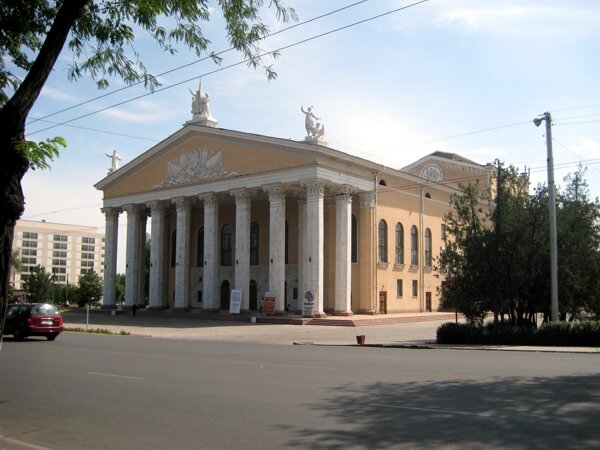


 Bishkek