An ABC of Bishkek
April 1st, 2012 Sections: At a glance, Bishkek
An “ABC” or “Alphabet book” is probably one of the first books that a person is ever given. Such books are designed to teach younger readers letters of the alphabet … often presenting each letter with words that start with that letter and/or images and sentences using the word.
A while ago I posted a postcard called “An ABC of Kyrgyzstan, here is a different one, an “ABC of Bishkek”. As in the previous postcard, I had to cheat a little with some of the letters … and I would love to here from anyone who has some better suggestions … but here it is.
| A is for: |
Ala Too Square - used to be called Lenin Square and it marks the center of the capital – at least for ceremonial, formalities, parades and the like. Underneath the square is apparently a “secret” complex of rooms connected to the White House by a long underground corridor. Apparently it hasn’t been used since before independence – there are still portraits of members of the politburo of the Soviet Union including Andropov and Brezhnev and apparently a lot of dust everywhere. The square is nearly always busy which people passing through, photographers and Karaoke machines. It really comes into its own, however, on holidays or festivals. Large gatherings of people are common for prayers at Nooruz (March 20th), at New Year or on Independence Day, when parades take place in front of the podium and fireworks light up the night sky, or for concerts on the stage erected at the southern end of the square.The square was renovated in 2009, with new musical fountains, a flower clock, some statues and a new flagpole. | 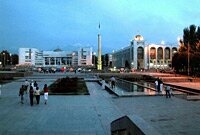 |
and also for:Ala Archa Alamedin Attaturk Park Aryk |
| B is for: |
Bazaars-There are a number of bazaars, (markets) in Bishkek. Most bazaars are open daily all through the week – but are busiest at weekends: Osh Bazaar is the biggest within the city limits – at the Western end of Kievskaya and stretching North upto Moskovskaya. It mainly sells food and produce – and is a crowded, lively place. A walk amongst the Fruit and Vegetable stalls is interesting – to see what is available (much of it is local produce), as is a visit to the Meat and Dairy halls, Behind the open air market are a number of market halls. Alamedin – at the junction of Almatinskaya and Jibek Jolu – this is smaller than Osh Bazaar and also sells mainly food produce – the main hall is covered – which can be an advantage in winter. Dordoi – also known as Tolchok – is located about 7km from the center of town. It is a huge area filled with containers, and narrow alleys of small stalls selling a wide range of goods (many imported) including clothes, (leather coats, shoes, track suits, shirts, …); household goods; toys; electrical goods … and so on. It is claimed that it is the largest market in Central Asia with 15000 traders, and other people working there. One estimate puts the turnover at over USD100 million(!). There are also a number of other local bazaars, (or mini bazaars) set up to meet the needs of a localized community. Some bazaars are more specialist – such as at “Comfort” – on Ibraimova (formerly Pravda) between Moskovskaya and Toktogula, which sells household and other related items (Ironmongery or hardware). | 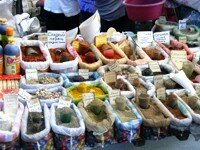 |
and also for:Bishkek Baitik Baatyr Banks Beta Stores Botanical Gardens Burana |
| C is for: |
Circus - In the former Soviet Union there was a network of state run Circuses – and the Khirghiz SSR was one of these, although it was established only in 1962, when a troupe was formed called “Molodaya Kyrgizia” – “Young Kyrgyzia”. Programmes were developed and performed over the years and, in particular, their performance at the special festival to mark the 50th anniversary of the October Revolution was highly praised. To encourage new talent a school was opened offering a special Two Year course providing training in subjects such as Acrobatics, Gymnastics, Choreography, Juggling and High-wire tightrope walking, (although it seems that clowns went further afiled to places like Moscow and Devyatkin to receive specialist training). In 1976, a new building was constructed to house the circus on Frunze Street in the centre of Bishkek. The arena had a striking circular design, resembling a “Big Top” circus tent and had capacity for seating over 1000 spectators. The building also provided other facilities such as a training hall, and offices as well as the main ring. | 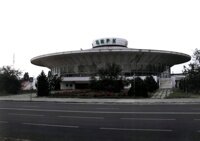 |
and also for:Capital Central Square Chon Tash Circus Corona Peak |
| D is for: |
Dom Druzhba – a two storey building topped with a dome is Dom Druzhba (“Friendship House). Built by the Czech Interhelpa Group in the 19302, it was the first Government House. There is a story of a nomad visiting the city from his high mountain pastures (Jailoo) who went back and told all his family and acquaintances what a wonderful city it was – with such tall building that if you bent over backwards looking upwards – with the top of your head on the ground behind you – then you still could not see the top of the building – it was this building he was describing. When the second Government house (currently the parliament) was built – this became the Historical Museum. | 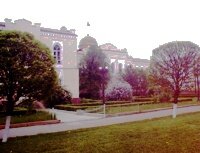 |
and also for:Dordoi |
| E is for: |
Erkindik – is Kyrgyz for “Freedom” and the Erkindik statue was often dubbed “The Kyrgyz ‘Statue of Liberty’”. It was unveiled in 1999 to commemorate the eighth year of independence, this represents a Kyrgyz woman holding a flame ringed tynduk, and replaced a statue of Derzhinsky (founder of the Cheka – the forerunner of the KGB) at the foot of Prospect Erkindik. It was later moved to the center of the main Ala Too Square until it was, in turn, replaced by the current statue of Manas. The statue is currently in storage. | 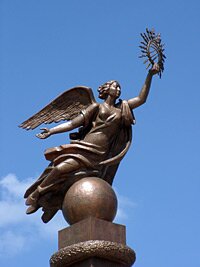 |
and also for:Embassies |
| F is for: |
Frunze - Mikhail Vasilievich FRUNZE was a renowned as the Red Army General who “subdued” Central Asia and after whom the city was renamed in 1926, (being renamed Bishkek in 1991). A revolutionary student, he was an important leader in the 1905 revolution and in 1917 commanded the Red Guards who seized the Kremlin in Moscow. There is also a Museum, (The Frunze Museum … on Frunze Street), which preserves many artifacts related to the general’s life and times, including what is said to be the house in which he was born … although many people say that the wrong house was preserved. There is also a statue of him, on horseback, facing the railway station at the top of Prospekt Erkindik. | 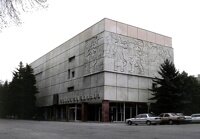 |
and also for:Fetisov Flagpole Fountains |
| G is for: |
Gvardia – The Avenue of the Young Guards, (Prospekt Molodaya Gvardia), is one of Bishkek’s main streets. It marks the course of one of the branches of the Ala Archa River – which was filled in by army engineers who also planted the trees and created the boulevard. Originally the street was known as Atbashinskaya Street, but in 1948 it was renamed in honour of the Komsomolets of Krasnodon as Molodoya Gvardia Street. Then, in 1960 it was reclassified as an Avenue (Prospect). Running from Leo Tolstoy Street in the South, under the railway and then North as far as Jibek Jolu, it is a broad, tree lined dual carriageway. The trees and shrubs from the railway down to Kievskaya were planted in 1940 and the rest were planted in 1951. Originally, the street was much longer – almost 5km in length, (4830m). In 1995, the lower part – from Jibek Joly down to Sadovaya Street – was renamed by the town authorities as Mahatma Gandhi Street, in commemoration of the good relationships between Kyrgyzstan and India. The street mainly comprises apartment blocks – but the central reservation is a popular spot for walking. | 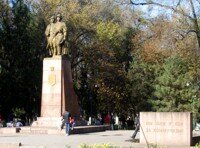 |
and also for:Grand Chui Canal |
| H is for: |
History Museum - The Historical Museum is located in the large marble “cube” in the main Ala Too square in Bishkek – behind the statue of Manas. The Museum was founded in December 1925 in the building which was supposed to be the boyhood home of Mikhail Frunze – now preserved in the Frunze Museum – and accepted its first visitors in March 1927. It was later housed in what is now Dom Druzhba before moving to its current home. | 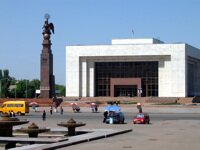 |
and also for:Hippodrome |
| I is for: |
Irakiliy- Born in 1863, in the Chernigov province of Russian, into a Cossack family, Sergei Matyah was to grow up and become Kyrgyzstan’s first officially recognized Orthdox Saint; Saint Irakliy. Apart from a few details, we know very little about him, especially his early life, even though he lived not long ago … he didn’t, for example, say much about himself. He served at the monastry at Svetly Mys on the shores of Lake Issyk Kul and after the Bolshevik Revolution in 1917, continued to live in the region performing his religious duties despite the authority’s crackdown on religious activities. He died and was buried in 1937. In 1993, Irakliy was listed in the list of sacred people of the Almaty diocese, and in August, 2000 he was declared a Saint. On September 13th, (his Saint’s Day), in 2004 his remains were removed from the Orthodox cemetery in Ananyevo, and placed in the Voskresensky Cathedral, Cathedral of the Resurrection, in Bishkek. | 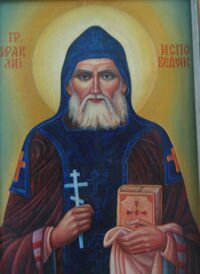 |
and also for:Ilbirs Isanova |
| J is for: |
Jogorku Kenesh- The Jogorku Kenesh is the name given to the Supreme Council of Kyrgyzstan. It is the unicameral (single chamber) Parliament of the Kyrgyz Republic. It has 120 members who are called Deputies. | 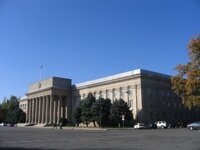 |
and also for:Jibek Jolu Jul |
| K is for: |
Karagachovaya Rosha - (Elm Grove) – North of the Grand Chui Canal, some distance to the East of Sovietskaya. Created out of swampland by Alexei Fetisov in 1881 this park is criss-crossed by concrete walkways beneath the trees and is especially attractive in Autumn and Winter – but because it is so far from the city centre attracts fewer visitors than it’s size might merit. There are two small lakes – still called Pioneer and Komsomolskoye – where children swim during the summer. The paved road which bisects the grove used to be the main Vernoe (Almaty) post road. It has over 50 species of trees and shrubs and houses dendrarium and a branch of the botanical gardens. |  |
and also for:Kievskaya Komsomol Kyrgyz Range |
| L is for: |
Lenin - Vladimir Ilyich Lenin was born in Simbirsk (now called Ulyanovsk) in the Russian Empire in 1870 – the son of Ilya Nikolaevich and Marai Alexandovna Ulyanov. The family was of mixed ethnicity – Russian, Kalmyk (the descendants of the Oirats – a Western Mongolian people that have lived in the Eurpoean part of Russia for over 400 years), German, Jewish, Swedish and “possibly others” including possibly Kyrgyz. Effigies of Leninb can be found in many places throughout Bishkek, not just behind the History Museum, in the Old Central Square. | 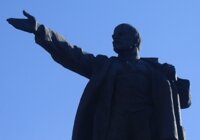 |
and also for: |
| M is for: |
Marshrutka - A Marshrutka is a minibus – often a Mercedes Sprinter or a Ford Transit – which plies a set route like a more conventional bus service. It is easy to think that the difference between them is one of scale – the buses seat some 40 or 50 passengers but the minibuses are smaller with less than half that number of seats. There is another important difference, however, in that whereas passengers alight and board a bus at a designated ostanovka, (Bus Stop), it’s possible to flag down a marshrutka anywhere. | 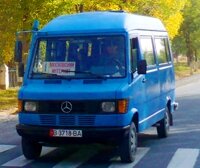 |
and also for:Manas Marx and Engels Microregions Mig Monuments Murals |
| N is for: |
Nightlife- Bishkek is a cosmopolitan capital city with a wide range of cafés, bars and nightclubs. As one website puts it: “Whatever type of bar or club you are looking for, you will find it in Kyrgyzstan.” As well as the variety of bars, discos and nightclubs, many restaurants also have dance floors and double as dance venues. They usually open in the evening and often work through until the last customer leaves. | 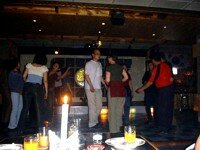 |
and also for:National Bank National Library |
| O is for: |
Opera and Ballet Theater - The State Academic Theater of Opera and Ballet named after Abdylas Maldibaev opened its doors on May 15th, 1955 and its classical design with colonnade is a distinctive city landmark. Inside there are several fine examples of Soviet style painting depicting many nationalities gathering for a wedding and scenery from the republic. | 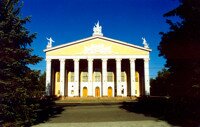 |
and also for:Oak Park Orthodox Church Osh Bazaar |
| P is for: |
Philharmonia - One of the most striking and easily recognisable, marble-faced, buildings in central Bishkek is the Philharmonia Concert Hall, (named after Toktogul Satylganova), at the junction of prospects Chui and Manas. This is, in fact, the third such home of the Philharmonic Society – which was established in 1936, based on the orchestra of the Kyrgyz State Theatre. The first home of the society was in the building now occupied by the Metro Pub, (on the corner of Prospect Chui and Turusbekova) and the second the Kyrgyz Promstroi Bank on the other side of Prospect Chui from the present building. | 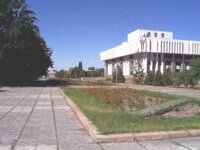 |
and also for:Panfilov Pishkek Ploshad Pobeda Pravda |
| Q is for: |
Queen of the Alai (Kurmanjan Datka) - an outstanding stateswoman of the Kyrgyz Republic. She is sometimes known as “The Tsarina of Alai”, and “Queen of the South”. The word Datka means “General” and she was awarded the title twice. There is a statue of her at the foot of Prospect Erkindik. |  |
and also for: |
| R is for: |
Rabochi Gorodok – a residential district on the South-Western outskirts of the city, built between 1928 and 1932 by the Czech Socialist Volunteers, Interhelpa, as housing for its own members. This circular, (“wheel and spoke”), community of single storey houses in leafy lanes represents Bishkek’s first planned community. A park, some shops and the Buddhist temple, (a converted house), are to be found at the hub. | 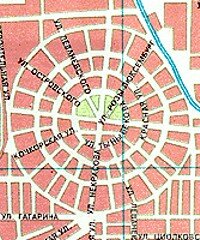 |
and also for:Roads Railway |
| S is for: |
Sports Palace - Known in Kyrgyz as the Sports Sarai and in Russian as the Dvoretz Sporta, the Sports Palace on Togolok Moldo Street is reputedly Bishkek’s largest venue, with seating for 2500. It was built in 1974 as one of the major construction projects designed to modernize the city. There are facilities for basketball, volleyball and other sports, but they must be reserved ahead. In the same complex there is an open air Olympic sized swimming pool and a small sauna. The main auditorium is used for concerts, presentations, conference, and has even seen use as a courtroom, (following the events of April 7th, 2010). It is also used for exhibitions. | 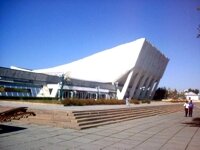 |
and also for:Silk Road Sovietskaya Souvenirs Spartak Stadium Stock Exchange Syddykov |
| T is for: |
TsUM-or ZUM Aichurek – is the main department store in Bishkek. The store was established in 1956 as part of a chain of shops throughout the former Soviet Union, run from Moscow by the Ministry of Trade, known as Central Universal Magazine. The current building opened in 1974 with 25000 square meters, with over 380 trading places on three floors (there are now four trading floors) with warehouse space on available on three more floors. At the time it also boasted the first (and only) escalators in the city (and in the country – although now there are some more) – and provided employment for 1000 people. | 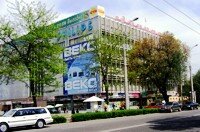 |
and also for:Terentiev Theaters Togolok Moldo Toktogul Trade Centers |
| U is for: |
Universities – Bishkek is home to a large number of Universities and other Institutes of Higher Education, some of the specialist, some being international foundations and some being private foundations. | 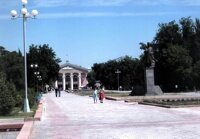 |
and also for:Urkuya Salieva |
| V is for: |
Vecherniye Bishkek - The Russian language newspaper “Evening Bishkek” has been published for over 30 years, and is the country’s leading newspaper, with one of the highest circulation in Central Asia, (700,000 copies and an annual circulation of 7.2 million – the circulation of the first issue was just 65,000). Known to locals as “Vecherka” it covers mainly local news, ( business and the economy, politics, crime reports, cultural and sporting events, jobs, and community events), although there is also news from some of the other CIS countries. The Friday issue is popular as it carries extensive classified advertising. They also have a website. |  |
and also for: |
| W is for: |
White house - Government House, built in 1984-5 as part of a massive construction programme in the city. It was to house the Communist Party Central Committee and the Council of Ministers but now it accommodates the President’s administration and the government. As with many such buildings, although it looks like a sold block, it is in fact a “figure of eight” with two central wells behind the facade. Originally access to the very doors of the building was possible, although it was officially closed to visitors. but a fence was erected for security reasons. | 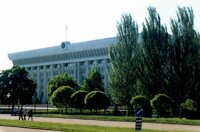 |
and also for:Wedding Palace |
| X is for: |
the unknown factor … anyone got any suggestions? |  |
and also for: |
| Y is for: |
Yellow Number Plates - Vehicles owned by foreigners are usually given a Yellow plate – with four letters followed by four numbers – e.g. KGBM1738. | 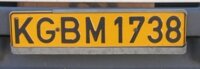 |
and also for: |
| Z is for: |
Zoological Museum- currently part of the Biological-Soil Institute of the Academy of Sciences. The collection was begun in the 1920′s – and was part of the Central Museum for the Study of Local Lore. Specimens were donated by scientists from various parts of the Soviet Union and were housed in a small single-storey building. In 1943 the collection was divided between the Historical Museum and the Museum of Nature, which was transformed in 1946 into the Zoological Museum and transferred to the Academy of Sciences. | 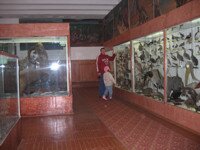 |
and also for:ZUM |
Write comment




 Bishkek