Pancake Day – Blinis
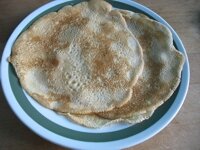
A plate of homemade Blini
Back in Britain, Today is Shrove Tuesday: Pancake Day. Tomorrow, Ash Wednesday, is the first day of Lent, the forty days before Easter when Christians around the world practice a form of fasting, giving something up – usually rich food. As with the Jewish Passover, housewives clear their larders of certain fats before the period of abstinence.
Making Pancakes was a simple, easy and popular way to do this and, as a result, although they could be served up at any time of the year, pancakes are a annual treat dished up on Shrove Tuesday.
The Orthodox Church follows the old Julian Calendar so most years Easter falls at a different time here, so I get two lots of pancakes: One lot on Shrove Tuesday and another during Maslenitsa; (in the Orthodox tradition this preparation for Lent is known as Maslenitsa, and lasts a whole week not just a single day. I wrote a postcard about it last year.)
Even though we weren’t particularly fastidious about keeping the fast, my mother always used to make pancakes for us when I was a child. A plate piled high would be quickly demolished, each flat thin pancake being squirted with lemon juice before sugar was sprinkled over it and it was folded into quarters ready for consumption. Although it was one of the few foods we were allowed to eat with out hands, my mother usually insisted on giving us a teaspoon to carve it up.
Pancakes, (Blini), are a popular snack here in Kyrgyzstan. The kids, in particular, love them. They are available all year round, not just at Maslenitsa. In Naryn, for example, they are sometimes served up with smetana and jam for breakfast.
People are often surprised to see me squirting lemon juice and then sprinkling sugar on them. Here they may come with cream, (usually sour cream – smetana), jam or honey. Sometimes, they will be filled with soft cheese or meat and then rolled up into little parcels or packets before being served.
I said that they are easy to make, and that’s true – even I can do it, with one exception, that is – flipping or tossing the pancake in the pan in order to cook the second side. The kids are far better at this than I am.
To be fair, some people seem to make the recipes more complicated, separating the egg yolk from the whites and then beating them into the mix at different time, and leaving the mix to stand for some time … but I tend to just get on with on it. It takes just over half an hour to prepare about twenty, most of the time being taken up with the frying the pancakes individually, one by one.
The ingredients are simple and easy to find, eggs, flour, milk, sugar, salt, vegetable and butter. To make a plateful of pancakes you need:
- a couple of eggs;
- 1 tablespoonful of white sugar;
- a pinch of salt;
- 1/2 cup of flour – several recipes say to use plain flour, but then add yeast. Interestingly, buckwheat flour, (made from grechka), can be used to make gluten free pancakes … now that’s a use of grechka of which I approve;
- 2 1/2 cups of milk;
- 1 tablespoonful of vegetable oil and
- 1 tablespoonful of butter
The eggs, sugar and salt are whisked together in a medium sized bowl. The flour and milk are added and stirred into the mix until is smooth and well blended into a a sort of liquid paste or batter – it has to be thin so that it can be poured. When it is ready, you just heat a little oil in a frying pan and pout a little of the batter into the pan, tilting the pan so that the mix spreads out evenly. It’s put onto the heat and the pan shaken gently to prevent the batter sticking to the pan.
We then come to the hard part, when the edges are already crisp and the center looks dry, and the pancake has to be turned over in order to cook the second side. Tradition has it that the pan has to be jerked so that the pancake flies into the air and flips over … although I admit to problems with this and usually use a spatula … with varying degrees of success.
When the pancake is ready and lightly brown, a little butter is put onto it and it is removed and put onto a pile on a plate. Most of the time it will simply slide out of the pan.
When the pile is ready it can be served just as it is with the lemon juice, sugar, honey, smetana or whatever … some people fold them into half and then half again to make “triangles” in the shape of quadrant of a circle … or it can laid out on a board, covered with the filling and rolled up into a parcel ready for serving.
Apart from being tasty and easy to make, there is another advantage to pancakes … there’s very little mess or washing up. Andrei always complains about both, especially the amount of washing up, when I settle down to cook a meal; but not when it’s pancakes.






 Bishkek