A better world for all, including …
My next door neighbours have moved. I can’t say I am surprised because they have been looking to sell the apartment for some time. They tell me that their family have lived here ever since the house was built by the Gold Company KyrgyzAltyn as a “Gostinitza” for their employees, back in 1948. (a gostinitza is a “hotel” – although it’s hard to see how it could have served as such).
It’s quite a nice flat: spacious by local standards, (certainly bigger than mine which is akin to a box room – but not as big and spacious as many of the “elite” apartments that are being built nowadays). Being what is called a “Stalinsky Dom” the walls are thick and sturdy, the ceilings are high and there are even moldings that give it some character and atmosphere. Its age, of course, means that there is quite a lot of running repairs necessary from time to time, but nothing, (so far – “fingers crossed”), particularly serious. It’s major attraction, however, is: its location in the heart of the city center. (As the estate agents mantra puts it: “location, location, location”.)
It’s one of the things I really like about living in Bishkek. Here I am, living in a small two storey building on one of the main thoroughfares in the center of the capital. In fact, the city center has a lot of residential accommodation. True, a lot of it takes the form of blocks of flats, (apartment blocks), but most of those are what might be called “low rise”: five or nine storey, (apparently, there are different licenses for builders and different regulations for building of up to five storey, from six to nine storey, and beyond), and there are still quite a large number of older two or three storey houses like ours.
There are plans to develop the city center with proposals for twenty, thirty, forty and even fifty storey building, that would, if they come to fruition, would change the face of the city dramatically. Even these plans, however, include provision for city centre housing and not just office blocks and retail outlets.
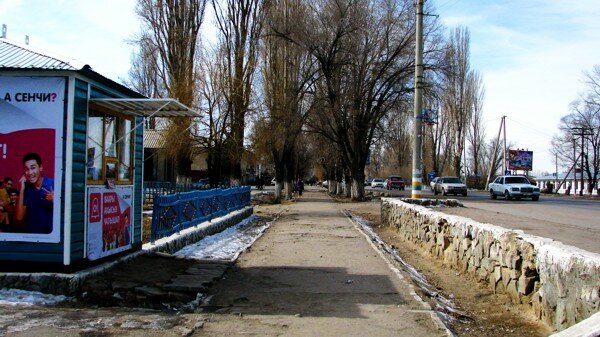
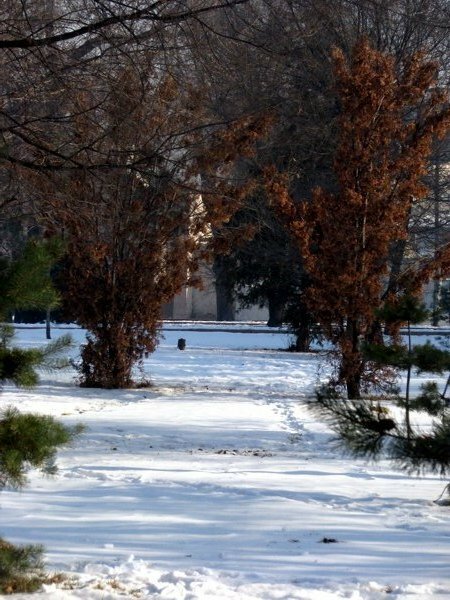
Most of the buildings have land around them, so it doesn’t seem to be crowded or cramped. To be honest, however, much of that land is disappearing as new constructions are being erected in almost any and every available plot. The plots of land of often green in summer as many have trees and bushes; it wasn’t just in the parks where plants flourished – even our small yard has over eighty trees and bushes of different varieties and sizes. Bishkek used to be known the Greenest City on Earth with more trees per head population than any other, although that seems to be a claim that is questioned these days.
If it is so “ideal”, you might wonder why my neighbours decided to up roots and move. The answer is actually quite simple. One of them was involved in a car accident some years ago and as a result is now confined to a wheelchair. The apartment is on the second floor and there is no lift in the building. As a result, she was also effectively housebound. She could only see those trees from her apartment window and only venture forth when someone was available to physically carry her down the single flight of stairs that separated her from the outside world. So, they’ve been looking for a ground floor apartment or house where she would have greater possibility for mobility and a better quality of life.
Today is the International Day for People with Disabilities, which has been commemorated annually since 1992 This year the focus is on development issues: “Together for a better world for all: Including persons with disabilities in development”. Although that doesn’t sound particularly catchy as a slogan, in its somewhat clumsy phraseology it says a lot and with a little rewording could applied to lots of “minority groups”: “Together”, “a better world”, “for all”, “including …”, as well as, of course, “the disabled”.
There’s been a lot of appeals for “togetherness” here, especially in the wake of the divisive upheavals we experiences last year and the question of improving the standard of living and achieving a “better world” is recognized as an imperative for the new authorities as they assume office. We will have to wait and see to what extent the “for all” is embraced, but there have been signs recently that the disabled are receiving attention – and, more importantly, not just because the International Day is here and for better or for worse, the spotlight is on them for the day.
Just as one example, one of the nice stories in recent weeks came at the end of October, when the Association of Parents of Disabled Children (ARDI), finally signed an agreement with the Ministry of Social Protection for new, bigger premises for their day centre for young children with disabilities. This came after three years of tireless work by HealthProm (a British based charity and aid agency,) together with ARDI to persuade the Kyrgyz Government to provide premises. This was to replace the original centre which was opened in 2009 in ARDI’s offices in the basement of a block of flats, as part of HealthProm’s project “Supporting families of disabled children in the Kyrgyz Republic”. The new premises will mean that ARDI will be able to help a much wider group of children and create a resource center.
Well, this week the spotlight has been elsewhere.
As you can imagine the inauguration of Almazbek Atambaev as the fourth President of Kyrgyzstan on Thursday has somewhat dominated the news. The ceremony in the Philharmonia was broadcast live, both on TV and on the internet. It’s also possible to watch it on YouTube and here is a link to a short clip of the highlights. There was quite a long list of foreign dignitaries in attendance, including the Presidents of Turkey and Georgia; the Prime Ministers of Kazakhstan and Tajikistan; representatives from Belarus, Turkmenistan, Mongolia, India, the United States, China and Russia; representatives of international organizations such as the United Nations, OSCE, the European Union, the Shanghai Cooperation Organization, the CIS, EurAsECT; The Aga Khan … and so the list goes on.
The low key delegation from Russia raised a few eyebrows … after all, we are now supposed to be on such good terms with the Russians. (There was one report during the week which suggests that Uzbekistan is very cautious about the new regime here in Kyrgyzstan, especially concerning its moves to be closer to Moscow.) It’s thought that the absence of any really major figure in the delegation may be due to the presences of President Saakashvili from Georgia, (who, incidentally, had some really nice things to say about Kyrgyzstan’s economic prospects indicating a hope for creating a better world for all).
Another possible reason might well be the question of the future of the American base at Manas, and it seems to have been taken by some as a sign of anxiousness in Moscow to the possible watering down of the Kyrgyz position about closing the base.
This is also being cited as a possible reason for the delay in transferring a credit from the Eurasia Fund, although the official explanation is that it is to do with the impending change of government.
For most of the population of Bishkek, the day was not exactly an indicator of better things to come … the streets were jammed with traffic as the main thoroughfares through the city center were closed. Kievskaya outside my office was choc-a-block with vehicles at a standstill. The tax inspector who was paying us a visit couldn’t get out and had to leave her car and return later to pick it up. It was impossible to get down to the hotel as it meant having to cross the main street, Prospect Chui, and someone coming to see me from his office just a block away phoned to tell me that he couldn’t make it.
Those in the hall, however, heard speeches from outgoing President Roza Otunbaeva and incoming President Almazbek Atambaeva. Roza Otunbaeva praised the transfer to a parliamentary democracy and despite the difficulties experienced had proved to be successful. said that Democracy Atambaev’s was delivered in both Russian and Kyrgyz, but mainly in Kyrgyz. He stressed the need for unity amongst the people and the need “to create conditions for the development of the cultures and languages of all nationalities” in the country. Although he was in favour of strengthening the use of Kyrgyz, he proposed the removal of the designation of nationality, (that is ethnicity), from Kyrgyz passports, leaving all passport holders as Kyrgyz Citizens.
Having taken the reins as President, he resigned as both Prime Minister and also as a member of the SDPK, his political party, as required by the constitution. With the resignation of the Prime Minister, it automatically follows that the government resigns and we now wait to see what new coalition government the Acting Prime Minister, (Omurbek Babanov), can arrange.
Over the last few weeks there has been all sorts of rumours about how this new look government might be comprised … at the moment the big controversy seems to be over who will gain the post of Speaker, who is not just the chairman of the Parliament, but the person who takes over in the event that the President becomes incapable of fulfilling his duties.
A little surprising was the news that the SDPK, Atambaev’s former party, has decided to withdraw from the coalition – on the grounds that Atambaev has called for an enlarged coalition with more parties – so it’s “all up for grabs”.
Amongst the tributes that have been paid to Roza Otunbaeva came the news that she has been nominated for the Nobel Peace Prize. Although she has successfully led the country through a difficult period, introducing of a new system of governance, (Parliamentary Democracy), there are a number of things which may yet count against her in the judgment of history, including the events in Osh and Djalal Abad last June and the cases against many of the leaders of the Uzbek community.
Thursday was December 1st, and that means it was also World AIDS Day, which got somewhat overshadowed by the events in the Philharmonia. Although the news agencies reported various events to commemorate the occasion, it seems to me to have largely passed under the radar this year. That’s not to say that AIDS has been out of the news as the controversy over the number of children infected with HIV as a result of receiving medical treatment in the period from 2004 to the present.
The controversy over the Iranian shareholder of the Finance Credit Bank, has come to a head with the Iranians deciding to sell their shares and withdraw from Kyrgyzstan altogether. The week began with a news report suggesting that the US had threatened Kyrgyzstan with Sanctions if they didn’t take action over the issue, as they claimed the investors had links to Iranian Nuclear program, On the list of shareholders issued following the sale it appears that one of the new owners is former Prime Minister Danioyar Usenov.
It’s been a difficult week for the government in other respects, with auctions for the sale of nationalized assets failing, and yet further delays in receiving credits and grants from international organizations. Despite that, we are told that the budget is in good shape and will cover the deficit this year.
The Ministry of Finance are probably breathing a sigh of relief over another matter – the security services have withdrawn their case against officials for revealing state secrets, that is the amount of money transferred to the them and the Ministry of Defense.
If, this year, we have seen a lot of information in the news about HIV and AIDS well in advance of World AIDS Day, there seems to be a lot of attention being released in regard to corruption in advance of the International Day against Corruption, which falls on December 9th. Transparency International have already released their Corruption Perceptions Index for 2011and Kyrgyzstan has fallen ten places in the league table to 163rd place. One of the leaders of the April Revolution certainly seems to think that corruption is still a growing problem as this was of the reasons he cited for refusing an award from outgoing President Otunbaeva.
There have been some interesting news items about alleged nefarious actions of one of the Presidential candidates when he was a Minister, and people dealing in drugs including the brother of one of the most prominent deputies and a government official. The Mayor of Bishkek seems to have acted in an attempt to pull the sting out of public disquiet over the collapse of a case against his son for causing the deaths of three young people in a car accident earlier in the year, by issuing a statement that he was seek a judicial review of the case, (even though the prosecutor has said that there is no legal grounds for continuing with the case after the families of the deceased all decided against pursuing a case against him), saying that his son must be punished. Afterwards someone asked me if such a thing would happen in the UK, and then went on to say that it was a sign of how things in Kyrgyzstan were changing. People in authority are listening to the people and civil society. “Do you think that would have happened 16 years ago, when you first came to Kyrgyzstan?”, he asked. Probably not, I had to admit, but I thought to myself that the continuous taking to the streets to express grievances wasn’t necessarily helpful.
Kumtor, for example, have had one of their depots blockaded for something like four days this week, and this is putting the work of the mine in jeopardy.
Another example of the rise of civil society is the proposal to create a formal “Neighbourhood Watch” scheme. I have seen some of the details and I am not sure how it will work, but it seems a short step from this to the “municipal police” being mooted in Osh.
We’ve had a number of energy problems during the week. A fault on the transmission lines from the Toktogul Power Station caused a series of power cuts during the week. As a result, one of my acquaintances was forced to leave their home and office and set up shop in cafes with wi-fi internet access. We suffered power fluctuations all day and then lost power in the evening at about eight o’clock. One of the reasons offered by the electricity companies is over consumption – the system wasn’t designed for the level of consumption that they are experiencing today. There hasn’t been enough investment in the infrastructure since the demise of the Soviet Union and the planned investment from Russia is seen as particularly crucial.
Then, Atambaev got a present on the day of his inauguration when Kazakhstan announced that it was going to limit the export of gas to Kyrgyzstan – even though they only recently signed an agreement for it, because of shortages in Southern Kazakhstan.
To make matters worse, it seems that there is a serious deficit of petrol and diesel fuel, especially in the South of the country.
Even if there is fuel, the state of the roads is such that many people might not want to travel far. Actually, I don’t find the roads all that bad, the main roads are basically adequate although they are a bit uneven and most of them have been or are undergoing renovation. Once you get off the main roads, however, especially in the mountains, then it’s true that they leave a lot to be desired. Many of them are not asphalt and quite a few are not open all year round. The road from Naryn to Djalal Abad, via Kazarman, for example, is impassable for something like eight months of the years. Several times it is reported that villages arte cut off bin bad weather as roads become blocked by landfalls and avalanches. Some of the roads in the Ferghana valley also have to pass through enclaves belonging to Uzbekistan or Tajikistan which creates more problems. So it was no surprise that Atambaev has told the Ministry of Transport to look at the possibility of improving the network, possibly by Public Private Partnerships creating toll roads, especially if roads are to match the development of the railway from China to Uzbekistan.
Another piece of transport news is, as I reported before, that Karakol airport has been reopened after a three month refit, and has now been designated an International Airport, with a flight scheduled to Almaty which cuts the nine hour journey by road to just half an hour. At the moment it is only two flights a week by a local airline “SKAT”, (on Mondays and Fridays), using 48 seat AN-24 planes – the first took place yesterday, but there are talks about adding new destinations to the timetable. Tickets cost over USD200 in Almaty, but just USD130-150 in Karakol. An interesting statistic: The airport now employs sixteen people which is about one for every twelve passengers assuming that every seat is sold.
I am not sure what sort of planes they can accept at the airport, but in one of the strangest stories of the week, a disabled “strongman” pulled two planes with his teeth in a bid to get an entry in the Guiness Book of Records: he pulled an AN-24 weighing 24 tons four meters and a Tu-134, weighing 37 tons, some 20 centimeters. It was all filmed and you can see it on the web.
It’s not the only video clip that might be worth watching. Here’s one of Atai Omurzakov’s performance on “Cesko Slovensko Ma Talent,” the Czech-Slovak version of the popular “Talent” reality TV series syndicate, which includes “America’s Got Talent” and “Britain’s Got Talent.” The Czech version, however, is obviously not as parochial as the American and British variants because Atai is a 21-year-old native of Karakol and he so impressed the judges that hew won the competition and walked off with a prize of 100,000 Euro. It’s not the first time he’s entered this sort of competition, having appeared on the Ukrainian version as well, but even so, it’s a very creditable performance and made him extremely popular back home!.
If these two stories weren’t contenders for the “strangest” news stories of the week – vying for the title was the announcement that Askar Akaev has re-emerged into public life, giving a lecture on the changes in the Russian Federation in the 20 years following the collapse of the USSR and attending the Chinghiz Aitmatov awards in London, (and not only that, apparently, even winning one of them).
Then there was the story of the translator who is working on translating some of the works of that great Kyrgyz author and national hero, Chinghiz Aitmatov – yes, the same one – from Russian into … believe it or not, Kyrgyz.
The motto for today’s International Day for People with Disabilities begins with the phrase: “A better world for all, including …”, As I said, I think it could equally be adapted and applied to a number of other groups and causes. Amongst them might be the children looked after by the Karakol Orphanage supported by the late Hugh Coulter and his wife, Jean, and the people helped by the two micro credit organizations that they set up. Hugh certainly believed and worked to try and create a better world for all and for the last seven years concentrated his efforts on these three projects in Karakol. He also believed that “A little goes a long way”, and his work was a testament to the truth of that motto. Jean will continue that work and has just sent out the regular newsletter with the latest update on developments … which you can download from ianbek.
Talking of which. It is now possible to follow me on Facebook, (where I have specific pages for Celestial Mountains and ianbek), and on twitter, (@Bishkekpostcard)
Postcard from Bishkek: the weekly postcard that I send out as an email also gets posted on the website ianbek.kg each week – and there are other postcards which don’t get sent out. This week, for example, there were posts about: Bishkek’s Russian Orthodox Cathedral; Bureau de Change – exchange offices in Bishkek; The Basmachi rebels who were the scourge of Central Asia in the 1920’s and 30’s; The Beautiful Game, Football (Soccer to our American friends), in Kyrgyzstan; Wear the ribbon with Pride, about World AIDS Day and It’s that time of year again … when KCBTA announces it’s programme of festival for the coming year.
I have also added some jpg images of some of the Panoramic scenes which are featured on our website www.see.kg
You can also download the November Update on the Karakol Orphanage and Micro Credit projects from Jean Coulter here: Karakol Orphanage – Update November 2011
If you decide that you don’t want to receive these weekly postcards in your email anymore, please drop me a line to and I will take you off the distribution list. Alternatively, if you know someone who might be interested in being added to the mailing list, then get them to drop me a line and I’ll be happy to do so.




 Bishkek
It is amazing what I find out form your postcards. I knew Hugh was feeling a bit rough but I did not know he had not survived. A great loss.