Wear the ribbon with pride
The Red Ribbon - Symbol of HIV/AIDS Awareness
The red ribbon has become a symbol of HIV/AIDS awareness, although its origins as an awareness symbol lie in a mark of respect, donned by the citizens of a small town in California in 1985, to commemorate a law enforcement officer working for the DEA, (Drugs Enforcement Agency), who was kidnapped, tortured, raped and murdered whilst working undercover. The ribbons then became a symbol for a campaign of prevention aimed at reducing the demand for illegal drugs.
In 1991, the Visual AIDS Artists Caucus looked for a symbol for compassion for those who were living with AIDS, either as victims of the disease or their carers. Inspired by the “yellow ribbons” honouring American soldiers serving in the Gulf they chose the ribbon as a symbol. The colour red was chosen to symbolize blood, (HIV – the cause of AIDS is a blood borne virus), and passion, (“not only anger, but love, like a valentine.”)
Worn by many celebrities, it was quickly adopted by the public and for twenty years has served as a powerful and easily recognizable symbol in both, the effort to increase public awareness of HIV/AIDS and the lobbying efforts to increase funding for AIDS services and research.
When I left Britain for Kyrgyzstan back in 1995, many people sported the ribbon, especially on December 1st, World AIDS Day, and I felt that it was almost a fashion item, albeit one with a serious purpose. It took a few year but over the course of time I saw more more and people here also wearing it. This year, however, I have seen very few.
In a way, that is surprising because the question of HIV/AIDS seems to be in the news quite a bit. There are often reports in the news about international agencies donating equipment or running courses on HIV and AIDS. A USAID Health Care Project, for example, are working with the Ministry of Health, the Drug Control Service and a number of other NGOs on AIDS prevention amongst vulnerable groups such as drug users and young people; the United Nations, World Health Organization and other bodies have highlighted work to fight and reduce TB infections, (which is a major problem for HIV patients).
On a personal level: I have twice had to obtain certificates about my HIV status, in order to my residence permit. On both occasions the staff were business like and efficient but there was a distinct difference between them in the level of “counselling”. On the first occasion I was directed to a counsellor who asked if I was aware of the likely implications of a positive result and asked if I was sure that I wanted to go ahead … I said “Yes,” and signed the declaration. On the second occasion it was treated as a formality, I was simply given the declaration to sign. To be honest, I felt that the level of care and training on the first occasion was better than the second, and the training may not been as effective as might have been hoped. (The result was negative on both occasions.)
The kids are involved with a project rather like the one run by the Red Cross, where young people are recruited to teach sexual health, drug and HIV awareness to others their own age in the streets and in schools.
The question of preventative education is a touchy subject in Kyrgyzstan, where both Islam and the Orthodox Church have raised questions about the propriety of some of the materials. For example, a “sex education” textbook which had been financed by one of the donor agencies had to be withdrawn a couple of years ago after complaints about the content.
There is some confusion on the level of incidence of HIV here in Kyrgyzstan. Apparently, data given by the CIA yearbook gives rise to the following statistics:
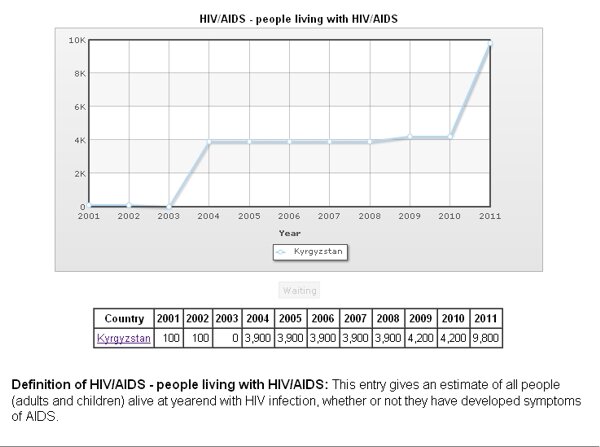
Data from the CIA World Factbook - as at 01/01/11
As I often say, “Statistics always seem to raise more questions than they answer” … and in this case: apart from the nice, convenient “round numbers”, which don’t change from year to year, there is the “0″ recorded for 2003 and the sudden rise in 2011. Of course, there may be good and valid reasons for these apparent anomalies, but they certainly raise questions in my mind.
On the other hand, official statistics reported by the Press Service of the Ministry of Health, issued in October suggested that there were only 3,743 cases of HIV registered in Kyrgyzstan by October 1st, and 398 of these had developed into cases of AIDS, and 180 people had “died of AIDS”.
For the record: According to official data quoted in news reports, the first case of HIV infection was apparently registered in the country back in 1987, (although one politician recently stated that the first HIV case was registered in Kyrgyzstan in 2003; an intravenous drug user), and by 2000 the number of cases had risen to 53. Whereas, in many parts of the world infection rates have been held stable, Over the next five years registrations grew at an average of 150 a year, (suggesting about 800 cases by the end of 2005). Then, in 2006, there was a surge when 244 new cases were registered bringing the total to something like 1050. Two years later this figure had almost doubled.
Statistics given earlier in the year are a little more helpful in that they contained more detailed information. In May, for example, it was suggested that there were only 3,519 HIV registered cases of HIV infection and in March, 3385. Most of these cases seem to involve Kyrgyz citizens, but there are also almost 200 “foreign citizens” included in those figures. In terms of a gender breakdown something like 62% of the registered cases involved males.
A similar set of figures were also issued in March which allows for a comparison to be made which indicates the growth rates:
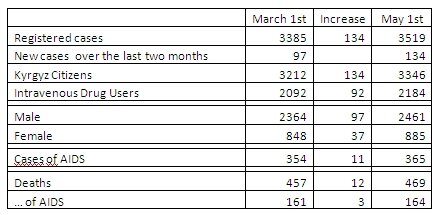
HIV/AIDS statistics for 2011 (March 1st and May 1st)
The figures for March also gave a breakdown by oblast:

Breakdown by Oblast, March 2011
The smart-eyed reader will notice another little difficulty here: although the number of registered cases of AIDS tallies with the 365, the total number of registered cases of HIV/AIDS falls short by 40 at 3345. Of course, there may be good and valid reasons for this anomaly but, once again, it raises questions in my mind.
For the record: One press report has stated that “No new HIV cases were registered in northern Kyrgyzstan since 2009. All new HIV cases are registered in southern Kyrgyzstan.”
Figures released yesterday state that in Kyrgyzstan the virus is spread mainly among young citizens aged from 25 to 29 years. This age category constitutes over 21% or 768 cases and that the main methods of transmission is through Intravenous drug use and sexual transmission. Something like 62% of HIV infections involved intravenous drug users, but the dynamics seem to be changing. Sexual transmission of the virus, for example, is reported to have risen from 3.1% of registered cases in 2001 to 26.6% in 2010. It was also reported that 13.7% of convicts are HIV infected and that these represent, in the main, injecting drug users.
There are also figures for infection passed from mother to infant, (it was announced yesterday that there are 361 pregnant women who have the virus.), and for infections contracted “in medical facilities.”
This last category is perhaps the most poignant, and includes a case in 2008 when at least forty two children were infected with HIV as a result of being infected blood during transfusions of being injected with infected needles.
For the record: This was not the first such case in central Asia. The previous year twenty one medical workers were sentenced to prison terms for infecting 150 children with HIV in Kazakhstan.
Fourteen medical workers were charged with malpractice and negligence after it came to light. Those accused include doctors, nurses and a chief administrator. If convicted they faced prison terms of between five and ten years. Some of the cases resulted in sentences that have been subject to the recent general amnesty, others resulted in suspended sentences, but some of the cases were closed for “unclear reasons” and these have now been reopened. A number of new cases have also been started.
For the record: According to news reports there are currently some 35 health workers infected with HIV in the republic, but they have been transferred to administrative roles and are not involved in the delivery of front line services. Oddly enough, I see that the Department of Health in the UK is consulting on ending the ban on HIV positive health workers from giving health care to patients.
The politician who said that the case of HIV in Kyrgyzstan was registered in 2003 also stated that the first case of HIV infection being contracted in hospital was registered in 2004. Two children contracted HIV in hospitals in 2005, 2 in 2005, 7 in 2007, 70 in 2008, 35 in 2009, 22 in 2011. Statistics released yesterday said that, in total, there are 283 children with HIV in total in Kyrgyzstan – 191 having been infected whilst receiving treatment in hospital.
Plans have been announced that all children born since 2004 or having received hospital treatment in that period are to be tested for HIV.
The mothers of some of those children have been protesting recently.
Their “demands” have included: compensation; apartments in newly built blocks of apartments; an increase in allowances for children from 3,000 to 10,000 som, (about USD67 to USD225); punishment for health workers who infected their children with HIV; and the expedition of the trial of health workers involved which has already lasted for several years.
They began by meeting officials from the Ministry of Health and representatives of the hospitals concerned, but then moved to Bishkek where they held rallies outside the parliament building dressed in black with white face masks. In Bishkek, at first, they attracted from politicians and officials, but they caught the eye of journalists and so managed to get some exposure for their cause. The speaker has allocated money from his special fund to meet the compensation demand and the deputies are looking at a proposal to increase the allowances, (although the Finance Ministry points out that there is no provision for this in next year’s budget) and one deputy has said that the maximum sentence for infecting someone should be twenty five years or life imprisonment.
On the other hand, the Health Minister has suggested that what is needed is greater awareness of the issues relating to the virus and how it is spread. It seems to me that this is where the red ribbon comes in. There’s more than enough confusion surrounding the issue of HIV and AIDS as it is. The lack of reliable statistics and the reluctance to face up to the need for effective preventative education do not help deal with the tragedy of the existing problem, alleviate grief and hardship, yet alone help to prevent further occurrences in the future.








 Bishkek