Bishkek’s Orthodox Cathedral
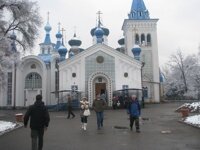
The Russian Orthodox Cathedral of the Resurrection
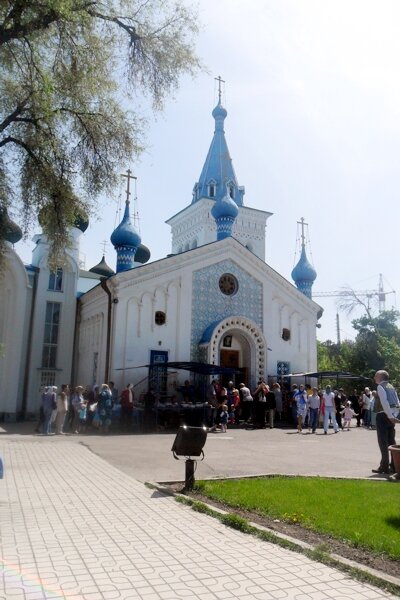
The Russian Orthodox Cathedral of the Resurrection in Bishkek is interesting, if only because of its origins, back in 1943.
In the West, we are so used to thinking of the Soviet Union as an avowedly atheistic regime, it sometimes comes as a surprise to learn that there were occasional thaws in the official attitude towards religion. One such occasion was in 1942, when the Stalinist regime in Moscow relaxed its negative approach to the church, possibly as an attempt to repair and cultivate good relations with the population during the Great Patriotic War, (World War II).
At that time there were no operating churches in the city. Churches throughout the country had either been destroyed of turned over for secular uses, (for example, as youth clubs or cinemas). Where the buildings still stood, the faithful in the local communities took advantage of the newly relaxed attitude of the regime and applied to have them returned to the church. Sometimes their requests were granted. In the capital itself, (Frunze, as Bishkek was then called), the main Saint Serafimovsky church, (which had stood on an island on Prospect Chui – opposite where the Academy of Sciences now stands), had been turned into a children’s home, and had later been demolished. Although a second church, (St. Nicholas’ Church, in Oak Park), still existed, it had been turned into an art gallery and, rather than hand this back to the church, the authorities instead allocated a plot of land on the corner of Lenin Street, (which is now called Jibek Jolu), and Voroshilov Street, (now called Togolok Moldo).
For the record, St. Nicholas’ Church is still owned and used by the Union of Artists, although it is no longer an art gallery.
There is an account that the building was originally intended as a theater. The floor slopes slightly as if rows of seats were to be installed. If this were the case, then the Cathedral of the Resurrection could be unique in that, whereas, whilst other churches were turned into clubs and cinemas, it represents a transformation in the opposite direction.
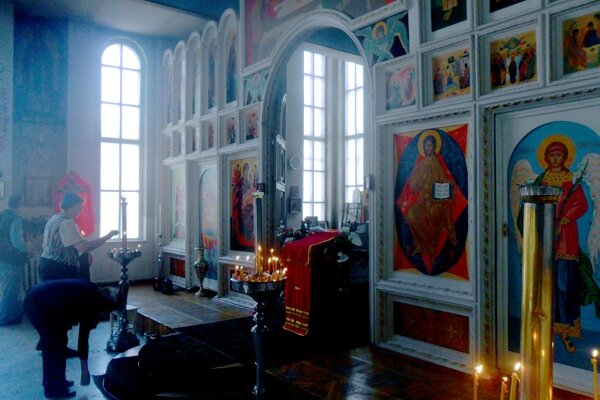
The renovations were carried out at the expense of the congregation but the city’s chief architect, Veruzhski, was in charge of the project. It mainly concerned the external walls of the building, decorating the pillars, installing the traditional “onion domes”, erecting the bell tower, adding ceramic tiles, painting the walls wait and the roof blue. There was still work to do inside, however, and some of the interior walls were demolished to create a large open space, ten meters wide by thirty long. An altar screen was installed and a gallery for the choir. The walls were painted, although some carved plaster reliefs and some paintings were erected. Some of the icons were collected from other churches around the country that had been closed by the Soviets, and some of the larger ones date from the end of the nineteenth century and the early years of the twentieth.
At first the ceiling was plain, although are three large chandeliers were installed. The current painting representing the blue sky, clouds and soaring angels was only added in the 1990’s.
Whilst reconstruction and renovation took place, services were held in the open air. Apparently, the congregation was enthusiastic and, on one occasion, children cleared the way for the Bishop, removing stones from his path, as he walked to the service.
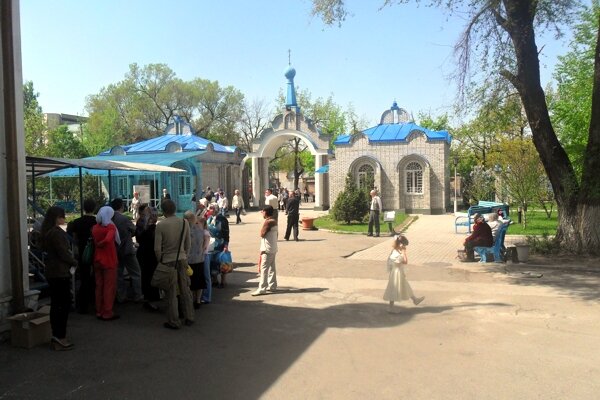
At first, apart from the Cathedral, there was just one small, single storey building on the site. This served as a home for the clergy and as offices, as well as being used as a Baptistery. The conditions were far from ideal and when, in the 1950’s, the main restoration work was completed, permission was sought to erect a separate Baptistery. Moscow consented although the local Communist Party was opposed, and it was only in 1956, with support from the Central Government, that work eventually began on constructing it. It provided one point of contention with the authorities, in that the roof called an onion dome which was forbidden at that point.
For the record: the Baptistery is to the left of the main church as you enter the gates from Togolok Moldo.
This wasn’t the only form of additional building, and now there are several buildings on the small plot of land, including accommodation for the clergy, a shop and a school, which also serves as a large assembly hall.
The authorities also made steel available for the fencing that currently surrounds the site.
Despite the opposition of the local Communist Party, the presiding clergy got on reasonable well with the authorities and were seen as loyal and progressive, (or “politically developed”). Party officials approved the church as being suitable for inclusion in the programme for the World Festival of Youth which was held in Moscow in 1957, as one of 32 “model” religious communities to be shown to foreign visitors. The aim, of course, was to show that “in the Soviet Union there is no persecution of the church”.
It is estimated that, at this time, there were about 10,000 confessing Christians in the city – no small number for what was still a small city – and between 500 and 1000 worshippers would attend weekly services, rising to between four and five thousand at Christmas and Easter.
After the Festival, however, things were to change. The relaxed, liberal, approach was replaced with a more strict interpretation of Marx and Engels’ view of religion as an “opiate of the people”. Walls were erected to create a sense of isolation from the apartment blocks of the neighbouring community. Part of the territory was commandeered for a hospital. The local authorities sought to restrict the number of clerics serving in the Cathedral. In particular, in July 1959, a campaign of criticism began in the press and some of the priests were accused of “counterrevolutionary activity” Party officials would seek to remove clergy from their post or, at least, have them transferred to other livings.
This “persecution” of the church intensified under Khruschev, but the community survived and the Cathedral remained at its center. The church, however, has seized the opportunities presented by the collapse of the Soviet Union and continues to grow and develop. The main church is currently being extended.
On 27th September, 2008, the Cathedral saw the translation of Saint Irakliy from his burial place in Ananyevo, on the Northern shores of Lake Issyk Kul, to a tomb to the right of the main altar.
Oddly enough, the church doesn’t get a mention in the first English language guide to Bishkek, (the “Bishkek Handbook: Inside and Out“, written by Daniel Prior and published in 1994). That omission is addressed in the later guidebooks that have since been published. The church does get a passing reference in some of the local books about the city.







 Bishkek