Bureau de Change
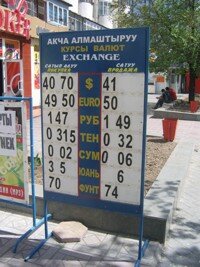
Exchange rates
I was reading an article the other day which said that there were 315 licensed Exchange Bureaus in Kyrgyzstan.
That struck me as odd – because it seems to me that there are an awful lot of Obmen around, (Exchange offices are called “Obmen valoota” in Russian – which literally means “change money”). There are five on our block alone and virtually ever doorway around MosSoviet, (the intersection of Sovietskaya and Moskovskaya), and the intersection of Sovietskaya and Prospect Chui seem to be to an exchange office; and every bank that offers an Exchange Bureau service also needs to be licensed.
It may well be that my impression is correct as the article went on to point out that there are cases of unlicensed bureau operating. So far this year there have been 52 prosecutions and fines of 63000 som imposed on such establishments – although only 52000 had actually been collected. Once again, that didn’t impress me very much – it’s just over 1000 som for each occasion, which doesn’t seem to me like much of a deterrent. Repeated infringements may carry additional penalties, for example, it can mean that the person or organization cannot be granted a license for three years.
Licenses are issued by the National Bank, or one of its branch offices in the oblasts, and they are valid for three years.
Although we don’t operate an Exchange Office in our hotels, I’m not sure why someone wouldn’t apply for a license if they are going to operate one; after all, the license itself only costs 300 som and, as they are valid for three years, that’s just 100 som a year! However, there is also a requirement to have 100000 som, (about USD220), deposited in a bank and some other controls which have to be adhered to.
For example, the Exchange office has to be housed in a separate room with a serving hatch or window for communication with members of the public. It is possible to have one in a booth or kiosk, for example in a shopping centre, but it must be self-contained, with a roof and not open and locked from the inside.
Personally, I prefer to use a bureau inside a shop, (for example in Beta Stores or our local Chemist shop), rather than one which operates through a window onto the open street because, even if there are more people around, it is probably safer. Some years ago there was a spate of people walking up behind clients outside an exchange office and grabbing the money as it changed hands.
The only people allowed into the working area of the exchange office are employees of the bureau, and they are not allowed to have their own money or outdoor clothes with them in side. All dealings where the currency is handled have to be in full view of the client and the employees shouldn’t move away from what is called the “cash desk”.
There has to be a board displaying exchange rates, which can have up to four decimal places, but in most cases only two are used. They are only allowed to exchange money at the rate on the board and sometimes this can cause problems because the displayed rate is not always clear – I have seen some rates where a figure, or a decimal point (comma) is missing (as in the photograph above) … which I always take to be sign to use a different bureau if there is one nearby.
However, the banks sometimes have different rates for each currency, depending on how much is being changed, which may vary from the rate shown on the display. Also, there is a limit on how much can be converted in any one transaction as part of the rules on preventing “money laundering”.
The rates can change several times a day. The official rate of the National Bank used for accounting purposes is different and is set just once a day for the US Dollar and once a week for other currencies.
Unlike in Europe and elsewhere, there is no commission for exchanging money, only a buy and sell rate. The operators of the exchange office derive their profit from the differential. If the client wants to change money from one foreign currency to another, then the regulations declare that the cross rate is determined by converting the sum first of all from the first currency into Kyrgyz som and then from Som into the second currency.
The Bureau also has to display a copy of the license and, (the original), letter of registration of the particular exchange office. A bank, for example, may have one license to cover all of its branches which offer Currency Exchange services, but each branch has to be registered separately and so there will be a separate letter for each one. The letter of registration should show the address of the exchange office and the number of the license, as well the details of the person or organization that has been granted the license and the date of issue – remember, they are valid for three years.
To be honest, although I have often seen these documents displayed, I have only occasionally bothered to look at them in any detail, (usually, only if I have had to wait my turn in a queue and so had time on my hands), but it seems that some unlicensed bureaus display copies of old documents or documents for another establishment, so I think I might do so in future – especially if I am using a Bureau for the first time.
The bureau should have technology for checking the validity and authenticity of the banknotes – for example, an Ultra violet detector, and the member of staff is required to do so before completing the transaction. It’s not that they don’t trust the client – although, maybe they don’t – but it’s in the regulations and they should have been trained to do this.
In theory the regulations also require them to check the identity of the client, (for example against their passport), but, to be honest, this rarely seems to happen. I have been asked for my passport on occasion but it tends to be “the exception rather than the rule”.
There are aspects of the regulations which often prove to be a bone of contention:
- The refusal to exchange money if it is possible, (i.e. the bureau has sufficient funds in the desired currency), is “not supposed”, (that is, they have to carry out the transaction and cannot refuse). However, I have encountered the situation where the employee says that they don’t have enough cash in that currency available at that time.
- They are not allowed to restrict in any way, nor establish different rates of exchange for the banknotes that they will accept according to denomination or year of issue. Despite this, many, (most?, all?) exchange offices refuse to accept old notes or low value notes, or after a slightly worse rate of exchange for doing so. I am told that they do this because they will not be able to circulate the notes to another client, because the other clients will simply refuse to accept them, but although it is probably true, I find that hard to credit. I have witnessed several arguments on this question, including one where the client demanded the details of the license and said they were going to complain to the National Bank about the infringement. I don’t know if they ever did, but the exchange office concerned still operates, and operates by the same rules that it always has done.
(On the other hand, they ARE allowed to offer a discriminatory rate, (or charge a commission) for accepting damaged notes: ones with colouration problems, notes where there are stamps of annotations written on them, ripped or burned notes. )
Although some people think I am an argumentative sort of person, I don’t normally make a fuss over these issues. On one occasion, however, when I had been told that a particular banknote, which I thought was perfectly good, attracted the lower rate, I went through the cash I was given in exchange, refusing to accept and asking the employee to change every old and damaged som bank note that he tried to give me.
There is a saying in Russian that “money wants to be counted” and, although most exchange offices work perfectly fairly and normally, it is important to check the notes which are given in exchange … even if one is in a hurry. At one time, and it is a long time since I heard of this happening, there was a spate of complaints from people that some bureau were shortchanging their clients.
Technically, Exchange offices are supposed to give out a voucher or receipt recording the transaction, (free of charge), but most clients don’t bother asking for it and many don’t bother. Unlike the situation in some countries, (it is not necessary to show these vouchers at customs on departure and so it is not a major issue for travelers). However, the bureau is supposed to record each transaction and submit a daily report on the level of transactions to their authorized bank or the National Bank.
The cash and records are required to be stored in a fireproof metal safe. There shouldn’t be any other cash or extraneous objects on the working surface where the calculations are made and the cash is counted.
In order to obtain a license, a list of the staff to be employed has to be submitted to the National Bank and any changes, (for example, at the change of a shift), have to be recorded in writing.
The operator of the bureau has to obtain a “patent” which is a one off payment covering his tax liabilities for the bureau. Like the license fee, it’s not very expensive, (up to 7000 som a month in Bishkek, but less in the regions). If, however, you consider that the differential in buy and sell rates represents a “profit” of just a few tyiyn per US Dollar or Euro, then it is possible to see that they have to have a considerable turnover in order to cover this, yet alone pay their other expenses, (rent, salary, etc.).





 Bishkek