Ticker Tape
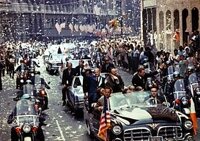
Welcome Home
I think the first time that I became aware of the phenomena known as a Ticker Tape Parade was when the Apollo 11 Astronauts returned from the moon in August 1969.
This phenomena was an honour organized by the City of New York for visiting dignitaries and involved the celebrity riding through the city streets in an open top vehicle and people in the office blocks lining the route jettisoning large amounts of shredded paper from the office windows in the high rise buildings lining the route creating a snow storm effect.
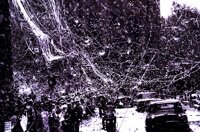
Ticker Tape Parade 1960
The practice started 125 years ago, the when office workers spontaneously throw ticker tape into the streets during celebrations to mark the dedication of the Statue of Liberty. The term ticker-tape originally referred to the use of the paper output by ticker tape machines, devices used in brokerages to provide updated stock market quotes. By the time that Armstrong, Aldrin and Collins had their parade in 1969, the use of ticker tape was already on its way out and the paper used was mainly scrap paper and confetti, (and comparing photos of the event with images of previous one, it seems to have been a bit more subdued). These days, paper that has been cut using conventional paper shredders is often used.
Ticker tape parades are much rarer these days than in the past, being reserved mainly for particular space or sporting triumphs since the assignation of President Kennedy in 1963.
As an aside, I suppose it’s the former teacher in me coming out but a couple of the things I have always wondered about, are: Is this a good example to set if we say that it’s wrong to drop litter?, and Who clears up all that mess after a parade?
Although they originated in New York, ticker tape parades take place in several cities in the states. I don’t think, however, that there are any suitable venues for such a parade here in Bishkek … but if we did, then I suppose the winner of tomorrow’s election, (that is, if there is a final decisive result), might be entitled to one.
After 86 nominations were originally submitted, just 23 names appear on the ballot paper, but seven of them will be crossed out as the candidates have decided to withdraw from the race leaving just sixteen candidates to choose from. Tomorrow, either just two will remain to go into the second round or one will have passed the crucial 50%+1 threshold and will have won outright. There seems to be a growing opinion that there may well be a final result tomorrow … but, although I’m not “a betting man”, even if I was I would still refrain from taking a wager on that possibility at this moment.
Quite why seventy candidates have withdrawn has aroused a certain amount of attention. It could well be that some of them have realized that they stood no chance of being elected and decided to save face – after all, this is Asia and “saving face” is a fairly major cultural trait. The general opinion, however, is that they have managed to use their status as a candidate to negotiate some form of package from one of the front runners. Indeed, the fact that some of them have openly come out in support of one or other of the candidates would seem to offer some support for this theory. The question is openly being asked: what has been promised, to who and by whom? … and whether the successful candidate will have promised so much to so many people that he might have difficulty in fulfilling those promises.
One article went as far as to say that the result of this election isn’t as important or interesting as the question of who will be the next Prime Minister.
As I said last week, there has been a certain amount of attention being given to the seventeenth option on the ballot: “None of the above”, with some commentary appearing to recommend this. Based on nationwide survey, (and regular readers of my Postcards will know what sort of opinion I have of surveys), of over 2000 people suggested that something like 27.3% intended to tick this box, (with just 15.8% opting for Atambaev, 10.9% for Madumarov and 5% for Tashiev). On the other hand, I have seen a comment that “None of the above” is not a viable option and only abrogates responsibility for the future of the country and its development.
The electoral monitoring process continues, but not without hiccups. Apparently, something like 67 of the 750-odd observers working for the OBCE were not granted accreditation status for some reason, even though the OBCE say that they submitted all the necessary documentation on time; one observer was “detained” on arrival at the airport because she appeared on a CIS blacklist and it looks as if it took diplomatic intervention from her embassy to sort the matter out – although the border authorities insist there was no issue; monitor monitors were not allowed into the printing house before the ballot papers were to be distributed to the regions, (as it happens, they have had to print additional ballot papers because the number of registered voters has increased to over three million).
There have been quite a lot of calls from both, within the country and abroad, for a fair and transparent election. There was, for example, a fairly large protest in the city center during the week calling for a “fair” election. The tendency to organize protests has also started to receive a fair amount of attention.
One article, for example, read that the “legal profession is dead, today it is all about the crowd”. One person quoted in it referred to “blackmail by rally”; gather a crowd in order to bring pressurize to bear and intimidate so as to resolve a problem, no matter how small. After all, they are following the examples of March 24th, 2005, and April 7th, 2010 when mobs brought down two governments. It reminded me of the talk of “rent-a-mob” back in Britain in the 1978’s and 80’s. Just as back then, there is talk that people are paid to turn up to rallies and that the same people attend a number of rallies not always aware of what the meeting is about. The police and army are unsure about how to react in these situations – which is hardly surprising following the way that many of their number were vilified last year, and they way that they are often criticized for being partisan.
Generally, however, although some negative aspects exist the interim reports on the process have been favourable; “orderly and uneventful”. Despite the concerns about the fragility of the situation, (more on that below), the general impression seems to be that the “transition to democracy” has been real and there are real signs of progress in the economic sphere as well as political. Many commentators point to the fact the Roza Otunbaeva looks like being the first Central Asian leader to voluntarily hand over power as the cardinal signal of this.
Some cases of unfair practice, however, have been detected … but it looks as if they are very limited in number and scope. Although there have been lots of allegations about the use of “administrative resources” to bolster the campaign of one or other candidate, (a common allegation in elections here), only three actual cases have been found to have any evidence to support the accusation and the authorities are taking this issue seriously.
On the other hand, “Black PR” seems to abound. One “newspaper”, for example, has had its accreditation to cover the election revoked as a result of articles “insulting the integrity” of a candidate. If it wasn’t for the election, then name calling might seem to be considered as part of the normal cut and thrust of political debate here; for example, I actually saw an article which called a politician, (not, I hasten to add, one of the candidates), “odious”. Also, some leaflets have been appeared that imply that one of the front runners has received a substantial bribe from another to withdraw from the race … well, if he did take such a bribe he hasn’t acted on it because he isn’t one of the seventy. The press is subject to monitoring and now the Interior Ministry has a team monitoring posts on the internet as well.
Some people have voted already; people who will be travelling and unable to vote in person tomorrow, although early voting has been somewhat sluggish – only 36 on the first day, Monday, and the figure had reached 87 by Wednesday and 304 by Thursday. I wonder if they had they had their fingers marked with indelible ink. Apparently voters on Sunday will have their fingers marked in an attempt to eliminating the practice of voting twice. This has raised some controversy in some quarters as it is seen as humiliating and a distinct lack of trust in the people and implies that they “are always ready to deceive” and that raised the possibility that the lack of the mark will be used to “discipline” people for not voting.
Following the events in the South last year, one question that might affect the eventual outcome is, “How will the Uzbeks and other nationalities vote?” There has been a lot of international attention to the attitude of those in the South, which is understandable following the disturbances there last year. One report says that people there are worse off than ever, another that the bottom has fallen out from underneath the Middle Class, a third that there is an atmosphere of desperation and yet another talks of fears of further unrest during or after the election
It was reported in one survey that none of the Uzbek respondents were going to particular candidate who is seen as being particularly “nationalistic”. One person quoted in an article said, “All the candidates only talk about ‘Kyrgyzdar’ [Kyrgyz], and ‘Kyrgyz eli’ [Kyrgyz people] in their speeches, No one ever says ‘the people of Kyrgyzstan’ or ‘all the ethnic groups living in Kyrgyzstan’.” I wonder what happened to that quaint old slogan that used to written everywhere when I first came here back in 1995, “Kyrgyzstan – nash obshe dom”, “Kyrgyzstan – our common home”.
Oddly enough I see a hint of a new campaign starting to try and eliminate ethnicity as an issue. Similar to Theodore Roosevelt’s condemnation of “hyphenated Americans”, (German-Americans, Italian-Americans, etc.),and Norman Tebbit’s “Cricket Test”, there was a call for people not to band together and refer to each other as diasporas, (Russians, Tatars, Uzbeks, Uighurs, Turks, Koreans etc.), but to identify, first and foremost, as Kyrgyz citizens. As one commentator put it: “The country needs to keep moving in a positive direction, inclusive of all citizens, not backwards to single family or clan control.”
One of the questions that this raises and that people are pondering is whether the vote will expose a North-South divide in the country. One candidate has apparently suggested that referring to this possibility should be a criminal offence.
Those surveys, (or as we would call them in the West, polls), suggest that there is a distinct possibility of the voting being, if not actually divided, then at least heavily weighted by geography. That shouldn’t be surprising in itself. Look at a map showing the election results of the US by State. It is quite clear that there are distinct regions when it comes to voting habits; swathes of the country coloured either red or blue. In the UK we have similar, if less marked, regions. Of course, the aim of the Scottish Nationalist Party top declare an independent country is what worries people here; not that they worry about an independent Scotland, but the parallel situation that the country will disintegrate into two different entities. There was even one article that had the temerity to ask if Kyrgyzstan will exist as a country in 2020. Personally, I think it will – there is too much to lose and too little to gain from a division – but that doesn’t stop the pundits from speculating.
At least one of those pundits, as I have already mentioned, highlighted the important and interesting question of who would be the next Prime Minister. If the President comes from the North, so the current theory holds, then the Prime Minister should come from the South, and vice versa, in order to avoid alienating the other voters in the other region. I have even seen the suggestion that we need to create a post of Vice President, but I don’t think that will happen.
There is considerable speculation, for example, about the possibility of an alienated population in one region or the other taking to the streets in protest following the announcement of the result. Unless there are clear and convincing examples of election fraud, then I think that this is unlikely, (at least in the immediate future). What happens when the new Prime Minister and government are appointed may, however, be a different question.
Hence the attention that has been given to the security measures that are being put in place: over six and half thousand police officers will be on duty and over twelve thousand civilian volunteers on hand to ensure safety; the Interior Ministry also has 800 officers in reserve which can be deployed with two hours notice if the need arises. Although some questions have been raised, (about the impartiality of the police, for example), on the other hand the surveillance has already located a stash of 90 kg of explosives in Naryn, although the authorities are not necessarily linking this to the election.
The campaign is certainly costing the candidates a lot of money. One candidate has spent just 285,000 som on his campaign, but the highest spender seems to have spent almost forty million and the top four have now spent over ten million soms each. Between them, these four alone have spent something like ninety three million soms.
In other news, some more mining companies have been hit by problems. Two of them have been fined as a result of breaching environmental norms and a Chinese company has been forced to halt operations whilst another has had its license annulled. Meanwhile, Roza Otunbaeva has signed the amendments and additions to the law on subsoil, which dictates that rights for subsoil use will be granted on the basis of competitions, auctions or direct talks. Preference will be given to domestic companies in cases where bids are equivalent and licenses will be granted through direct talks where tenders auctions fail to produce a result, for example due to an insufficient number of bidders.
There has also been a controversy over another mineral – coal. Kyrgyzstan has huge coal reserves but the authorities decided to import something like 640,000 tons of coal for use in the power stations. To add insult to injury, when the coal arrived, 8000 tons of it (which were destined for the Bishkek heating plant which supplies central heating and power to the apartment blocks and office buildings in the city center), turned out to be “radioactive” and was sent back.
Even if the radioactive coal has been returned to its point of origin, the heating has been turned on, which is very welcome news because it is already getting quite chilly and snow has started to fall. At least, everyone told me it’s snow – but when it began it looked like rain to me. When I asked one person to settle the argument for me, (was it was snow or rain?),she used a lovely little Russian phrase: “doshd se snegom” – rain with snow. As it happens, I noticed the drop in temperature more than I normally would because I developed a high temperature and took to my bed for one and half days.
The Doslik border post with Uzbekistan, just North of Osh has finally opened after being closed, (at at least operating on a restricted regime), for one and half years.
The question of liberalizing the visa regime is still alive, although the Ministry of Economic Regulation has reduced the number of countries for which they were proposing to introduce a 90-day visa free regime to 41. That’s not the end of the story though because although the measure has been approved by the government it still has to go to the parliament for their approval.
There has been little news reported this week about the Customs Union, although I have seen an international comment about how Kyrgyzstan and Tajikistan are being “forced” to enter it. That seemed a little strong. Although there is some opposition and considerable doubts about the move, most people seem to accept that there is a certain amount of logic and inevitability behind Kyrgyzstan joining.
There was another interesting article about the Islamic revival that is taking place amongst the population. It talked about groups of young men who go on Daavat, house to house missionary work. The interesting thing to me was something that the author of the piece missed: the comparison between this tradition and that of the Jehovah’s Witnesses, who have been prohibited from doing just this.
We have finally seen an end to the squabble over providing fuel to the Manas air base, as a new contract has been placed effectively removing Mina Corporation, who are supposed to have ties with Maxim Bakiev from the picture.
A verdict has been returned in the case against Kadyrzhan Batyrov and other prominent Uzbeks who were charged with organizing disturbances in the South last year. The trial took place in their absence and it may not be all that surprising, but they were found guilty, receiving hefty prison sentences and confiscation of property, although their lawyers plan to appeal.
We also got an interesting into the last few days of the Bakiev era when it was revealed that an official report on Bakiev’s desk in pointed to some of the rising unrest in the country and proposed a number of measures including abandoning the energy price hikes and sacking the Prime Minister, Daniyar Usenov. It is impossible to say how things might have turned out if Bakiev had followed the advice, but let’s hope and trust that the winner of the election process that is under way learns the lessons of history.
Once again this week I have written an awful lot about the election but, once again, it has dominated the news here in Kyrgyzstan – one news item even referred to all the discussion as “never ending”. At least the campaign is, technically, over … today is a “quiet day” with no campaigning allowed.
It’s strange really, when you consider the attitude of “so what?” that seems to prevail. Many people are saying that they don’t know who to vote for and the campaign hasn’t identified any major policies to divide the candidates. Most of the population have little hope of change, (as the Washington Times heradline put it), and seem to want just to get it all over and done with, as was reported in another survey, (this one conducted by Gallup, no less), which concluded that “having been through two revolutions in five years, the country will give up a lot for security”. According to various pundits and commentators, most people are tired of parliamentary democracy already, even though we have had one for only just over year. The vast majority of the candidates want to go back to a Presidential form of government and there is speculation that even those that support the present set-up will want to strengthen the powers of the presidency if they are elected. I suppose that will mean yet another referendum on the constitution in the near future.
I suppose that if we do get a result tomorrow and someone deserves the ticker tape parade, then next week I’ll be able to write about other things once again.
Incidentally, for those that read Russian, there’s an interesting analysis of the various prognostications that are appearing in the press here.
And, for those of you who are in Bishkek next Thursday, here’s an event that looks as if it will be interesting: The Desert of Forbidden Art documentary screening and biography book. Those of you not in Bishkek, then keep a look out for a screening of the film in your location … it’s been highly recommended to me.
– – – – – – – – – –
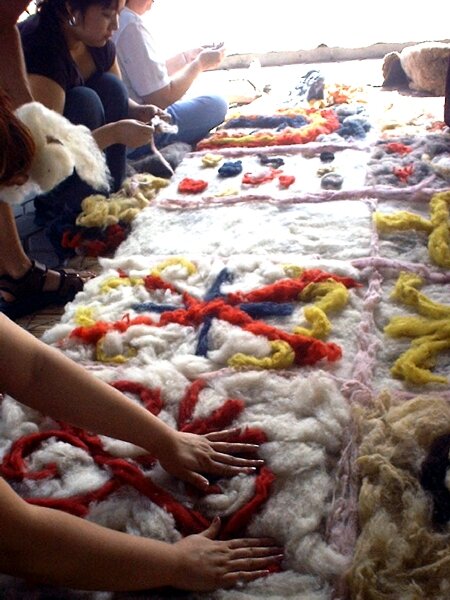
Postcard from Bishkek: the weekly postcard that I send out as an email also gets posted on the website ianbek.kg each week – and there are other postcards which don’t get sent out. This week for example there were posts about: A taste of home – an answer to the question if there is anything I miss from home, typical English condiments; How can you lose a seven storey building? – about how I went in search of meeting and the vagaries of the street numbering system here in Bishkek; Kurak – the traditional Kyrgyz handicraft of patchwork; the Forty Tribes of the Kyrgyz; the UNESCO designated Day for Audio Visual Heritage and what happens when something does go wrong on a tour.
Since I installed the “Flag Counter” just over a year ago, (in mid-September, 2010), the site has apparently been visited by over 10,000 people – from over 152 countries and territories. Most visitors have seen just one page, (presumably having found it through a search engine enquiry), but some have stayed for a longer look and over 22,000 pages in total have been viewed.
If you decide that you don’t want to receive these postcards in your email anymore, please drop me a line to and I will take you off the distribution list. Alternatively, if you know someone who might be interested in being added to the mailing list, then get them to drop me a line and I’ll be happy to do so.





 Bishkek