Barsbek
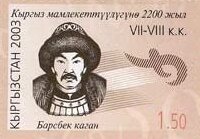
A stamp featuring Barsbek, issued in 2003
It was announced in August, 2011, that three new monuments would be constructed in Osh in time for the City Day October 5th. There would be one each to Manas, the legendary hero of the Kyrgyz, Barsbek and Alymbek Baatyr.
The “nobles” of the Kyrgyz state were called “bek” – or “beg” – and “Bars Bek” (Bek the snow leopard) was an honourific title which seems to have been applied to the leaders of the nation.
One leader in particular was called Barsbek, it is claimed that this ruler of the Yenesie Kyrgyz, and by some people to have been their first true ruler, and he is thought to have been part of the inspiration behind the epic hero Manas. He is also known by the honourific title “Umai Beg“, a reference to the claim that his family were descended from Umai – Mother Earth.
Although we know that he was a real historical figure, (he is mentioned, for example, he is mentioned in ancient runic chronicles), we know precious little about his life.
What we do know is that he lived at the end of the 7th century, through the beginning of the eighth century.
He was born into one of the ruling dynasties and had three, (or four), brothers, both older and younger. The family were followers of Umai Ene – the mother earth goddess, who was especially the protector of women and children. He lost his father early in his life and although not the oldest son, he rose to become the leader of the Kyrgyz.
According to some sources he was elected leader of the Turgesh Kaganate – a Turkic confederacy of nomadic tribes which came together in response to a rebellion against the local Chinese vassal. It was headed by a military commander from the Talas region, and they quickly captured the Silk Road city of Suyab, (which is near to Tokmak in present day Kyrgyzstan), from the rebels and made it their capital city. Shortly afterwards, the capital was relocated to the nearby city of Balasugin, the only city in Central Asia to escape destruction at the hands of Genghis Khan’s Mongol invasion centuries later. Today, all that remains of Balasugin is the Burana Tower and a mound where a citadel once stood.
Barsbek was granted the title ajo which was reserved for the Grand Khan of all the Kyrgyz, a post which was rarely filled as, at that time, the nomadic nations such as the Kyrgyz were really just bands of small nomadic communities rather than unified “nations”.
We know very little about about his everyday life but, apparently, one source tells us that he was a keen hunter and had a beagle which he was fond of.
In order to protect his people, he entered into a union with a number of local tribes and the Chinese Tang empire. He also set about fortifying the region. Although his works were aimed at defence, the Kyrgyz rose in influence, such that their presence not only impeded the expansion of the Turkic Kagan Khanate, they even rivalled the Khanate for power over the region. In 707, 709 and 711 he sent embassies to the Chinese Court and he even sent ambassadors the Tyurgesh Khanate and Tibet.
Matters came to a head in the winter of 711. Over the previous years the Turkic Khanate had successfully conducted a number of campaigns against local tribes to the south – preparing a route that pointed to the Kyrgyz heartland. Barsbek’s preparations included fortifications designed to prevent penetration from this direction. The Turkic army, however, found their way to the Yenesei over mountain passes to the North, which had been thought to be unassailable. A local guide undertook to show them a path over the mountains and although he was killed for failing to do so, (apparently he led them into a marsh and many of the soldiers drowned – it’s not clear if it was deliberate or not), the army did manage to negotiate a path across the treacherous mountain passes.
The Kyrgyz were taken by surprise, (it is said that they were attacked in their sleep), were routed before their powerful allies could be summoned to their assistance. Barsbek died in the battle.
A eulogy on the death of the hero exists, the Kyrgyz Koshok, (a Koshok is a dirge, lament or funeral song – it is also the “farewell song” sung at weddings when the bride leaves her family home to join the family of her husband). This Kyrgyz Koshok is considered to be the earliest known such eulogy ever discovered.
It is contained in an inscription on a memorial obelisk and a translation by V. Lastochkina is given in Tabyldy Akerov in his book “Ancient Kyryz and the Great Steppe (Following in the Tracks of Ancient Kyrgyz Civilizations)“:
On the left side of the obelisk:
My mother had me inside
Till the tenth new moon light
She made me unite my people,
I stood my ground with heroism
I fearlessly fight against the enemies
I’ve left my people in mourning. Alas!
On the front:
You sent your gifts to brothers
In the camel sacks.
You didn’t know surfeit
In your heroic exploits
You were the heroes
Without bringing up of fathers
Dogs were hunting on the game
Nomads!
You were hunting on the dogs.
Keep Out! The spirit of death
With your power, tremendous!
Be lost!
Snow leopard! Oh, snow leopard!
Don’t leave us! Don’t go away!
Alas!
Umay! Do run away!
Our rank is the same,
Brave men – the fighters of our people
You didn’t take the six of them,
You left your racehorses,
You didn’t take them
You left three dear vessels
Oh, treasure! Oh, dear snow leopard!
Don’t leave us!
As usual make glad! Us
On the right side:
Black game of my gold Sugna!
Do give a birth to prosperity in store
Snow leopard left the bulls and horses,
He left the World
And went in time. Alas!
For the sake of my martial heroism
And the power of my brothers,
Older brothers, younger brothers,
Who made unsmoulder monument,
For my sake!
(Updated: 21/11/11)


 Bishkek