It’s the Great Pumpkin Charlie Brown
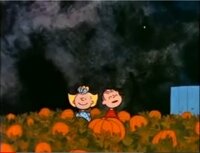
Linus and Sally waiting for the appearance of the Great Pumpkin in his "sincere pumpkin patch"
I like to surprise people sometimes by doing unusual things – like celebrating Beethoven’s Birthdayevery year, (that’s December 16th, by the way). Some people assume that I do this because I am a great fan of the composer but, although I do like his work, that’s not the original reason behind it. It’s all to do with Peanuts, the cartoon strip drawn by Charles M Schultz for nearly 50 years. I am a great fan of Charlie Brown, Snoopy, Lucy and Linus van Pelt and the rest of the gang. One of the characters is called Schroeder and, when he is not playing catcher for the baseball team, he is usually featured sitting at his toy piano playing some piece by his great hero – yes, that’s right: Ludwig van Beethoven.
Another of the Peanuts gang is Linus van Pelt and he has a number of endearing qualities, such as his attachment to his “security blanket” and his belief in the Great Pumpkin”
The Great Pumpkin is a holiday figure (something like Santa Claus or, for the Americans, the Easter Bunny – a tradition I have never really understood). The only problem is that the Great Pumpkin seems to exist only in the imagination of Linus van Pelt.
Every year, since the theme was in 1959, Linus has sat in a pumpkin patch on Halloween night waiting for the Great Pumpkin to appear. He only appears in the “most sincere pumpkin patch”, (and then flies through the air delivering toys to all the good little children in the world), and Linus is convinced that his pumpkin patch HAS to be the most sincere, (… whatever that means). Each year, however, the Great Pumpkin fails to appear and a humiliated but undefeated Linus stubbornly vows to wait for him again the following Halloween. Undeterred, Linus famously says: “There are three things I have learned never to discuss with people: religion, politics, and the Great Pumpkin.”
The theme became a regular feature of the cartoon and inspired an animated television special in 1966 called It’s the Great Pumpkin, Charlie Brown. In this clip from the film, (courtesy of YouTube), Linus persuades Sally Brown to sit with him and await the arrival of the Great Pumpkin rather than go out “Trick or Treating” – another tradition I have difficulty understanding.
.
http://www.youtube.com/watch?v=xiSIQzwIPzQ
It may be because I am British and grew up in the 1950’s and 60’s, but Halloween and “Trick or Treat” have never really meant that much for me. It was not part of our tradition, although I understand that it is more common these days as the influence of America and all things American seems to pervade communities and culture all round the globe. They are not part of Kyrgyz tradition, but over the last few years I have noticed that not only do the American ex-pats hold Halloween parties, but even some of the local children go out Trick or Treating. This may, or may not, be a result of exposure to Peace Corps volunteers, but I understand that a number who are placed in schools do celebrate Halloween as part of their activities, “sharing American culture”.
Note to myself: I must remember to get some goodies – sweets and biscuits – ready, just in case they come again this year. One more thing that I thought that I might do this year is make a pumpkin lantern … I think the kids might enjoy it. That is, if I can find one.
Actually, I should be able to because, although they are thought to have originated in the Americas – the earliest seeds having been found somewhere in Mexico, pumpkins do grow here and are part of the diet. The World Food Program has a project in which vegetable seeds are given to women’s groups to help increase the range and quantity of vegetables, not only for consumption, but also for sale in the local markets – often the sale of vegetable is the only source of additional income for some families. Some are sold in the markets, but you often see a Babushka, (“grandmother”), sitting on the pavements in Bishkek with a range of produce spread out in front of her which she is offering for sale.
They are usually used as either a supplement of replacement for meat in Manti, (stuffed steamed dumplings), Samsy, (similar to Indian Samosas and small Cornish Pasties, a form of “finger food”) and Oromo, (a steamed dish with layers of dough intermingled with a filling). (The links are to recipes on our site www.tastes.kg – there are French and Russian versions as well as English for anyone who is interested, click the appropriate flag in the top right corner of the page).
Pumpkin seeds are also sold as a form of finger snack to “nibble” on, but unlike in the states, only the kernel of the seeds are eaten, the shells being discarded.
.
For the record: Pumpkins are a gourd similar to a squash. The name pumpkin comes originally from Greek for “large Melon” and travelled through French until it became pumpkin in the Americas. Here, they are known as tikvah. They require warm soil which retains water well and can grow to somewhere between 4 and 8 kilograms. Most parts of the plant are edible. In China, even the leaves are used as a form of cooked vegetable.
.
For the record: I wrote a postcard about Halloween last year, so I won’t repeat what was written there.


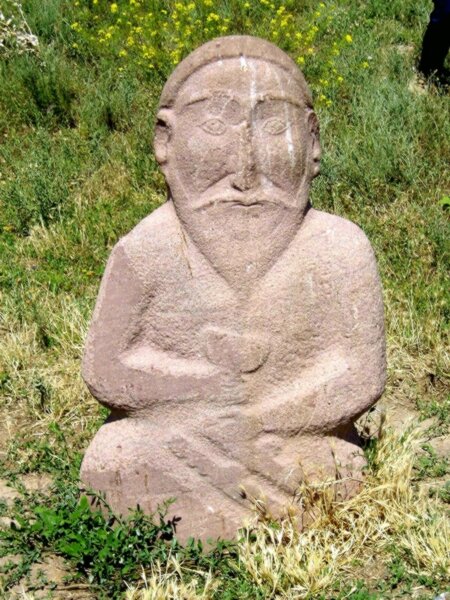


 Bishkek