Kolbassa
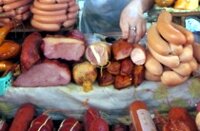
Sausages and cold meats in the market
As I sat listening to my regular download of the Archers, (tum-te-tum-te-tum-te-tum, Tum-te-tum-te-tummmm), I gopt a bit of shock as young Tom Archer was talking to his friend Jazza about their preparations for the upcoming British Sausage Week. “I can’t believe it’s that time of year again,” says Jazza.
“What’s that?”, I asked myself, “is this another example of my being well and truly out of touch with events back in my homeland after sixteen years here in Kyrgyzstan?”
Because I had never come across this before, I assumed it was new. After a little internet search. however, I discovered that it’s not all that new. The earliest reference I could find to it was in 2000: “The World’s longest sausage was made in October 2000 during British Sausage Week and weighed 15.5 tonnes and was 35 miles long!” Wow!
For the record: There seems, however, to be some doubt about that record. The renowned Guinness Book of World Records tells us that “The record for the longest sausage measured 59.14 km (36.75 miles) and was made by J.J. Tranfield on behalf of Asda Stores Plc, at Sheffield, South Yorkshire, UK on 27-29 October 2000,” and “The largest sausage weighed 1,740 kg (3,8402 lb 61 oz) and was made by Kayseri Greater Municipality (Turkey) in Kayseri, Turkey, on 4 October 2009.”
There also seems to be some doubt as to when the week is this year with one website saying it is between October 31st and November 6th and another claiming the week between November 1st and 7th. Looking at the dates for the last few years, it looks as if it is the first week in November.
It’s obviously an example of a “Hallmark” holiday – not that it has anything to do with that selling greetings cards, but in that it was designed as a marketing ploy in order to promote and boost sales. Mind you, I am not sure why it’s necessary when Brits eat three billion sausages each year, (that’s 186 210 tonnes!), spending over six hundred and fifty million pounds each year and , apparently, according to the Daily Telegraph there are “an estimated 1,720 different uses for sausages”.
Well the week should, at least, offer a good marketing ploy for David and Malcolm at Vis-a-vis, (the “British Butcher” here in Bishkek). They make a wide variety of traditional (British) sausages which are tasty and one of my favourites when there are a group of us is a plate of assorted sausages, downed with a glass or two of beer.
Sausages are usually made from ground meat, (most commonly pork or beef – although other meats such as veal, lamb, chicken and turkey are sometimes used), mixed with herbs and spices and encased in intestines. They represent an extremely old form of foodstuff; Homer even mentions a “blood sausage” in the Odyssey. Sausages allow a butcher to make the most efficient use of a carcass because they can include meat which although, edible and nutritious, are not particularly appetising such as the entrails.
There are many different types of sausages, the differentiation depending not just on the ingredients but also on the method of preparation, (for example: cured, dried or smoked), or the geographical region where they originated, (such as the Cumberland sausage in the UK).
Amongst those 1720 ways in which sausages can apparently be used (!) there are boiling, frying, grilling and steaming as well as being put in sandwiches or used as ingredients in other dishes, (such as “toad in the hole” – which I must try out on the kids one day), or being sliced and eaten raw.
Here sausages are either called sossiski, (which is a word obviously borrowed from the English Kolbassa and used for the smaller, thinner type of sausage), or Kolbassa, (which is probably derived from the Polish kiełbasa, arriving here with the Russians – although there are also Turkish possibilities such as kül bassï, which is a grilled cutlet.)
There are several varieties available, amongst the most common being Doktorskaya, (a sort of luncheon meat – useful in salds and sandwiches) and Moskovskaya, (an example of kopchornaya – a form of smoked sausage).
As might be expected for a basically agricultural society where livestock breeding plays an important role in society, where the traditional nomadic diet relied heavily on meat and none of the carcass was to go to waste, sausage making is nothing new for Kyrgyzstan.
Amongst the traditional forms of Kyrgyz sausage there are Chuk chuk, (made from horsemeat), Kyshki, (thin sausages made from mutton) and Bedji (mutton mixed with rice).
I remember my first encounter with Chuk chuk. I was in Naryn and one of the local dignitaries invited me out, za goroda, ( literally “out of town” but usually taken to mean “into the country side”), for a “picnic”. We drove about 50 meters beyond the city limits and the driver was told to stop the car. Now, it’s true that we were we were in a picturesque spot by the side of the river and, literally, “out of town”, but I was surprised because it didn’t exactly correspond with my idea of “into the country”. The “picnic” didn’t exactly correspond with my idea of a picnic either. Out came the customary bottle of vodka and a single sausage – Chuk chuk.
The sausage was about 25 centimetres long and had a diameter of about 3 centimetres. Unfortunately about 75% of this diameter comprised of fat – pure unadulterated fat. Now, one of the elements of local cuisine which is not to my taste and which I find extremely difficult to stomach, (pun intended), is the fatty nature of many of the dishes. Some sausages contain a lot of fat, (some may contain as much as 50%), but this pure concentration of fat was just to much for me to bear. I stood with a rumka, (a shot glass), in one hand and a slice of Chuk chuk in the other wondering which one to down first and thinking, “which is worse?” I am ashamed to say that I pointed into the distance saying something like “Oh look over there, what’s that?”, and whilst everyone’s attention was diverted disposed of the offending articles – but not into my mouth. That was actually a mistake because my host noted the empty glass and immediately topped it up; noted the other empty hand and put another slice of chuk chuk into it … this time there was no escape.
Since then I have often eaten chuk chuk. It’s often, for example, served up at tois, (family celebrations), and people often wait until you have swallowed your first mouthful before they tell me it’s made from horsemeat. Presumably they have seen the reaction of other Westerners when they have been told this and they want to see how I will react. Fortunately, I had eaten horsemeat on several occasions even before I came to Kyrgyzstan and as, thankfully, the chuk chuk I have been given has come nowhere near those first slices in terms of fat content, I am able to pass this test “with flying colours”.
For the record: They even have slabs of fat, (saalo – pronounced saala), which is often eaten raw, (or, at least, seasoned). As it happens, I am not unused to the idea of slabs of fat – at least for cooking; my mother used to buy slabs of “lard” for frying and my father loved a good, greasy, “fry-up” of the “traditional English Breakfast” of Bacon and Eggs fried in a sea of melted lard – especially on a Sunday morning. Personally, however, I never really took to it and when I started cooking for myself I nearly always used cooking oil of one sort or another for frying.




 Bishkek