Who’s the cake for?
The day began with music blaring out of my computer from a CD in the Drive. This doesn’t happen very often, but is an annual event on December 16th, as is the “birthday cake” which arrived later in the day. Now, the people of Kyrgyzstan enjoy a celebration and they take every opportunity to join in any festivities, so birthdays are pretty important events here.
So, who’s birthday was it?

The answer often surprises people … Ludwig van Beethoven.
I have been commemorating Beethoven’s Birthday since 1977 and it has now become somewhat of an eccentric tradition. Some people assume that I do this because I am a great fan of the composer but, although I do like his work, that’s not the original reason behind it.
It’s all to do with Peanuts … not the sort that you make butter from, but the cartoon strip drawn by Charles M Schultz for nearly 50 years. I am a great fan of Charlie Brown, Snoopy, Lucy and Linus van Pelt and the rest of the gang. One of the characters is called Schroeder and, when he is not playing catcher for the baseball team, he is usually featured sitting at his toy piano playing some piece by his great hero – yes, you’ve guessed it: Ludwig van Beethoven.

As the end of term approached in 1978, the usual “end of term” and Christmas preparations were underway: rehearsals, for example, for the Carol Concert and the school play. I decided to play a little prank, and started little notices appeared in the staff room on the wall above the noticeboards, each sporting a picture of a Peanuts character and a number – 25, 24, 23 … a countdown of the number of schooldays left to … December 16th.
As I tended to arrive early in the morning, before anyone else, I was able to get them up on the wall without anyone knowing that it was me.
At first they attracted little attention, but after four or five were up people started to talk about them … who was putting them up? … and what did they signify? As we approached the final stages of the countdown, things started to go wrong … there was a pay dispute and one of the teachers’ unions had given notice that it intended to take industrial action … and some people suggested that it was a countdown to that, which created a certain amount of tension. Only about half the staff were members of that union and so feelings between the different camps began to run high. If they had thought about it, however, and done the reckoning, then they would have realized that the countdown would end on the Friday 16th and not the day of the proposed industrial action. Still the suspense continued.
Then, one day, I had to be absent from school – I was going on a training course – and I had the dilemma of how to place the cartoon on the wall. I approached a member of the Mathematics Department who was also an “early bird” and usually arrived just after me. I came clean, explained the situation and asked if she would help me out. She was slightly bemused, but relieved to discover it had nothing to do with the industrial action, and agreed to help me out. That helped to deepen the mystery and take the suspicion away from me. I actually took part in a conversation where someone pointed out that I could be the person behind the mysterious postings as I always arrived early and could have put them up before anyone else arrived. Fortunately, one of my other colleagues intervened to point out that it couldn’t be me because one appeared on that day I was absent on a training course. Margaret and I kept our silence and enjoyed watching everyone trying to guess who? – what? – when? – why?
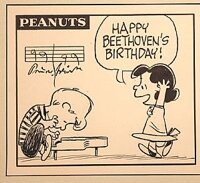
As people arrived to work on the day, they were surprised to be greeted by a recording of the Ninth symphony – and a banner proclaiming “Happy Birthday Ludwig”. Then at morning break, there was a small birthday cake and people helped themselves. Actually, it was a very small cake and the pieces were very tiny – I learned from that for future years.
To be honest, I am not sure how many people on that first occasion actually understood what was going on.
The next year I started a new job in North London, and tried the same trick. It worked a treat. There were no diversions like impending industrial action, and as the school was based on a single site, (not three), the staff were more of a single unit.
In subsequent years, of course, there wasn’t the same element of element of surprise. That’s not to say there wasn’t any surprise. The next year, for example, I didn’t bother with the countdown and just had the music and cake – people walked into the staffroom and were taken aback to be greeted by the music, but then the look of recognition came across their faces as they asked, “Oh, is it that time of year again?”. Then again, there were always the new members of staff who had joined the school since the previous December.
Sometimes, the event got bigger. One year, for example, we decorated the staffroom and bought in special coffee from a local coffee house. The cakes definitely got bigger as people started to look forward to the event. I always tried to make sure that everyone was invited to the staff room and got a piece of cake, (such as secretarial staff or lab technicians), not just the teaching staff. Sometimes I would be asked: “When is Beethoven’s Birthday?” – or “Why don’t you do it one for Mozart as well?” We even had people, such as retired teachers, choose December 16th to come to the school to visit old friends and pass on Christmas Greetings to former colleagues.
This year, I even received a message over Facebook from a former colleague who asked me: “Do you still celebrate Beethoven’s Birthday?” … I was happy to tell her, “Yes, we do”.
.
As an aside: I notice that here in Bishkek they have just renamed one of the streets after Frederick Chopin. I wonder if they’ll also name one after Ludwig one day …
… or his great fan, Schroder, or Charlie Brown, or Charles M. Shultz.
For the record:
Beethoven is considered to have been one of the most famous and influential composers of all time.
Born into a musical family in Bonn in 1770, probably on December 16th – but, to be honest, we don’t know for certain as there are no records of the actual birth. We do know, however, that he was baptised on the 17th and it was common practice at that time for the baptism to take place just one day later – and anyway, there is evidence that the family celebrated his birthday on December 16th.
Of the seven children born to his parent, only Ludwig and two of his younger brothers survived into childhood. His musical talents manifested themselves early on and he was only seven when he gave his first public performance in 1778, at thirteen his first published composition appeared and a year later he started to draw a salary as an assistant organist.
He moved to Vienna in his twenties and settled there. He studied under Haydn and quickly gained a reputation as a virtuoso pianist. In fact, in his early years he concentrated on his playing rather than composition, although he was particularly known for his improvisations. It was later that he turned to composition, creating many well known, easily recognizable and popular works.
His hearing began to deteriorate in the late 1790s, yet he continued to compose, conduct, and perform, even after becoming completely deaf. There is a story that following the initial performance of the Ninth Symphony he turned round to face the audience and saw them in rapt applause – hearing nothing, he wept.


 Bishkek