The long and winding road
It’s been a long and tiring week.
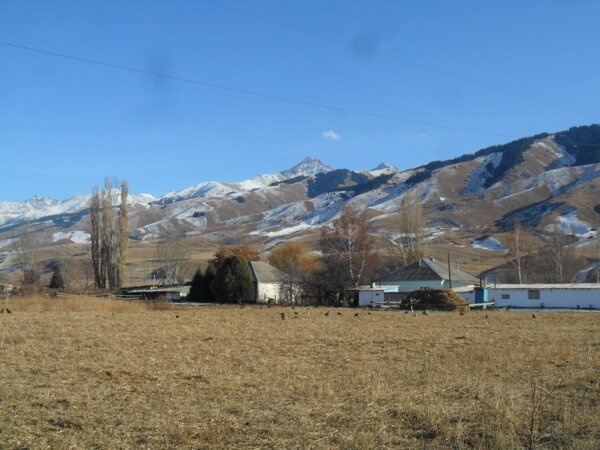
It began with my regular monthly trip up to the guesthouse in Naryn. This month we decided to take the opportunity to have a long weekend and visit Karakol as well. The result was three days of travelling – something like seven hours in the car each day, even though each leg of the journey was just 350-450 kilometers. To make matters worse, the condition of the road has deteriorated over the years and is now extremely uneven, slowing us down even further. Whereas we used to be able to travel up to Naryn in something between four and five hours, we haven’t been able to do t in less than five for about a year now.
Still, not to waste the time, I managed to listen to a number of podcasts on my mp3 player and did quite a lot of reading: about the European Reformation, some short stories by the Irish writer John B. Keane and some of the “Just So” stories by Rudyard Kipling.
The reason behind this itinerary was to take Victor Rehemaye with us in order to take some photographs and panoramas for our website www.see.kg. He is in the process of editing the panoramas which will be posted shortly.
First of all, on Saturday, travelling from Bishkek up to Naryn; the journey normally takes about five hours, but they are doing work widening the road which is one of the few major trunk roads in the country. This has caused a certain amount of disruption to traffic, especially in Boom Gorge, (which translates as “Shoestring Canyon” – which gives some idea of how narrow the road is at the moment). It has also resulted in the road over the Kuvak Pass, (between the main road and the Orto Tokoi Reservoir and Kochkor), being closed, which meant a long detour up to Balykchy and Lake Issyk Kul, adding almost an hour to the journey.
The roadworks, (and their cost – each kilometer in Boom Gorge is said to cost a million dollars with a n umber of donors granting funds to help meet the cost), has been in the news quite a bit this week, and there is even talk about setting up a system of toll roads around the country as a way of financing the development of the road network in the country. It will be interesting to see how this works out, but it is obviously a long term project.
Whilst we were in Naryn, Victor took some panoramas of the guesthouse and Naryn which should be ready for posting this weekend.
Then on Sunday we travelled from Naryn up to Karakol, the administrative center of the Issyk Kul oblast. It’s a relatively old city, (for Kyrgyzstan), and an interesting mix of styles and cultures. The guidebooks all refer to it as a Russian colonial town, (it was established as a garrison town in the days of the Tsarist Empire), and special mention is given to the architecture of colonial buildings, although there are also Soviet and more modern styles as well. I like Karakol and find it an interesting, friendly and even, to some extent, a romantic city. (You can find more about the history of the city in the postcard: http://ianbek.kg/?p=3733) We particularly wanted to get some photos and panoramas of two of the main sights in the city: the Russian Orthodox Church and the Dungan Mosque.
Finally, on Monday, we returned back to Bishkek. On the way we called in on two of the most enchanting valleys in the country: Djety Oguz and Skazka. Djety Oguz is famous for a couple of rock formations: the “Broken Heart” – a solid slab of red sandstone rock which resembles a heart which has been rent asunder, and the Seven Bulls, (which is what Djety Oguz means in Kyrgyz), a series of red sandstone cliffs. It is most of the tour itineraries that travel through this part of the country, so sees many tourists throughout the year. Skazka, on the other hand is relatively unknown. Just a short distance off the road which skirts the southern shore of the lake, this dry valley has a number of strange rock formations, and multi coloured striations of different rocks, that resemble castles; the “Great Wall of China” and even petrified monsters such as Dragons.
I’ll post some separate postcards about all these places on ianbek.kg in the coming weeks.
We got back to Bishkek after our long and tiring weekend late on Monday evening, and I sat down to catch up on all the correspondence, accounts and other work that accumulated in my absence. It is surprising how quickly a huge backlog of work amasses.
.
I found it difficult to get down to work on my return to Bishkek. There seemed to be so many interruptions that I wasn’t really able to get a straight stretch of even half an hour to concentrate on a single task. It reminded me of the “mental gymnastics” involved in being a school teacher, jumping from taking a class in basic arithmetic one moment and having to switch to the intricacies of differential equations when the bell rings and the thirty eleven year olds in front of you are replaced by a small group of sixth formers.
The sad part, and the interruption I would have been happy to do without, was going to order the headstone for Roma’s grave, (my friend who died last year). Normally we’d try to erect it for the anniversary of the death but, as that was in January when there was snow and mud on the ground, we decided instead to do it to mark his birthday in July.
Fortunately, however, most of the interruptions were good news … and very welcome distractions. There was, for example, the gift of Marmite, (which you can’t get here … ), and a copy of Ella Maillart’s “Forbidden Journey” which I mentioned in a precious postcard, (Thank you Denis and Nicole!) That will keep me occupied for some time – especially as I cross reference it with Peter Fleming’s account of the same journey.
There was also a reception for the Asia Mountains Guesthouse, here in Bishkek, which was celebrating its tenth anniversary. Although we are technically competitors, we are also colleagues, and it was good to see that they are coping in these difficult times when the number of tourists has taken a considerable downturn. The government seem to be getting their act together as regards the problems facing tourism … at least they have announced the long awaited tender for the development of a new tourism policy and there are discussion about revising the country’s visa regime.
Then we had a visit from Roza who used to manage the Silk Road Lodge for us, back to visit her family after five years in the States. Other visitors have included a number of tourists and one of our investors from Australia.
.
As the anniversary of last June’s events in Southern Kyrgyzstan approaches, we are travelling along another “long and winding road”. Unlike our trip, however, where we knew our final destination each day, it’s not clear where the twists and turns are taking us.
There has been a lot more attention being focused on the results of the different inquiries that have been held. Accusations are flying around about who did what, and why each commission came to the conclusions that they did. As seems to be quite common here, there is talk about decisions being “bought” and accusations of huge sums of money changing hands before, during and after the calamitous affair.
There has been much discussion about who is to “blame”, President Otunbaeva pointing out that both communities suffered and that there shouldn’t be a concentration on one ethnic group as “victims”. The blame seems to be fairly evenly spread amongst the “usual subjects”, (members of the former regime – not Bakiev himself; members of the interim government; “separatists”; criminal elements, religious extremists and terrorists. There are even suggestions being made that at least some of the blame for the events, lies at the feet of international agencies and non-governmental organizations who were pursuing their own agendas.
Even some of the most unlikely groups seem to be getting caught up in the furor. The internet, for example, has seen some articles on the conviction of a couple of Jehovah’s Witnesses in the Batken region, in the South of the country, for possession of extremist materials tied to the Hizb ut Tahir movement, although I haven’t seen any mention of this in the local press.
The President has drawn attention to the need to reform the armed services, to make It reflect the ethnic mix of the population as a whole. This was one of the major criticisms levied last year when the troubles down south erupted. Because the army is predominantly Kyrgyz it was accused of coming to the aid of the Kyrgyz community rather than generally trying to restore order. One of the parliamentarians, however, has since suggested that the return of some thousands of refugees displaced as a result of the events implies that they have implicit trust in the authorities to protect them.
The government has also been looking to see how it can improve its response to this and other crisis situations, (e.g. earthquakes), by adopting a Crisis Management System modeled on the one employed in France so that in future it can react in a rapid, appropriate and effective manner. Therev have also been discussion with the Koreans about how they deal with emergencies. It is good to see that they are taking this seriously.
Another interesting development, showing that at least some people are thinking “long term”, was a round table conference that discussed the likely effects of climate change on the country. It was suggested that the changes will possibly lead to a shift in natural conditions and zones, (desert, steppe, meadows, forests, etc.), higher up the mountain slopes by between 100 and 300 meters above where they are found at present. The change in the average annual air temperature and rainfall, may lead to increased incidences of infectious and cardiovascular diseases and affect the types and conditions for growing crops as well as an increase in the intensity and frequency of natural disasters; changes in runoff of surface water, (including the fall of water levels in lakes and reservoirs).
Two of the largest foreign investments in the country are facing problems … the Kumtor gold mine and the Reemstma tobacco company. There has also been a shake up of the leadership of the Kyrgyz Oil and Gas Corporation leading to protests which blocked the main Bishkek-Osh Road for a while, led to the resignation of one minister (although he claims it was for health reasons) and allegations of “manipulation” against the governor of the Djalal Abad oblast.
There have, however, other less controversial developments throughout the week: various agreements about development of the hydro electricity potential of the country, for example, or attention to the Town Plan for Bishkek with an emphasis on developing the residential districts on the outskirts of the city rather than the central downtown district.
.
As the week comes to an end, I can’t help thinking that, no matter how tiring last weekend was, it would be nice to get out and about again … to travel another long and winding road. The kids are already asking about the possibility of going up to Issyk Kul once again, so who knows … maybe next weekend.



 Bishkek