The Big Day …
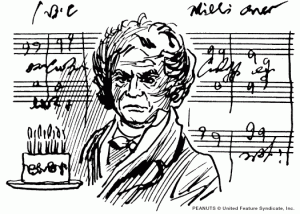
Happy Beethoven’s Birthday!
I often say that, “Every day is a special day … for someone”.
It may be a religious or National holiday, and anniversary of some event that happened in the past, of a commemorative day – whether, that is, me it be one of the official UN designated theme days, or a locally designated Professional Holiday. It might be special simply because it is somebody’s birthday.
Today, for example. is Beethoven’s Birthday.
.
For some reason, most people seem to consider the Twenty-fifth is the “Big” day in December … after all, it is Isaac Newton’s Birthday, in case you had forgotten … but I tend to disagree. I think there’s plenty of competition for that title,
For example, there is: World AIDS Day (1st); Human Rights Day (10th); the Winter Solstice – in the Northern Hemisphere, that is, Down South it would be the Summer Solstice (21st/22nd); and even New Year’s Eve (31st) … in addition to Christmas Day – somebody else’s birthday, at least nominally (25th).
… whilst some other days also have more local significance: The Restoration of Independence Day – in Portugal (1st); Union Day – in Romania (1st); The Birthday of the King of Thailand (5th), The Emperor’s Birthday – in Japan (23rd) and Washington’s Birthday – in the US(26th); Constitution Day – in Spain (6th); Pearl Harbour Day – in the US (7th); the Bill of Rights Day – in the US (15th); the Day of Reconciliation in South Africa (16th); Turkish Language Day (21); Rizal Day – in the Philippines (30th);
… and the National Days of Portugal (1st), the UAE (2nd); Finland (6th), Kenya – Jamhuri Day (12th); Bahrain (16th); Kazakhstan (16th); Slovenia (26th)
… or of religious significance: Sinterklaus Day (5th) and St. Nicholas’s Day (6th); The Day of the Immaculate Conception (8th); Bodhi Day – commemorating the enlightenment of the Buddha (8th); the St. Lucy Day (13th); Yalda – the birth of Mithra (21st); The Solstice (21st); Hanukkah and the Demise of Prophet Muhammad and Martyrdom of Imam Hassan (movable holidays, the date varies from year to year); St. Steven’s Day – Boxing Day (26th); Holy Innocents’ Day (28th); St Sylvester’s Day (31st)
… a commemorative Day: International Day of Persons with Disabilities (3rd); International Volunteers’ Day (5th); International Day of the Mountains (11th)
… or secular, (Hallmark), days such as: Egil Skallagrimsson’s Day (9th); Monkey Day (14th); Zamenhof Day – celebrating the Esperanto language (15th); Festivus and Human Light Day(23rd) … and not to forget Kwanzaa and Yule which stretch over several days
… and, I am sure that there are many, many more, that I haven’t mentioned.
Some of these “special days”, (such as Festivas, Kwanzaa and Newtonmas – December 25th), are “parody festivals” – which aim to mimic or draw attention away from the hype and commercialization of Christmas. Others are more serious and commemorate specific issues, causes events or people – such as the execution of the Filipino nationalist and national hero, José Riyaz.
I tend to commemorate December 16th as Beethoven’s Birthday … partly, to be honest, as a joke – the idea arose out of Charles Schultz’s Peanuts comic strip, partly as a protest against Christmas and New Year excesses … and partly as an opportunity to concentrate specifically on … Music.
.
Music, (using sounds to convey meaning, mood and emotion), has always held an important place in human culture and development.
Now, Kyrgyzstan has a rich musical heritage which can be traced back back to ancient times, to the nomadic lifestyle of the peoples, its place on the ancient Silk Road and encompasses and eclectic mix of genres.
Pride of place, of course, goes to traditional, nomadic, Kyrgyz music. In fact, there were several different types of traditional music: vocal and instrumental. As with all cultures there were, for example, work songs, celebratory and ritual music. The themes embodied in the music and the sources of inspiration encompassed happiness and sorrow, love and courage, freedom and equity and the relationship the nomads enjoyed with the natural environment.
Over many centuries, songs and music were handed down from generation to generation amongst the nomadic Kyrgyz creating a rich heritage, both oral and aural, and it was only when they came into the Russian sphere of influence that their traditional music was written down in any form, yet alone in musical notation. The Russians also brought many different forms of music with them.
Such traditional Kyrgyz music, complete with a performance by a manaschi and competitions between akyns, (a form of traditional bard), are often a feature of the many festivals which take place throughout the summer. One thing that all the performers seem to have in common, whether professional or amateur, youth group or adult ensemble, is an infectious enthusiasm for their music … an enthusiasm which is invariably transferred to their audiences.
With over 80 different nationalities represented in its population, however, the Kyrgyz Republic has a wide range of ensembles, or troupes, which give performances, often complete with national costume, which adds interest to, and enriches, a visit to this remote mountainous country.
The arrival of the Russians brought new instruments and a different musical heritage – what, in the West, we tend to refer to as Classical Music … including, of course, Beethoven.
Classical Music in Kyrgyzstan is represented by Philharmonic Societies, a Symphony Orchestra, Chamber Orchestra, the orchestra and companies of the Opera and Ballet Theater and the State Choir.
The Philharmonic Society was founded in 1936 – and the leader of the society, Shubin, set about establishing the republics first professional orchestra. As well as being a talented classical musician and conductor, he was a connoisseur of traditional music – and brought into the society the best performers of traditional instruments of his day. Shubin’s orchestra also performed a wide variety of classical music, by Russian, Ukrainian and European composers. He also established a number of smaller ensembles and a choir.
The Kyrgyz State Academic Orchestra was founded in 1936 – and consisted of 16 musicians who performed on traditional folk instruments. Gradually, some Western instruments were introduced, (the oboe, clarinet, bassoon and drum), to supplement the traditional timbre as the number of players and the repertoire grew.
The Kyrgyz State Choir was established in 1938 and the formation of the Union of Composers followed a year later. Of great importance in shaping the development of music in the country, however, came with the Great Patriotiuc War, (World War Two), when the Pyatniskiy State Russian Choir and the State Symphony Orchestra of the USSR were evacuated to Frunze, (as Bishkek was then known). Symphony music, developed particularly in the post war years and sometimes local composers would incorporate both local traditional instruments and Western Classical instruments in the compositions.
In 1969, the Kyrgyz State TV and Radio Symphony Orchestra was established to perform both works by local composers and pieces of the world’s classics for the broadcaster’s library. It made many recordings, and traveled far and wide, entering International festivals.
Since 1984 the Philharmonic Society has also featured a Chamber Orchestra. As well as performing in Bishkek, the various ensembles and orchestra have been on several international tours.
The first home of the Society was in the building which is now the “Metro Pub” on the corner of Prospect Chui and Turisbekova Street in Bishkek. In 1958 it moved to the building which houses the KyrgyzPromStroi Bank (Kyrgyz Construction Bank) opposite it’s present home, the marble edifice of the Philharmonia, which was constructed in 1981.
In addition, there is a strong, traditional, commitment to musical educational and a number of specialist Music Schools exist, as well as a conservatory.
There have been a number of notable composers, such as Vlasov, (who, although he was born in Moscow, settled in Kyrgyzstan and played an important role in the development of classical music and musical education in the Republic), and the homegrown Abdylas Maldibaev.
In Bishkek there are several venues which offer musical programmes, but perhaps the three most important are:
- Philharmonia – on the corner of Manas and Chui – There are two concert halls, (large and small) which feature concerts of classical, traditional Kyrgyz, and pop music as well as variety shows.
- The Opera and Ballet Theatre – on Abdrakhmanove, (which is probably better known by its former name: Sovietskaya) – the theatre has resident opera and ballet companies and there are sometimes performances by visiting companies as well. The season is usually held between Autumn and Spring – although there may be performances at other times of the year as well. There is a ballroom, which is also sometimes used for concerts.
- The Conservatory – 115 Jantosheva – occasional concerts by students and professors.
The English author GK Chesterton may have thought that “music with dinner is an insult to both the cook and the violinist”, but it is commonplace to encounter either live performances, or “canned” music in many of the country’s restaurants. Some performers concentrate on classical or “easy listening” music, whilst others specialize in Jazz, Pop, Rock and Rap music and it is also possible to find groups performing traditional music song and dance. Basically, there is something to suit almost every taste … if you know where to look.
Finally … no celebration of Beethoven’s Birthday would be complete without a rendition of at least some music … Right, Schroeder?:

You do know the words … don’t you?





 Bishkek