The Theatre of Opera and Ballet
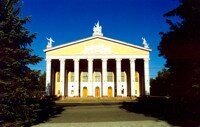
The Opera and Ballet Theatre
The Royal Opera House in Covent Garden, London, opened its doors on December 7th, 1732. Home of The Royal Opera, The Royal Ballet, and the Orchestra of the Royal Opera House, this large building in the centre of London seats over two thousand people in four tiers balconies and “boxes”, and is one of Britain’s major performing Arts venues.
Originally a playhouse, the first ballet was presented in 1734 and a year later, Handel’s first season of operas began. (Handel had a particular affinity with the theater and many of his operas and oratorios were specifically written for Covent Garden and had their premieres there.)
In fact, the current building is not the original. Two previous buildings were victims of fire in the nineteenth century, (in 1808 and 1857). Although the façade, foyer, and auditorium date from 1858, almost every other element of the present complex dates from an extensive reconstruction in the 1990s.
The State Academic Theater of Opera and Ballet named after Abdylas Maldibaev here in Bishkek doesn’t have such a long and distinguished history but then, Bishkek doesn’t have such a long history as London.
Building started on the theater in 1952 and it opened its doors on May 15th, 1955. Land had been assigned to project on the edge of Pafilov and Oak Parks. Construction wasn’t easy.
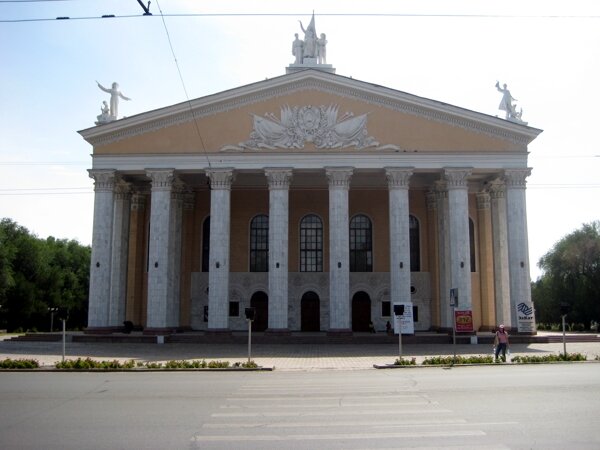
The architects were Laburenko and Ivanov and their classical design with colonnade is a distinctive city landmark. Ivanov had a major impact on the development and face of the city because, before the war he had been the city’s chief architect and in that role he had established the Kyrgyz School of Architecture. As well as the buildings that he was personally responsible for, a whole generation of Kyrgyz architects studied under his influence and count themselves as his pupils.
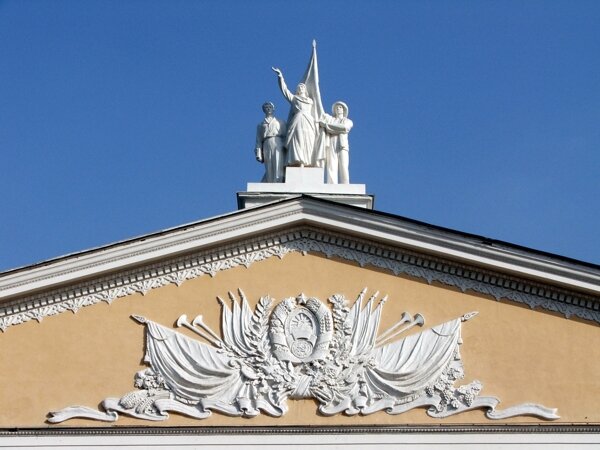
Although the design is functional, to serve as a theater, it is also akin to a gallery with its rich decorations, recently renovated, and of historic interest with its communist symbols and symbolism, including: the communist red star and the fresco of the coat of arms of the Kyrgyz Socialist Soviet Republic over the main entrance.
Many of creative geniuses in the Republic at that time were gathered together and employed in the decoration of the building. These included the monumental sculptress Olga Manilova who created many of the wartime monuments that decorate the city, and the painter Aitiev in whose honour the Museum of Fine Arts is named.
The building is set back from main road, (Abdrachmanova Street, but more commonly known by its former name of Sovietskaya), and the paved area in front of it makes a piazza for people waiting to meet friends before going in to take their seats. Banners announcing forthcoming performances are usually placed between the columns at the front of the building.
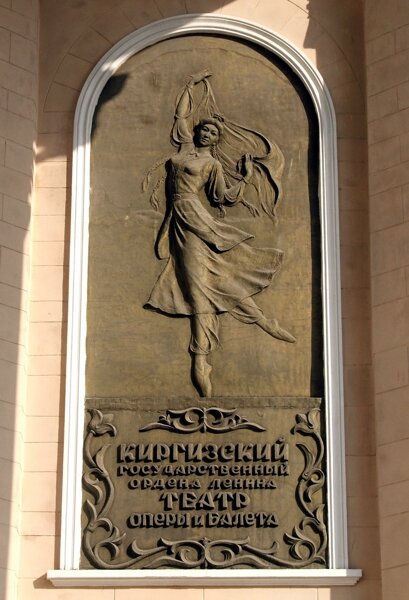
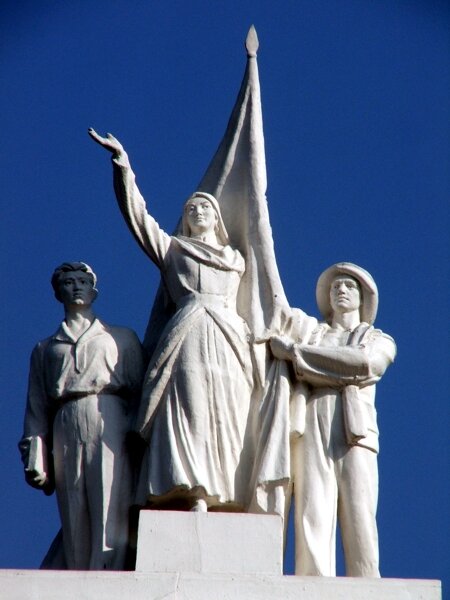
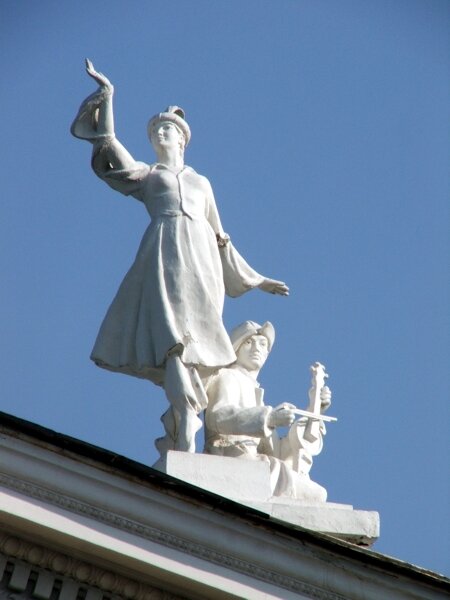
Amongst the several statues around the building, there are two figures representing “Youth” flank the main entrance, a male figure by Koshkion and a balerina by Manilova. Manilova also created three sculptural complexes for the roof of the building, two figures on the corners of the building and one for the apex over the center of the entrance. The central composition comprises a dynamic young woman in national costume flanked by a worker and a student representing the present industry and the bright future of the republic.
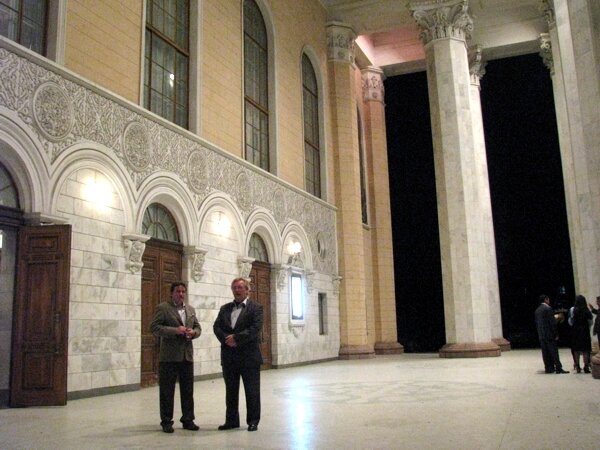
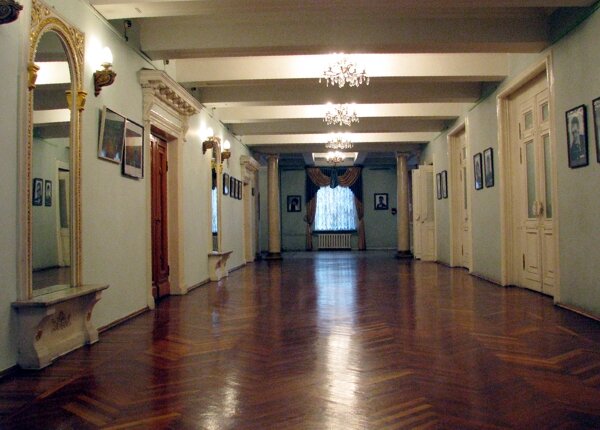
Although fairly spacious, the main foyer or entrance hall is often crowded as only one of the available doors is usually used and a there is often a crowd around the two counters in front of the cloakrooms on either side. In the corridors behind these cloakrooms are small bars where drinks and snacks are available both, before the performance and during the intervals – but even though they can get busy during the intervals, these bars don’t get anywhere near as busy the ones in Covent Garden.
From the main foyer, some steps lead up to the entrance of the auditorium … which opens out as you pass through what feels like a tunnel into a major sporting arena. Over this tunnel is the Presidential Box. There are some other boxes at the side of the stage and the winds of the balcony, but most of the audience is accommodated in the main well of the auditorium.
The ceiling of the auditorium includes some 15 characters representing the nationalities of the Soviet Union, characterized as one of the heroes from classical or national opera, (for example: Tchaikovsky’s Evgueny Onegin and Maldivaev’s Aichurek from the world of Opera and Tchaikovsky’s Swan Lake and Rauchverger’s Cholpon from the world of Ballet).
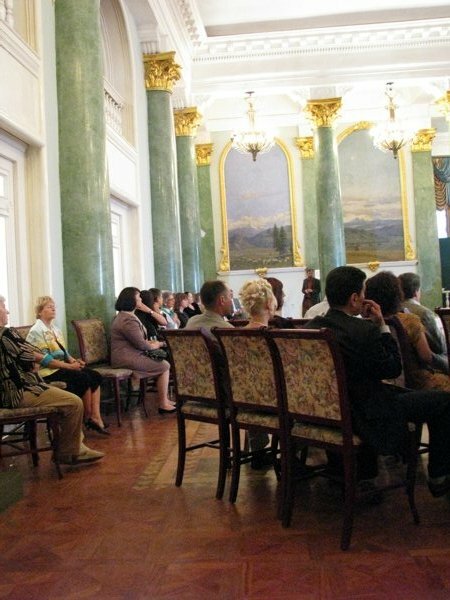
The small balcony is reached by two staircases from the foyer – one on the right and the other on the left. Behind the balcony in the auditoria there a large spacious foyer, which is occasionally used for concerts and other functions. It is richly decorated with landscape paintings representing different mountain regions and life in the republic, such as: The cotton fields of Southern Kyrgyzstan and Lake Issyk Kul.
The company includes over 200 different operas and ballets in its repertoire, including: Boris Gudunov; Prince Igor; Evgeniy Onegin, Iolanta, Swan Lake, Sleeping Beauty, Aida, Rigoletto, Il Traviatore, Carmen, Don Carlos, Faust, Mestopholes and, of course, local compositions such as Cholpon. Most of these are still performed … although they don’t manage 200 performances a year any more.
The theater also hosts performances by visiting artistes and companies from, for example, Kazakhstan, Russia, France and further afield.
Performances are usually held at weekends and tend to start early … at 4:00, 5:00 or 6:00pm.














 Bishkek