It’s not a joking matter
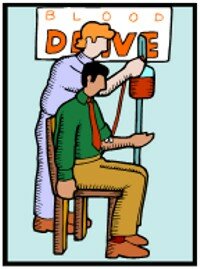
Today is World Blood Donor Day
One of the classics of British television humour was an episode of Hancock’s Half Hour called The Blood Donor.
First broadcast in June 1961, it was one of the last episodes he made for the BBC and recorded shortly after a road accident. As a result he ended up reading his lines and aficionados often say that it is not one of his best.
Some of the humour is a little dated but – at the beginning, for example, when he arrives at his local hospital to give blood, he tells the nurse that he wanted to do something to do something good and it was either give blood ” or join the Young Conservatives”, before getting into an argument with her about whether British blood is superior to other types. That’s just one example of of how he manages to offend other people and exposes his character’s simple ignorance and prejudice.
Actually, giving blood is no joke … and today is another one of those designated Commemorative Days: World Blood Donor Day, which was first celebrated by the World Health Organization (WHO) in 2004. Like most of these days a theme is chosen every year and last year’s was Give the gift of life. Countries around the world were encouraged to highlight stories from people whose lives have been saved through blood donation, as a way of motivating regular blood donors to continue giving blood and people in good health who have never given blood before, particularly young people, to begin doing so.
For the record: This year’s theme is Safe blood for saving mothers – highlighting the essential life-saving role of blood transfusion in maternal and perinatal care
Many countries around the world do not have an adequate supply of safe blood – at the moment only about 60 countries are – and the WHO have an aim that all countries will be self sufficient in the supply of blood products in voluntary donations before the year 2020. This shortage creates many problems – not only in collecting donations but also of ensuring the quality and safety of what supplies they do have. Kyrgyzstan also has that problem. Earlier this year, for example, the Republican Blood Center announced the shortage of supplies – especially in the rare blood groups. At the moment, they reported that, although almost 35000 people gave blood last year, only about four thousand active donors. That’s only about 0.6% of the population – whereas WHO estimate it should be about 4% for the country to be self sufficient … so there’s a long way to go if we are to meet that 2020 deadline.
About three quarters of that blood comes from friends and relatives of the patients. On several occasions I have met people who have been going around their relatives and friends seeking donors … because one of their family is in need of an operation and the doctors have asked them find donors to help replenish the equivalent amount of blood that they will use in the operation … although it doesn’t have to be a match for the same blood group … although that obviously helps when it involves one of the rarer groups for which there is a shortage.
Although it is, literally, a life saving service, it’s not been without its fair share of controversy … apart the shortfall of supply, there was the case a few years ago where a number of children in Southern Kyrgyzstan who contracted HIV from having been given contaminated blood – a situation we are assured will not be repeated as a result of the reforms that were subsequently introduced.
As a student I was a blood donor, but once I started working I lost contact with the service and here, I have discovered, I cannot give blood – it just so happens that donations are not accepted from citizens of a foreign country. There are other people that are turned away – for a variety of reasons … if, for example, they are taking medication. Donors are advised about how to prepare for a donation session – for example, about what to eat to and drink in the days leading up to the visit to the blood center – and afterwards – the need to rest to allow a full recovery and, again, what to eat and drink. Donors are also advised that they, even if the volume of blood in the body is replenished within a couple of hours, they should allocate about two months between successive donations … so they can visit the donor unit maybe 5 or 6 times a year – but not more frequently.
.
In English we have a phrase about “trying to get blood from a stone” implying that something is well nigh impossible – as in trying to find Andy Capp a job is like getting blood from a stone.
We often talk about “transfusions” in other contexts as well – particularly in economic terms. In some respects we’ve had a number of transfusions which have helped to sustain the Kyrgyz economy through “difficult times” … and we’ve certainly seen some difficult times …
The support of the international donor community, for example … although there is considerable concern that this has been squandered, much of it being spent in ways that the t people of Kyrgyzstan think were not all that helpful. A large proportion of the money given in the form of bilateral aid, for example, is spent back in the donor country.
Then again, a lot of that “aid” comes in the form of loans … and the country’s level of public debt is rapidly approaching 50% of GDP … and will require some 141 years to repay in full – somewhat dwarfing the sixty years it took Britain to repay all the debts it incurred fighting the Second World War.
Then there were the monies received for the lease and operations at the Manas Transit Base – which provided considerable sums of money into the country … but will be lost now that, (for various reasons, political and security), it was decided not to renew the lease.
The Russians have been stepping up to the wicket – or to the plate (a reference for the Americans) – in that respect. Although it is denied by both Russia and Kyrgyzstan, virtually everyone seems to agree that Bakiev’s original decision to end the lease was based on promises of financial help from Russia … and they have been true to their word providing support for a number of capital projects, concessions on fuel and so on.
There is a problem, however, with the Russian takeover of KyrgyzGaz – which was sold to them for the princely sun of one dollar, provided they took on all the existing liabilities and invested in the development of the sector. The Uzbeks decided that they would cut off gas supplies to the southern part of the country until it could formalize the arrangements with the new owners of KyrgyzGaz. They don’t seem to be very keen to get on with doing this, however, and so the population has been without gas for two months now … and both tensions and tempers are beginning to flare. The comment from one official who suggested that it shouldn’t be such a hardship, there were other sources of fuel that could be used for cooking while the issue was being resolved, was reminiscent of Marie Antionette and didn’t go down too well. A protest meeting was held outside the parliament and several protesters were arrested … I wonder if their plans to present members of the government with tezek – the traditional Kyrgyz brick of manure might have had something to do with the arrests.
Incidentally, the long running protest in support of the ex-parliamentary speaker, currently under detention and awaiting trial on corruption charges, also continues … blocking the main road in the region to (and hence trade with) China. Keldibekov, whom they are supporting to be supporting, has even asked them to call off the protest – but there are no signs of that. It seems organizers are feeding the protesters, slaughtering sheep everyday as a result, someone commented, they are eating better than normally.
No doubt it is examples like these that has led the Prime Minister to call, once more, for people to reject the calls for extreme and “destructive” actions, which can nothing but harm no matter how well intentioned the protesters motivations might be.
Another transfusion that has helped to keep the Kyrgyz economy alive has been the remittances sent back from migrant workers who have gone to Russia and Kazakhstan to find employment, sending money to the families back home. Although the average salary in Kyrgyzstan has risen once more – to 11535 som … or about two hundred and twenty dollars … a month, (and remember that means that whereas some people earn more … there are also those who earn less), they can still earn more abroad than they would receive here – that is, if they could find a job.
More concerning was the news that some 60% of pensioners live below the poverty line – their income, for example, being less than what is considered necessary for basic subsistence.
It is hoped that entering the Customs Union (CU) and the newly established Eurasian Economic Union (EEU) will help to make the situation faced by these migrant a little easier – reducing the formalities (although the cynic in me wonders if this will ever be possible give the local predilection for formalities). Kyrgyzstan has declared that it wants to join the CU this year and the EEU shortly afterwards. Not everyone, however, thinks this is a good idea.
The opponents of Kyrgyzstan joining these two bodies got an unexpected ally during the week … President Karimov of Uzbekistan who was scathing about the wisdom of the EEU in particular. Whereas everyone has long been aware of Karimov’s doubts, it seems a little odd for him and the Kyrgyz lobby to share a similar platform.
One reason that many critics cite in opposing these organizations is that represents a return to the Soviet Union. Indeed, one of the interesting consequences of Kyrgyzstan’s decision to join the Customs Union was that the Human Rights Council (a voluntary body which included among its membership many well known human rights campaigners) has chosen to terminate its activities in the country … seemingly concerned about the decision to align itself with stronger, more developed neighbours … and also more authoritarian … in a “political union”. They say they are going to direct their future efforts in different directions: educating the population and liaison with international organizations.
Whereas there may be some substance to this claim… it is probably overstated – at least, for the time being. The treaties establishing the CU and EEU are clearly economic, addressing economic issues and not political ones. The individual countries even have considerable independence and can “veto” measures taken by the umbrella organization. At the moment there doesn’t seem to be a drive to extend the treaties to political and social issues as in, for example, Europe … something which seems to have caused somewhat of a backlash in the recent European elections. Mind you, I suppose that in the future, the EEU may well develop on similar lines to that taken by the EEC (European Economic Community) in the past. It is hard to imagine the major players (OK – Russia) not using its domineering position to help direct the two along the particular course chosen in Moscow.
Having said that, however, I do not think that it will be possible to recreate the USSR … maybe to create something new that has some similarities … but as President Atambaev has said several times … we cannot return back to the past … just make our way into the future.
The mainstay of the economy, of course, has been the Kumtor Gold Mine. Although, over the years, it has been the subject of much controversy, it has provided a huge transfusion into the economy – more than just a “fillip” So the threat of the Canadians to suspend the mine over obtaining official approval for their next set work plans caused concern of a different sort – with the President weighing in to say that it would be an economic and environmental disaster. Fortunately, that seems to have been resolved, at least with for the time being, with the approvals finally being granted - at the eleventh hour.
The company have also announced that they are seeking scientific assistance in monitoring the effect of work on the neighbouring glaciers – and there has even been talk of the newly passed law on glaciers being amended to take into account the strategic nature of the company, it’s contributions to the local communities and efforts to comply with regulations and address the concerns of the people and government. That last bit, however, came as a bit of a surprise – given that the Board of Directors has been criticized for ignoring issues raised by the Kyrgyz side … and meetings have, apparently, been somewhat contentious.
In a way. it is ironic that Kyrgyzstan, which sits aside several of the branches of the Great Silk Road, apparently hasn’t produced any silk (and virtually no cotton – although it still grows about 100 tons of raw cotton which then has to be sold abroad because there are not facilities for processing it here), since 2010. Originally the Chinese kept details about the manufacture of silk was a closely guarded state secret … and legend has it that the secret was betrayed when a princess was betrothed to a foreign prince and had to to travel far from home and took with her some silk worms and the mulberry bushes on which they fed. Since ancient times the Ferghana valley was one of the places where silk was produced … but apparently, not any more.
The Minister announced the sad statistic said that for these industries to develop, they need investments – and work was under way to identify potential investors. That’s only the first step, of course, because once they have been identified they have to be persuaded to commit to projects here in Kyrgyzstan … and then they have to be looked after so that they don’t decide to pack up and go.
One deputy suggested in a speech in the parliament that some 70% of investors leave the country … due to corruption. Another person pointed out that the fight with corruption was an everyday battle … not just an issue for an annual conference.
In one of the measures designed to combat corruption, one of the inspection bodies – for educational institutions – has been disbanded. Oddly enough, just last week, the Ministry decided to withdraw licences from many institutions of higher education for a variety of irregularities. I wonder if this inspection unit was involved in those decisions?
The proposed “anti-gay propaganda” bill is getting considerable press coverage both here and abroad. The bill has been debated in committee in the parliament and the proposers seem to have a lot of support.
The government issued an opinion on the bill, which they have to do by law as part of the procedure, pointing out some of the difficulties that it presented, including contradictions with the constitution, other laws and international commitments. The deputies took umbrage at this and launched into “attack mode”, so much so that a government spokesman then felt it necessary to issue a statement to the effect that they had misunderstood the point of the paper. It wasn’t that the government didn’t support the bill, but they were pointing out issues that would have to addressed … which sounds to me that, if the bill is finally passed, there will then have to be a series of other measures undertaken … and we won’t have heard the last on this topic.
In the debate, one deputy claimed that, although it was estimated there were something like 35000 gay people in the country, the figure was probably more like 150000 – but the standard statistic that used to be banded around of 1-in-20, would suggest something like double that.
It was also said that it was rumoured there were many prominent people who shared this “non-traditional” sexual preference, including employees of the law enforcement agencies, (which made me wonder about the controversy over the recent Human Rights Watch report into abuses of power by those working in such agencies that seemed to stimulate the appearance of the current bill) and also a member of the government.
I can’t help wondering if this is a possible indicator of a potential “witch hunt” in the future, such as those we have seeing recently in parts of Africa.
More to the point, however, were the comments reportedly made by one of the deputies in the debate:
“I myself have a bad attitude to the phenomenon. If I had my way, I would have shot all those people in the square. …”
Admittedly he was giving his own personal opinion and antipathy – and everyone is entitled to their own opinion and antipathies – and, to be fair, he also went on to add that such “radical” measures should not be adopted … stressing that the bill was limited to banning “gay propaganda” …
To be honest, however, I can’t help wondering what the response would have been if another group of individuals had been the target of those comments … .
In the meantime, the LGBT community has tried to organize a letter writing campaign with over 60 letters being dispatched to deputies … with some of them posted on line … but I suspect that opinions are so entrenched that it will achieve little.
Among the other news items this week were the following snippets:
It was announced that the new alternative North South road, from Balykchy to Bjalal Abad should be completed by November 2018 … a little late for the presidential elections … President Atambaev had said that he had hoped it would be completed during his term of office.
The weather has been tumultuous, in addition to the winds that brought down trees here in Bishkek last week, there have been lightning strikes in the South this week which have had fatal consequences … both human and livestock.
It didn’t however strike the strange Chupacabra which is being blamed for attacks on livestock in the Naryn region. (The Chupacabra is a legendary creature that is supposed to be found in Central America – the name is derived from the Spanish for “goat sucker” – a reference to it’s tendency to drink blood from its victims. Variously described as being like a small bear with spines down it’s back, some instances in the states have been traced to dogs with mange mistakenly identified due tho their savage appearance.)
It’s not just gay propaganda that is under threat of being prohibited … it’s been proposed to ban billboards in Bishkek and also the sale of “energy drinks” together with graphic “scary images” on tobacco products in order to reduce their consumption – especially among the young.
The trial of the former mayor of Bishkek on corruption and abuse of power charges is coming to a close – with the prosecution asking for a sentence of eight years to be imposed on him.
Apparently, Kyrgyzstan now has diplomatic relationships with over 100 countries.
Of course, there’s also a lot of attention being paid to events in Brazil – mainly on the field of play – even if Kyrgyzstan is only represented by am Assistant Referee (Linesman). Most people seem to take an interest in football and can rattle off the names of the biggest teams around the world … it’s always a safe topic of conversation whenever you get into a taxi.
There hasn’t been that much attention to the other big event, for members of the British community at least, The Queen’s Official Birthday. The only references I have seen to it have come from the British Embassy, but it always arouses interest when we point out that she actually has two birthdays … her “real” birthday and this “official one”.
One of the kids also has two birthdays … and has been having fun by pointing out the fact that he shares this with the Queen. His mum and the older members of the family are adamant that he was born in July, (as it happens, on the birthday of his eldest brother – what a birthday present he got that year!), but a slip of the pen on the birth certificate turned that into June – there is just one letter different in the names of the months … which was later transcribed onto his passport. It only came to light when he he had to register with the Army. We thought about trying to get it corrected, but decided that would be too difficult and, anyway, he quite likes this new arrangement because he now gets a day to himself instead of having to share it.
I once had to explain to someone that, despite the fact that for over a century they have all celebrated their birthdays in June, not all British Kings and Queens were actually born in June – and no, it wasn’t part of the job description.
Oh, yes … and for the record: here’s a copy of Hancock’s The Blood Donor, from You Tube.
_______________________________________
Postcard from Bishkek: the weekly postcard that I send out as an email also gets posted on the website ianbek.kg each week – and there are other postcards which don’t get sent out. This week, for example, there has been the following postcards:
- Car Games - On International Children’s Day, I took a look at some ways opf keeping them occupied on long car journeys – 08/06/14
- Schass! - An example of how different peoples have different concepts of time – 09/06/14
- A Day lasts how long? - On the anniversary of the death of the great Kyrgyz author … I took a look at one of his most famous novels … the title of which definitely hints at a different concept of time – 10/06/14
- The camera never lies … or does it? - abreathing new life into old black and white photos isn’t as difficult as it seems – 11/06/14
- At Bashi - I always thought that Nag;s Head was the name of a pub … but here it is also the name of a village, a local authority district, a mountain range, a river and a valley … – 12/06/14
- Cat Flap - Sir Isaac Newton’s invention (probably) which is a “must” for cat lovers worldwide – but not necessarily here in Kyrgyzstan – 13/06/14
It is possible to follow me on Facebook, (where we also have specific pages for Celestial Mountains, the Silk Road Lodge, The Celestial Mountains Guesthouse in Naryn and also links.kg, Kyrgyz Diary and Kyrgyzstan Visitki … and not forgetting ianbek), and also on twitter, (@Bishkekpostcard and @celestialM





 Bishkek