Money matters …
June 15th, 2014 Sections: Economy, Life In Kyrgyzstan, Tourism
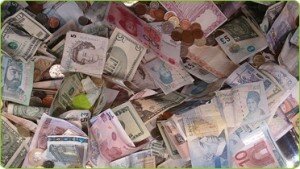
- Money … makes the world go around
Although the situation is changing, over the years the Kyrgyz economy has been, and basically still is, a “cash based” economy.
As a result, visitors to Kyrgyzstan need to give plenty of thought to the questions …
… such as :
- how much? – obviously travelers will have to be able to cover their immediate needs – and, they will probably want to budget for some extra to cover incidentals.
.
It is necessary to make sure that this is enough … in one form or another … so that they have cash to meet additional (unforeseen) expenses, emergencies, souvenirs and so on.
.
It can be difficult to judge if this their first visit to the country, guide books and travel blogs might give an idea but these are usually out of date almost as soon as they are written so they shouldn’t be taken as “gospel”.
.
One way to cut down on the amount of cash that they have to carry is to pay as much as possible in advance – for example, by booking a tour … hey, I run a tour company – so of course I would say that, wouldn’t I … but, in my defense, there is some logic behind it. Although it may be possible to travel cheaper as an “independent traveler”, using a local agent can resolve a number of issues – especially if you don’t speak the language. They know, for example, the layout of the land – the places to go, people to see, and also know the local language, culture and customs. -
how to keep it secure? – There’s lots of good advice around on this theme, like:
- “Try not to carry all your money in one form” – remember, money is not just cash … one guide book used to suggest carrying cash, travelers’ cheques and credit cards – but : …
- in terms of cash: … It’s probably unlikely that travelers will be able to get hold of Kyrgyz som before they travel … so they will probably need some foreign currency … probably US Dollars or Euro. Although banks and exchange offices – may accept a variety of currencies – the Dollar and Euro predominate in terms of Western currencies … some banks and exchange offices will accept Pounds Sterling – but not every one will.
.
Banknotes should be clean, (no stamps, or numbers written on them), whole, (no tears, or sellotape, or burnt corners – even if the serial number is intact), and larger notes with a face value of 50 or 100 being preferable, Smaller denominations tend to attract a slightly lower exchange rate … they shouldn’t – they law is clear, a bank or exchange office can charge a commission in the event of the note being dirty or damaged … but not if the value is smaller – but that is provision of the law is honoured more by being ignored rather than enforced … and they don’t HAVE to accept the transaction, anyway.
.
Having said that, some small notes might be usual – if you need to pay for a taxi or drinks … (USD20 will be worth about a thousand som at the current rates of exchange at the time of writing … but look at the currency box in the panel to the right to see what the latest rates are).
.
There is no currency “black market” and most sizable towns will have facilities to exchange banknotes. There is no commission, just the differential between the rates used for buy and sell … (unless the notes are old, dirty or damaged in some way); - Travelers’ Cheques: These have never been that widely accepted here in Kyrgyzstan, Only a few banks and outlets will be prepared to accept them – and probably only VISA dollar cheques. As a result, even bank officials may have difficulty in remembering what they are and how to treat them. Also, there is a commission payable on cashing travelers cheques.
.
So travelers’ cheques are of limited use here. They could be useful for an “emergency find” … I still have USD80 worth of travelers; cheques that I brought with me on my first trip, back in 1994 as part of my emergency fund on that trip.As it happens, they are becoming less commonly used in the West as well, as other forms of carrying money and they. -
Cash Cards for use in ATMs (Automatic Teller Machines) have to a large extent replaced Travelers’ Cheques: There is a growing network of Bankomats, (ATMs), operated by different around the country and they can be found in most of larger population centers … but not necessarily in the villages.
.
Many will be located in bank branches, but in some places - for example in Naryn - there may be several located together in a central spot in the town.There may well be a commission for using “foreign” cards in these as well as the exchange rate losses.
.
ATM’s are very convenient but they also present a number of problems …- Make sure you know your bank’s rules and advice about using ATMs abroad … know your daily limit and keep track of your balance - for example, many (most?, all?), have some advice on their websites … and if they don’t – ask them, why not?;
- It may be a good idea to inform your bank that you are traveling and warning them to expect activity from, say, Kyrgyzstan … so that they don’t freeze or block the account for “unusual activity”. Also, you might consider asking them to temporarily change the daily limit;
.
Incidentally, even if you personally have a large limit on how much you can withdraw from an ATM … remember, the machines themselves also have a limit – and that may depend on such things as the currency (if it is an ATM that can handle more than one currency), or the location. - Try to make sure that the machine is actually working … for example by seeing if someone else use it;
- Having said that – keep your wits about you, be aware of your circumstances because this is a time when you are particularly vulnerable – to “skimmers” interested in trying to obtain data so they can access the account, or just straight forward muggers … Hey, that’s good advice where ever you are in the world … not just here … even at home – where you are likely to be more vulnerable because you “feel at home”!
- Think about how much you want to withdraw:
- Some banks actually recommend withdrawing more than you might usually do at home – partly because you might need it, but also because it might/should reduce the amount of transactions.
- Remember that sums in round figures – such as 3000, 5000, 10000 som – may result in several large notes which you then have to get changed into smaller notes … choosing, say, 2800 som instead of 3000 means you are more likely to get a mix of notes. (As an aside – I once withdrew 1000 som from an ATM and expected to receive some small notes … but instead received one single banknote which I then had to go from shop to shop seeing if I could find someone willing to “break it”)
- Check that it offers a multi-language option – most here offer Kyrgyz, Russian, and English – and avoid using one which only operates in a local language unless you know that language;
- If the transaction is rejected for any reason, although you might attempt to perform the transaction again, but NEVER try to use the card a third time … the machine may simply retain the card – and it’s difficult to get it returned – and even if it the transaction is successful on the third attempt, the account may then be blocked by you bank who will be monitoring transactions for “unusual activity”;
- If possible have more than one card – drawn on more than one account – but keep them separate – not in the same wallet;
- Take and keep receipts of all transactions … and if, for some reason, the ATM doesn’t give one, make a note of the date and time, location, and sum;
- Be prepared for additional fees – especially if you are taking a cash advance on a credit card;
- One travel writer suggests that you should never count your money in the open – for example, having just made withdrawal from an ATM … even if the machine has made a mistake and dispensed the wrong amount, it might be better to accept the loss (or, I suppose, possibly the gain). Apart from the fact that it will avoid the time and effort in trying to get the local bank to deal with the matter … it is also safer than let some potential hooligan count it with you – and possibly relieve you of it.
- The same travel writer also suggests taking a taxi straight back to the hotel and depositing the cash in the hotel safe … rather than walking around with it. Personally, although I can see the logic behind this suggestion – once again, anywhere in the world – I am not sure about the necessity of this … I suppose that it all depends on the individual circumstances – like the location, time of day and how much you have withdrawn.
.
- Credit cards: Although they are becoming more widely accepted, with local banks now issuing their own cards, their use is still fairly limited outside the main population centers. There are also costs involved, as there are with their use on any foreign trip, not just to somewhere like Kyrgyzstan … commissions and exchange rate costs .
.
If possible, have the transaction recorded in local currency in order to avoid additional exchange rate losses and fees – that shouldn’t be a problem here because the law requires that all transactions are in som;
- in terms of cash: … It’s probably unlikely that travelers will be able to get hold of Kyrgyz som before they travel … so they will probably need some foreign currency … probably US Dollars or Euro. Although banks and exchange offices – may accept a variety of currencies – the Dollar and Euro predominate in terms of Western currencies … some banks and exchange offices will accept Pounds Sterling – but not every one will.
- “Don’t keep all your money in one place” … one pocket or one bag. Divide it up and separate it. Losing one pile of money can be annoying – but losing all of it can be disastrous.
- “Try not to appear rich” – use local currency and try to ensure a supply of smaller notes (and coins) dress modestly and don’t have ostentatious displays of jewelry … remembering that what is normal “back home” may indeed be ostentatious here. Don’t carry cash in a huge bundle, don’t count out large sums of money in the public …
- “Don’t forget your natural instincts” – just because you are away from home, don’t leave all your normal caution back there. Try not to carry large sums of money with you. Try not be aware of your surroundings at all times; try not to travel alone at night; avoid short cuts and dark alleys and try to stay in well lit areas; keep a wary eye open for anyone who might be a “distraction”, keep an eye on your belongings … and so on.All of this is good advice for anywhere in the world – not just in Kyrgyzstan … in Rome, Paris, New York, London … even Blackpool … and, yes, I do have reasons for naming those five cities!
- “Try not to carry all your money in one form” – remember, money is not just cash … one guide book used to suggest carrying cash, travelers’ cheques and credit cards – but : …
- in the event that they do need to get extra cash, how can they do so? – Think about how you might arrange a money transfer (e.g. by Western Union – they may need passwords, so you should arrangements before you travel … and unless you have made such arrangements with someone beforehand you may may find your friends and relatives worried by a request to send funds – and also skeptical given the number of frauds that occur arising out of hacked email accounts).Don’t think that you can rely on your embassy or consul to help out … although, in theory, they can offer assistance the rules governing this are pretty stringent covering both the amount (which is pretty small) and the purpose for which it can be used (basically to get you home again) … and remember: it’s a loan – you have to pay it back.
____________________
Photo credit: BlatantWorld.com / Foter /Creative Commons Attribution 2.0 Generic (CC BY 2.0)
Write comment | Trackback


 Bishkek