Chatkal
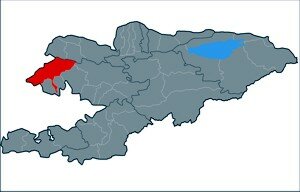
The Chatkal valley – marked in Red
Located in the Western Tien Shan mountain range, the River Chatkal flows for 189 kilometers in a remote valley in the extreme West of the country, flanked by the 120 km long mountain range of the same name and the Chandalash range lined with walnut groves, Semyenov’s Maple and, albeit less frequently, ash and tree-like hawthorns along the lower slopes as it flows across the border into Uzbekistan.
This remote valley is sparsely populated and rarely visited. The 150 km of road, (only a tiny fraction of which is asphalted), can sometimes be very dangerous with it steep cliffs, (and, in winter, frequent avalanches cut off access), but the landscape, picturesque and diverse, can be staggering.
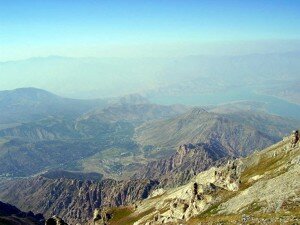
The Chatkal Krebet: Attribution: Denis VL at the Russian Language Wikipedia
Despite the remoteness and difficulty of the terrain, the region has a long history of human settlement.
Traces of early human habitation have been found in cave sites (such as the vicinity of Obirakhmat) where hunting tools, stone-processing sites and petroglyphs from the Neolithic period have been discovered. In particular, in 2003 archaeologists are said to have discovered here, the remains of a young boy, (apparently between 9 and 12 years old), similar to a Neanderthal and said to be as much as 50,000 years old.
Minerals were extracted from various sites during the Bronze Age (about 3000 BC); first non-ferrous, then ferrous metals were extracted. Huge burial mounds with bronze vessels have been found dating to this period. Archaeologists have discovered evidence of nomadic cattle-breeders in the area dating from the early Iron Age. In the lower reaches of the Chatkal river over 2,000 burial mounds, 30 “tepe” and 3 ancient settlements have been found.
During the Kushan-Turk period (between the 4th and 7th centuries), the region was already densely populated, with settlements, (town), appearing in addition to the nomadic herdsmen. Some of the main trade routes of the Silk Road passed through the region. A number of local products were exported far and wide, including silver from the Talas and Chatkal river basins, Sal ammoniac and mercury, cattle and walnuts from the Aslanbob region
A little South-West of Djani Bazar is the site of an ancient settlement, Changar Khan, dating from between the 10th and 12th centuries.
Near by is the gumbez (mausoleum) of Idris Baygambar – dating from the 19th century.
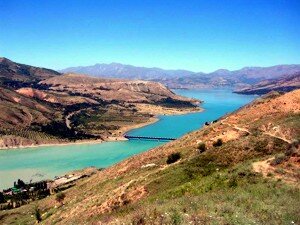
The Chatkal river near Charvak lake :
To the North East lies the site of the town of Arlankent, which dates from between the 7th and 12th centuries and appears to have been the main town in the region – which at that time was known as Djydguil. The town is mentioned in several chronicles dating from the Middle Ages.
Also to the North, in the gorge of Kuru-Tegerek, archaeologists have discovered ancient mining excavations and the site of the ancient settlement Kurbes Kan.
The valley is rich in biodiversity, both flora and fauna. On the brown mountain-forest soils there are as variety of shrubs and trees: barberry, honeysuckle, almonds, pistachio, hawthorn, maple, ash, walnut, apple, plum, pear, juniper … and so on. On floodplains of the various rivers in the basin there are thickets of birch, willow, poplar and brambles, sea buckthorn, raspberries, currants, and even some wild grapes. On the slopes above 2,700m there are subalpine and alpine meadows which are used as summer pastures by the local nomadic shepherds. and above 3200-3500m there are the high mountain desert which is home to a number of small glaciers and snowfields.
In the forests of wild fruit trees and shrubs live boars, foxes, bears, and there are some deer as well. Other forests provide a habitat for Porcupine, Badger and the forest Dormouse, the Marten, and the occasional Stoat and Weasel. High in the mountains Siberian Goats graze, hunted by Snow Leopards. Almost everywhere there are Marmots. It also plays host to a variety of birdlife: the deciduous forests are home to Starlings, Orioles , Blackbirds, Woodpeckers, Goldfinches and Nightingales. In the Juniper woods live Magpies, the Juniper Grosbeak , Finches, and Buntings. On the steep rocky slopes nest Bluish Doves, Swifts as well as many birds of prey such as Vultures, Kestrel and Golden Eagle. Stony deposits are also a favorite place of the Partridge.
The mountain rivers are home to three species of fish in particular – Marinka , Amudarya Loach and the Turkestan Bullhead.
The Besh-Aral Zapovednik (Bio-diversity Reserve), established in March 1979 with the purpose of preserving the unique natural environment: the forests of the Chatkal valley; the habitat of the Menzbier’s Marmot and natural habitat of Greig and Kauffman tulips. It is situated in the south Western corner of the district – on the border with Uzbekistan – is 340 km from Jalal Abad the oblast centre and 25 km from Kanysh-Kiya the Chatkal Rayon centre.
The region is also rich in mineral deposits – which has led recently to a number of efforts to excploit the reserves. It is said, for example, that there are over 20 mining companies registered in the region – although only about six are active. Mining activities currently include alluvial gold extraction along the rivers and exploration of major deposits. In fact, the region has a long history of mining, but in recent times it has led to some social tensions over the need to develop the area and environmental issues. Although some of the mining enterprises have contributed to the local communities, renovating a hospital, kindergartens and schools, constructing a bridge and providing lighting in some of the villages, and also asphalting some of the road. This last one, however, has been a contentious issue as the locals claim that promises to improve the roads in the valley have not been met.
.
Life in the region is difficult; the main source of income is agriculture – although the soil is not very fertile and lies under something like two meters of snow in the dead of winter.
There are few opportunities for either employment or education. As a result many people have left the region is search of better opportunities elsewhere – for example, in Bishkek or Russia. One of the advantages, however, is that the crime rate is apparently relatively low – mainly robberies or acts of vandalism … according to one press report, no one can remember the last case a murder was reported – a product that in the small communities, and the fact that everybody knows everyone else.
The Chatkal river was often used for rafting expeditions in the Soviet period but border problems with Uzbekistan have prevented recent expeditions. Rafters were attracted to the transparent water, the five spectacular rocky canyons, exciting rapids, the sense of the wilderness … and the warm weather, (during the summer season).
The mountains were also used by athletes from the former Soviet countries for ‘high altitude’ training and the mountain slopes are often used by skiers.





 Bishkek