Kyrgyzstan’s Military
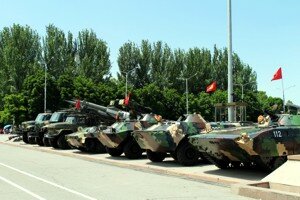
New Military equipment on parade in Ala Too Square
As today is Victory Day, a public holiday commemorating the victory over Nazi Germany in the Second World War, I thought that it provided an opportunity to take a look at the Armed Forces of the Republic.
When Kyrgyzstan declared independence in 1991, it inherited from the Soviet Union several military units that had been stationed on the territory of the republic: Army (land forces), Air and Air Defence units. the Northern and Southern Groups of forces, Interior Troops and Border Troops. However, that wasn’t formally finalized for at least a year when a Presidential Decree was issued accepting jurisdiction over the military personnel, equipment, weapons, barracks and other facilities.
In the transitional period there was much that had to be settled.
Originally, there had been some discussion of whether the country needed an Army, and the first government supported the idea of combined CIS force, but the Russians indicated that they were unwilling to fund such a force and so the idea was dropped.
Plans were drawn up soon after Independence for a National Guard but that was never implemented and was replaced by a plan to set up a standing army consisting of about 5000 personnel, mainly conscripted troops, with reserves of about three times that number.
At the beginning on 1992, the decision was taken to establish a State Committee on Defence. The First Chairman of the committee was General Umetaliev, an experienced commandeer with a a broad political and cultural outlook. Under his leadership, work began on the complex tasks of forming the various military units, integrating them into a new national structure, ensuring their effective interaction with the executive powers and law enforcement agencies, establishing appropriate command and control structures, organizing training and logistics … and finance.
.
Apparently, the main military force in the country had been the main military force in the country had been the legendary 8th Guards “Panfilov” Motor Rifle Division which had achieved fame in the defence of Moscow in November 1941. Following the war it had been based in the Baltic countries but in 1967 it was transferred to Frunze, (as Bishkek was then called), where it was based until it was finally disbanded in 2003.
The Army has a number of units based in Koi Tash, (outside Bishkek), Tokmok, Balykchy. Osh, Isfara, Karakol and Naryn (which historically were both Garrison towns in the days of the Russian Empire). Over the years we have come to hear of some of the Army’s special units:
- The Scorpion Brigade – originally formed in 1994 and now considered to be the best equipped unit in the country;
- The Ilbirs Brigade (or Snow Leopards);
- The Panther Airborne Battalion, Bars and Edelweiss units of the National Guard;
- The Alfa anti terrorist unit of the Agency of National Security;
There is also a small Air Force, apparently equipped with MiG 21 and L-39 craft as well a number of transport planes and helicopters. Most of the fleet, however was handed to Uzbekistan in 1995 in settlement of a dent swap arrangement.
The Border Service has a somewhat chequered history … with an early agreement with Russia to provide the service coming to an end and Kyrgyzstan assuming the responsibility, with control passing variously between the Ministry of Defence and Committee for State Security.
.
It was in 1993 that the Army undertook their first “combat mission” as part of an initiative of the Commonwealth of Independent States, (CIS), to safeguard the Tajik Afghan border – sending an infantry battalion to take control of a 100 kilometer stretch of the border – establishing border and observation posts. The mission lasted five years with troops being rotated every six months.
The experience gained in the remote and difficult mountain conditions was to come in handy when, in 1999, the army was called up to deal with an armed force that came onto Kyrgyz territory – the Batken incidents. This led the creation of the Southern Group of forces and the creation of some specialist battalions and the creation of the Defence Council.
Formally, the armed services are under the control of the President who acts as Commander in Chief and who is advised by the National Security Council.
Although the armed forces were integrated into the structures of the Collective Security Treaty Organization, (CSTO), they also became partners of the NATO program “Partnership for Peace” ensuring a wide range of international cooperation at both the collective and bilateral levels – with some 27 different countries: China, Turkey, Britain, the United States … and, of course, Russia – which have provided valuable logistic, training and experience for the personnel.
In particular, over the twenty or so years since independence, the armed forces have participated in a number of international exercises under the auspices of the CIS, CSTO, the Shanghai Cooperation Organization (SCO), and participated in several UN peacekeeping missions.
Following the 2005 Revolution, work was undertaken on the development of the material and technical resources of the services – including accommodation for the service personnel and training facilities in the National Military Lyceum and the Higher Military College.
Other reforms were carried out, including a reduction in numbers … Kyrgyzstan was still operating a system of conscription, but an increasing number of the ranks were filled with volunteers serving on a “contractual” basis. A system of “alternative service” was also developed for those of military age who could not fulfill their military service for one reason or another. This has been a somewhat controversial issue – with some people arguing for the creation of a volunteer, professional army rather than one based on conscription … but others arguing that military service was an important factor in fostering loyalty and national pride.
Following the 2010 revolution and the tragic events in the south of the country that followed it … there has been some further reorganization … including the disbanding of the National Guard.





 Bishkek