Drugstore
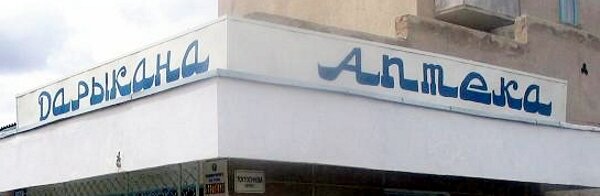
Darykana – Apteka – Chemists’ Shop – Drugstore
Andrei often asks me questions about English … and they often takes the form of: “Is that in English-English … or American?” Although there are differences – quite real and significant differences – at times. I remember, for example, as a child reading Superman and Batman comics, or watching American TV sitcoms, feeling a little confused and amused over little things … for example, the way they spell Mom rather than Mum.
Another was the way that what we in Britain called called a Chemists’ shop was referred to as a Drugstore, (Apteka in Russian and Darykhana in Kyrgyz). That would lead to jokes like: “I’m just going down to the drugstore,” “OK, can you get me some ecstasy while you are there”.
It was a little more complicated because the films also showed that a drugstore seemed to be a cafè - a meeting place for young people to gather and drink soda-pop. To be fair, a chemist’s shop in Britain would also sell many different items: cosmetics, health foods, toys and all sorts of things … and the biggest High Street chain of chemists’ shops is basically a supermarket … with a pharmacy counter.
Here in Bishkek, most apteka are usually dedicated shops … although many are simply little more than kiosks – especially those based in hospitals … that’s about half of the 2700 points of sale around the country. Sometimes it seems as if there an awful lot of them; about ten years ago there was a massive growth in the number of pharmacies – an almost 50% growth in five years, which is pretty impressive growth for almost any sector of the economy.
The Bishkek directory which sits on my desk lists almost 200 pharmacies … with more than half of them apparently open kroogloosootochno - around the clock. Within a couple of blocks of my office there are something like six pharmacies – mind you, that is in the heart of the city center … and there are also: a clinic, several dentists’ clinics, a private diagnostic center and the main ambulance station.
For the record: A recent news article here in Kyrgyzstan had the claim that the first pharmacy appeared in Baghdad in 754AD.
That surprised me, especially as the article began with references to the age old healing practices of shamans, priests, sorcerers, witches and wizards … treating their ailing and injured fellow tribesman using their own concoctions, medicines, powders, ointments, salves etc. – each made according to recipes which had been handed down from generation to generation … albeit accompanied by rituals and incantations.
Doing a little bit of research and I came across several references in the history of medicine to Apothecaries in ancient Sumeria, Egypt, China, Japan, Greece and Rome … but also references to those pharmacies established in 754 under the Abbasid Caliphate, during what is called the Islamic Golden Age, and it seems that they are generally accepted as a watershed marking the development of pharmacy as a separate from the medical profession.
In the Soviet period, the supply of pharmaceuticals was heavily regulated following state plans and a state monopoly, Kyrgyz Parmacia, apparently controlled the import and distribution of medicines through a network of state controlled apteka at fixed prices.
With the collapse of the union, however, and as a result of privatization, control over the supply of drugs was lost and the country began to experience shortages … and a “black market” emerged; the practice of providing drugs only on the basis of a prescription no longer worked and people could buy almost anything “over the counter”. Indeed, when I first came here I was surprised to see antibiotics on sale openly in the main Osh Bazaar. It is still possible to buy virtually everything over the counter … if, that is, there is any of that particular medicine available …
As as aside: when I was visiting Britain with a friend a few years ago, he got a severe case of toothache and went to a chemists’ shop to buy some pain killers, saw a brand that he recognized and went to the cashier to buy them. He was was astounded when the assistant referred to the Chemist on duty who refused to sell them to him and told him to go and see a dentist. He couldn’t understand why he could buy them easily in Bishkek … but not in London … they weren’t even “prescription drugs” – they were on display in the main concourse of the shop but, as it was explained to me, they were a particularly strong brand and there were restrictions on the number that they could sell to one person at a single purchase … this particular packet was bigger and fell foul of those regulations. It seemed very strange to me, but as I had been away for so long I had no idea whether it was true or not and had to take his word for it … and spend a couple of days trying to find a dentist willing to take a foreigner (who spoke very little English) as an emergency patient … but that’s another story.
Towards the end of the 90′s the government introduced a number of measures to try and improve and control the situation …
It was estimated back in 2009 that the pharmaceuticals market was worth almost a hundred million dollars annually – and most of that was spent on imports as there is very little local production; herbs on the other hand, as an example of traditional knowledge, have been seeing a comeback. Much of the purchasing is undertaken centrally by the Department of Drug Supply which operates a series of tenders – which, incidentally has led to a number of scandals recently. The emphasis seems to be on providing generic medicines rather than brand names.
In most cases, the patient is given a list of medicines and told to go and buy them … although there are a number of conditions for which patients are entitled to free medication and the Ministry of Health operates a scheme where others are available to certain categories of patients can purchase medications from special outlets at reduced rates.
The medication usually comes with instruction leaflets – some of which are quite lengthy and copious = which contain the compilation, details of what it can be used to treat, the method of treatment, (dosages and so forth), and counter indications, (when it shouldn’t be used) … all in Russian, (and occasionally other languages – but rarely ever in English).
For the record: Here are some notes which we put together in response to an inquiry from a client a few years ago about medications:
Travelers visiting Kyrgyzstan who are taking medication for an existing condition, should remember to bring it with them – enough for their trip – and not rely on being able to find it here, especially in rural regions.
It would also be a good idea to carry a copy of the prescription.
In some countries, it is an offence to carry (or post) certain medicines abroad unless they are for your personal use, (or, perhaps, the use of someone travelling with you). In Kyrgyzstan a person can bring medicines for your their own use – adequate for the purpose and length of stay – but not so much that it might appear that they are carrying them for someone else – or for sale.
It is also important to remember that medicines which can be obtained “at home”, (even some of those which are available “over the counter”), may not simply be unavailable in some parts of the world, they may even be illegal … and although that is unlikely to cause problems in the Kyrgyz Republic, it would be best to check – for example, with the nearest Kyrgyz embassy.
It is best to leave medicine in its original packaging, clearly labelled with the patient’s name and dosage instructions.
If it involves injecting medication, then it might be preferable for a traveler to carry their own needles and syringes, (but check on the regulations in the countries being visited … and with the airline before you travel), and also, possibly, arrange a letter from their doctor explaining why they need to carry them.
It is important to be aware that some items purchased overseas may be packaged under a different brand name to those available at home. Even where the names are and packaging seem similar, or even identical, to that used at home, the strength and active ingredients of similar-sounding medications can vary.
If the traveler wears a bracelet/medallion etc. indicating particular health problems that require special emergency treatment, then it would be a good idea to carry a translation.



 Bishkek